- 01A factory in disguise
- 02Tobacco from Yenidze
- 03Hammitzsch's design
- 04Scandal, war and restoration
- 05Getting inside
- 06Seeing it from outside
01A factory in disguise
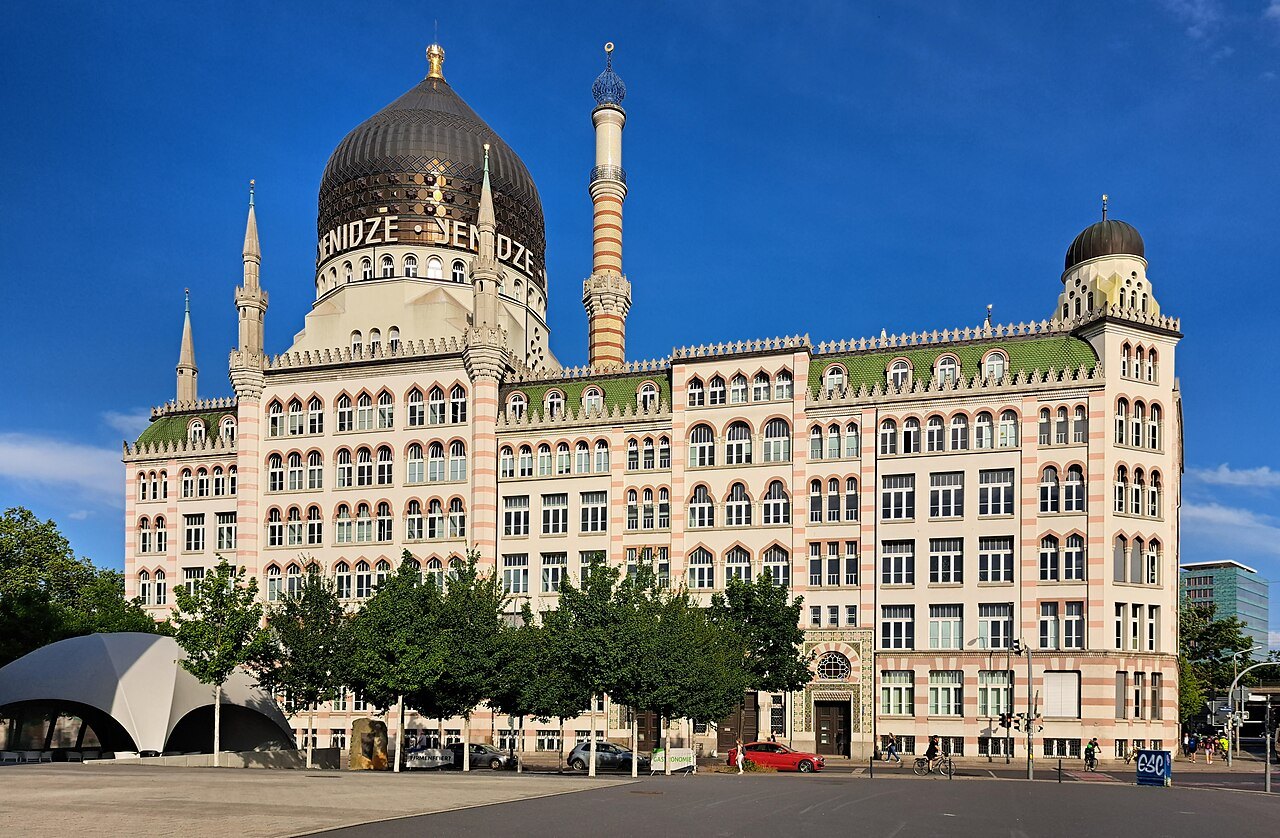
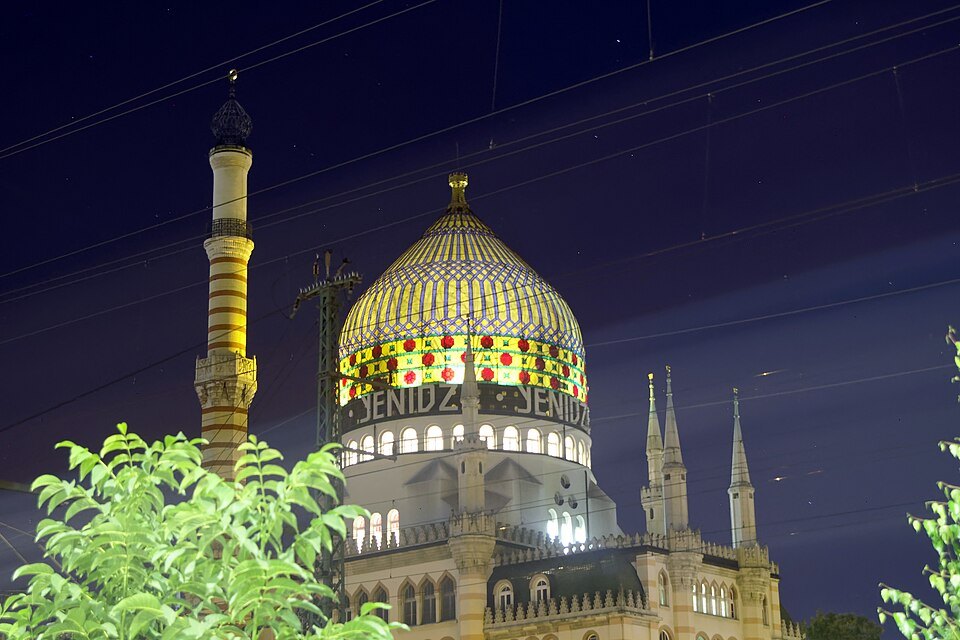
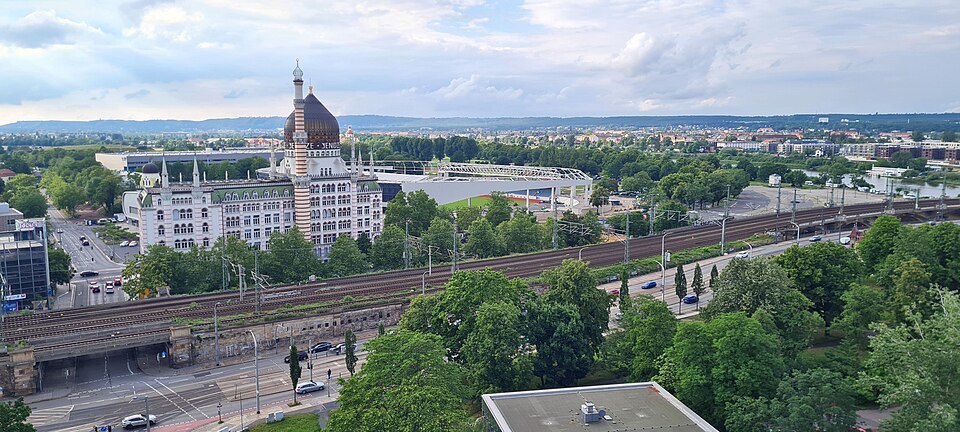
The Yenidze is a former cigarette factory built to look like a mosque, with a colored glass dome and a factory chimney shaped as a minaret. It stands on Weißeritzstraße at the eastern edge of the Friedrichstadt district, just west of the Altstadt beside the railway and the Marienbrücke, a few minutes on foot from the center.
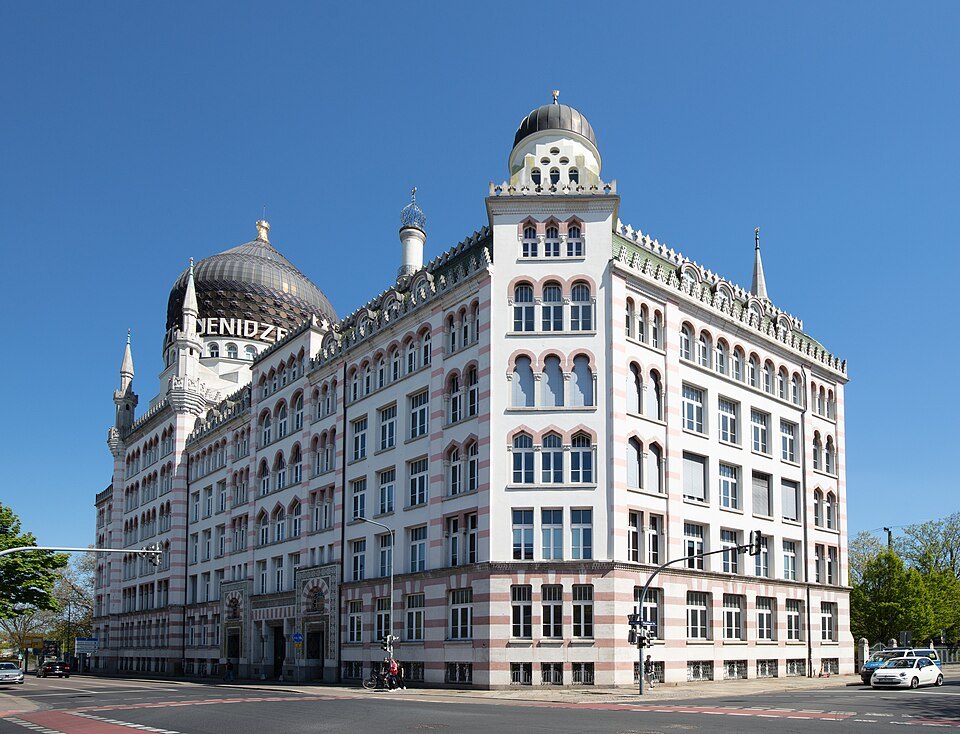
Among Dresden's baroque and Renaissance landmarks it is an outlier, and that was the intention: the building was designed as an advertisement. It is one of the most recognizable shapes on the city skyline, a chapter of Dresden's industrial history, and an early reinforced-concrete high-rise, all in one.
02Tobacco from Yenidze
The company behind it, the Oriental Tobacco and Cigarette Factory Yenidze, was founded in 1886 by the Jewish entrepreneur Hugo Zietz. He imported tobacco from Yenice, or Yenidze, a small town near Xanthi in what is now northern Greece and was then part of the Ottoman Empire. Its leaf was prized as one of the mildest and most aromatic cigarette tobaccos.
As the cigarette business boomed, Zietz bought a plot in 1907 in an awkward wedge between Magdeburger Straße, Weißeritzstraße and the railway tracks, close to the Elbe and in sight of the old town skyline. Dresden then forbade factory buildings that were recognizable as factories within the central townscape, and that rule helped shape what he built.
03Hammitzsch's design
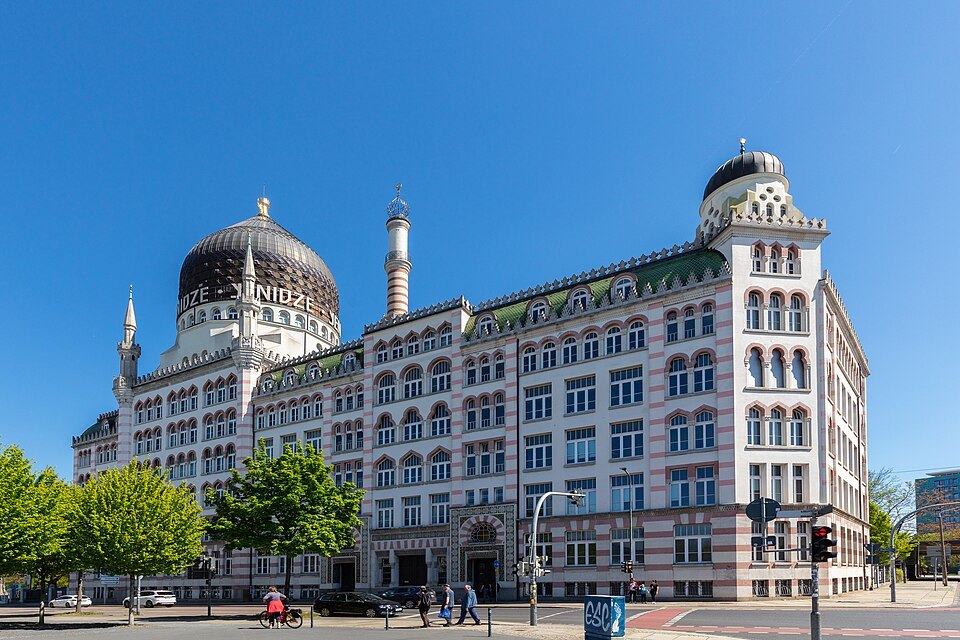
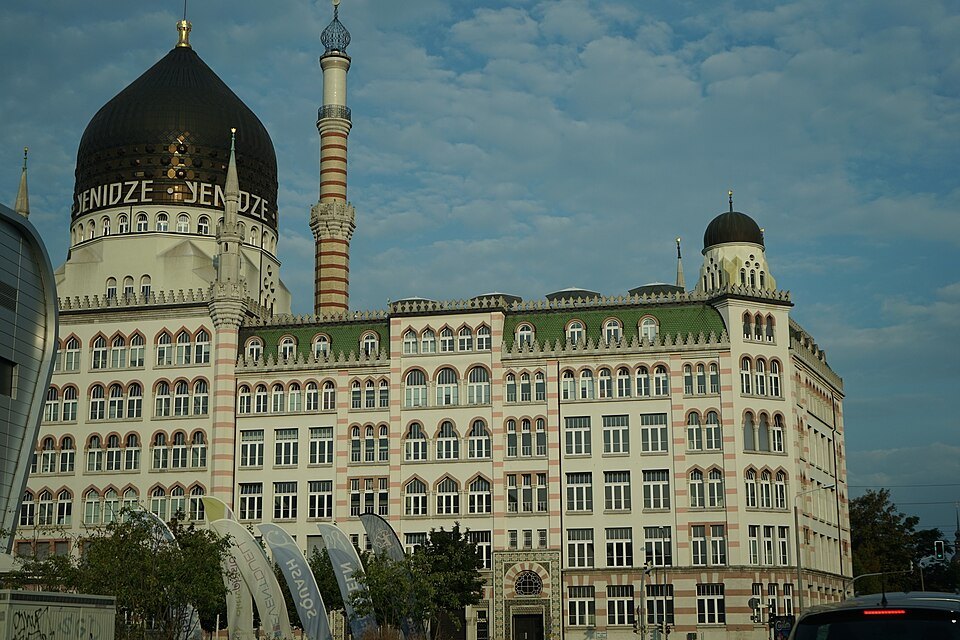
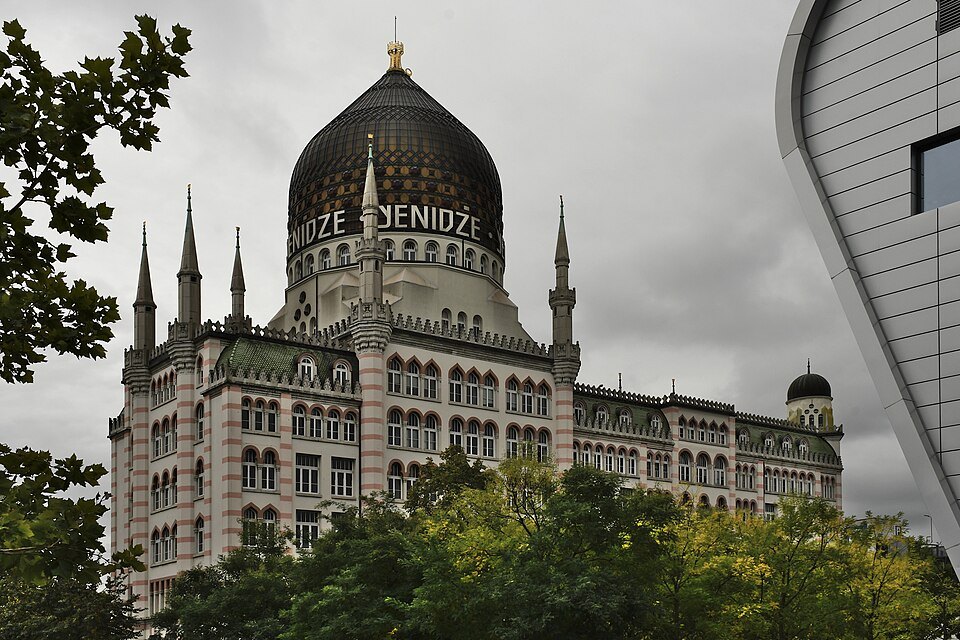
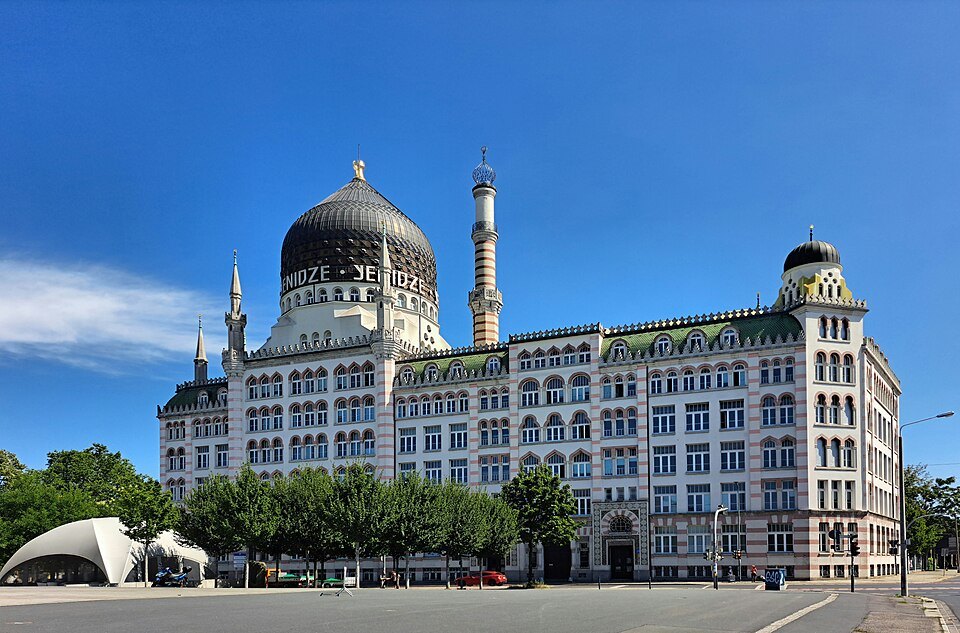
At Zietz's suggestion the architect Martin Hammitzsch designed a building in a fanciful oriental style. Sources date the work between 1907 and 1909; the owners give 1908 as the start of construction. One model is said to have been the Mamluk tomb mosque of Emir Khair Bak in Cairo. The facades mix Art Nouveau with Moorish-style ornament, and colored tiles appear both in flat patterns and in unusual three-dimensional forms.
The building has five full stories plus a mansard floor, some 600 windows of different shapes, and a total height of 62 meters. Behind the ornament is a reinforced-concrete skeleton designed by the Saxon concrete pioneer Benno Löser, and the owners describe it as one of the first skeleton-frame high-rise buildings in Germany. A band of colorful mosaic stalactites runs beneath the cornice.
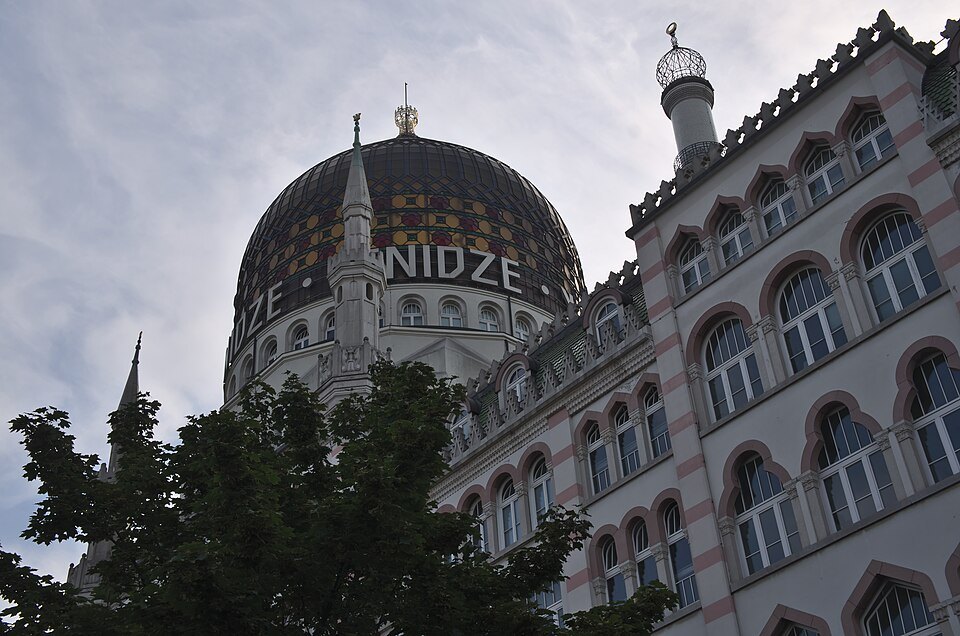
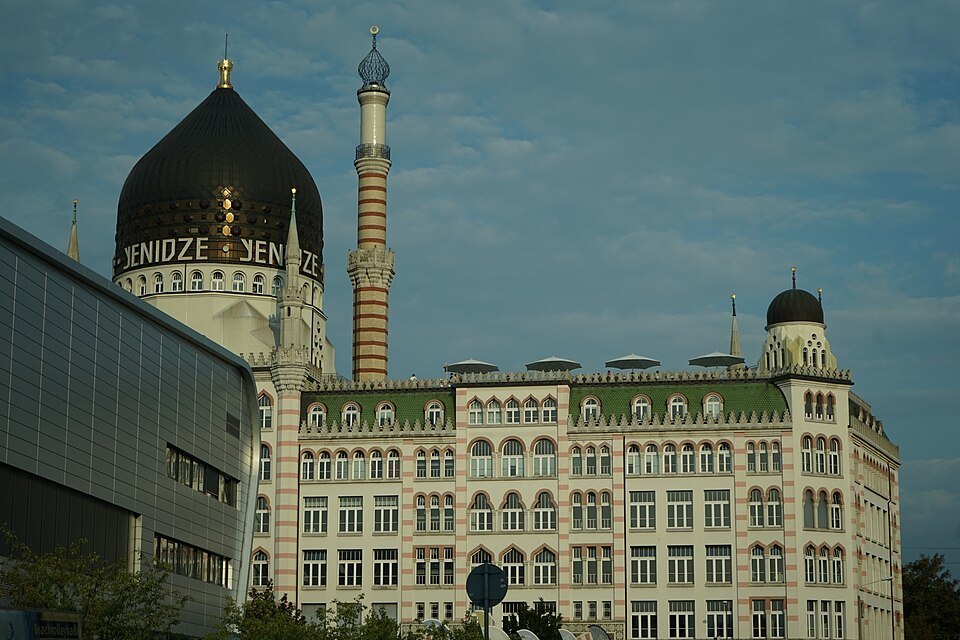
The pointed dome is about twenty meters high and glazed in emerald and ruby-colored glass, and it is lit from inside after dark. A golden crown on its tip recalls that Zietz was a purveyor to the Saxon royal court. The slender minaret beside it is the factory chimney.
04Scandal, war and restoration
In a city famous for its baroque buildings, the design met fierce opposition, and legends grew up about what it cost the owner and the architect. It did its job anyway: everyone talked about it. Dresden nicknamed it the Tabakmoschee, the tobacco mosque, a name no longer used officially because it never was a mosque. Zietz sold the business to the Reemtsma company in 1924.
The raids of February 1945 did serious damage. According to the building's owners and German-language sources, a bomb hit the south wing, the dome was badly damaged and about a third of the factory was destroyed; some English-language accounts describe much lighter damage. The wrecked wing was pulled down in 1946, and cigarette production resumed in 1947 before stopping in 1953.
From then on a state tobacco trading enterprise used the Yenidze to store raw tobacco for all the cigarette factories of East Germany, and in the 1960s the dome was reglazed in brown and green. After reunification the building was sold in 1991 and restored as a listed monument: the south wing was rebuilt to its original design and about 860 square meters of glass were made for the dome from old patterns. It reopened as offices in the late 1990s.
05Getting inside
Note The Yenidze is an office building, not a museum, and there are no general visitor tours of the working floors. The one part designed for the public is the front section under the dome. Its upper floors hold a restaurant with an outdoor terrace used in summer, and directly beneath the dome a small theater stage presents dance, theater, talks, live music and exhibitions.
Seeing the inside of the dome therefore means going as a guest of one of those two venues. Check the theater's program or the restaurant's own information before making the trip, rather than turning up and expecting to wander in.
06Seeing it from outside
The best views are from a little distance. From the Marienbrücke the dome and the minaret stand out against the sky above the railway, and from the meadows on the Neustadt side of the river the whole building rises above the far bank; see the Elbe for a riverside walk. Close up, walk around the outside to see the tilework, the window shapes and the mosaic frieze.
Allow half an hour for the outside. The Yenidze is a short walk from the Zwinger and the Semperoper, and across the Marienbrücke lies the Japanese Palace, so it fits easily into a loop along both banks. Trams and S-Bahn trains stop at Dresden Mitte station nearby; see getting around.