- 1715builta garden palace for Count Flemming
- 1729–1733builtAugustus's porcelain palace
- 1945lostburned in the air raids
- 1951–1987rebuiltexterior and some rooms
- 01A palace for porcelain
- 02From the Dutch Palace to the Japanese Palace
- 03The porcelain that never moved in
- 04Library, museum, war
- 05What to look at
- 06How to visit
01A palace for porcelain
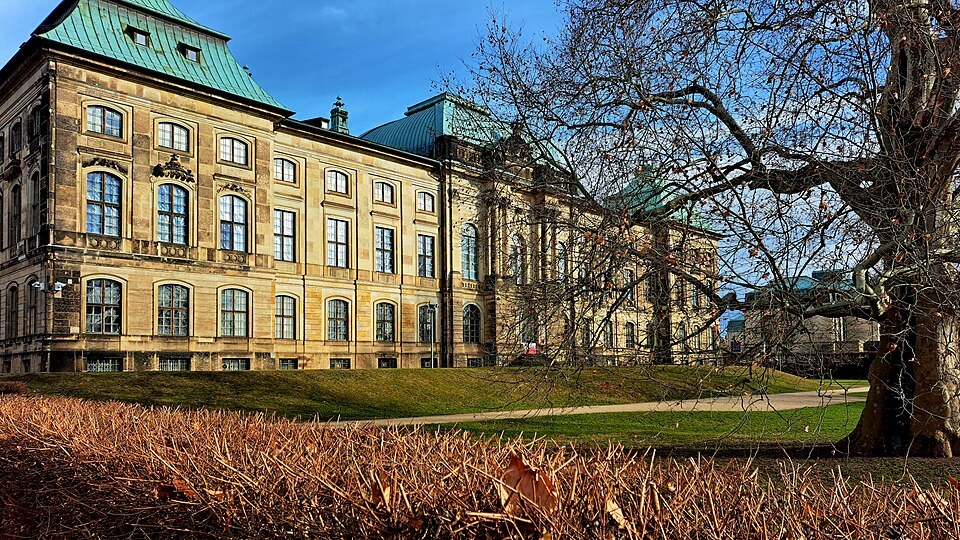
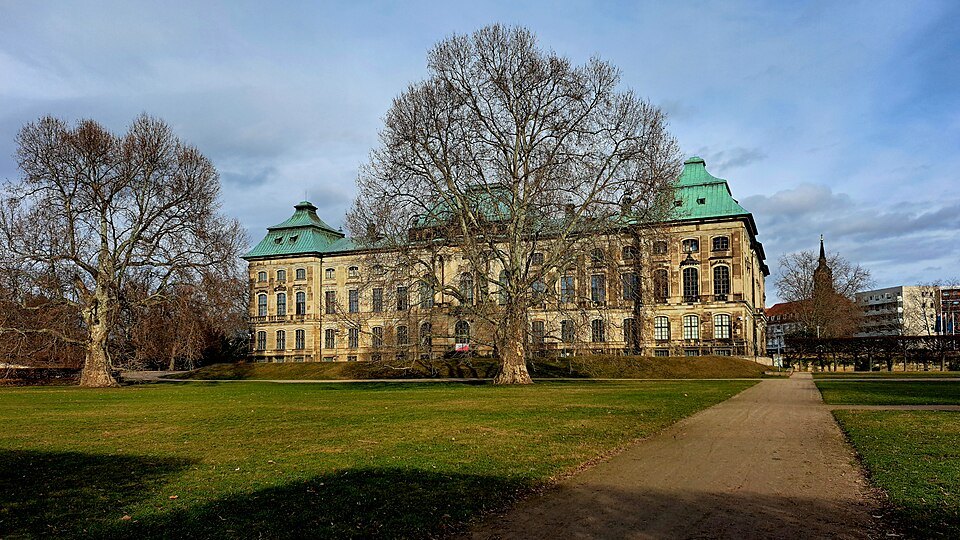
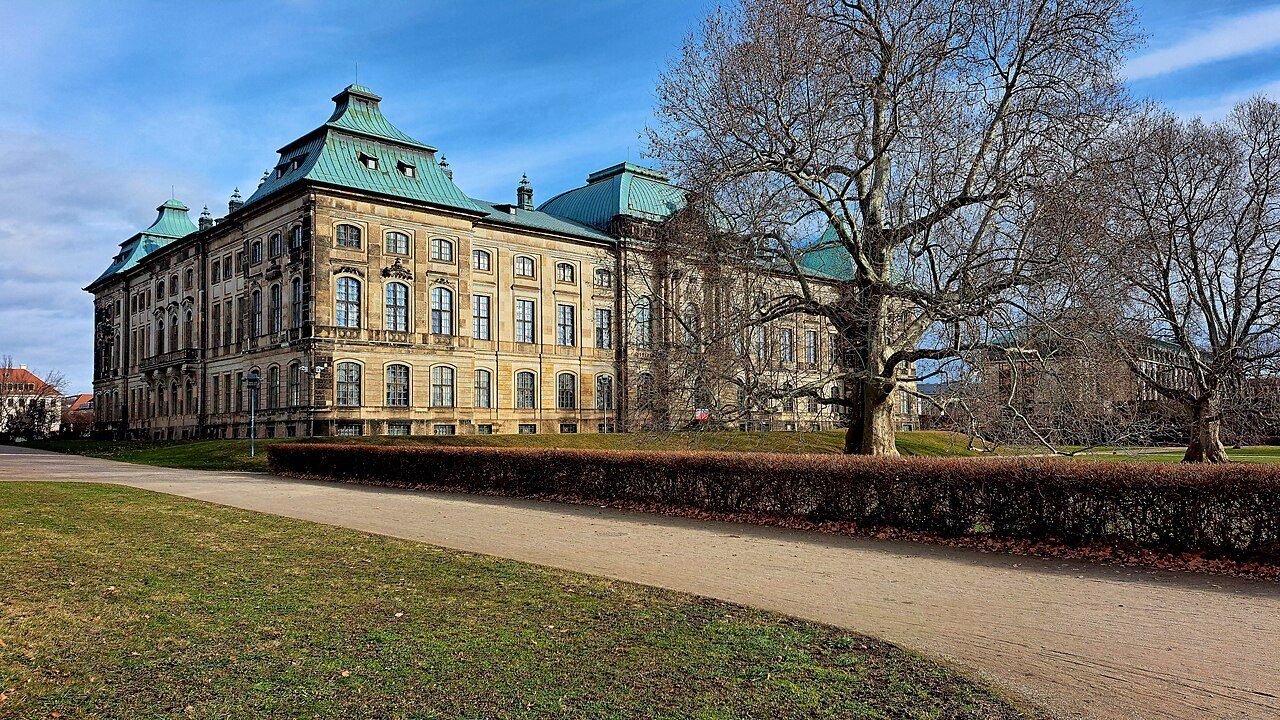
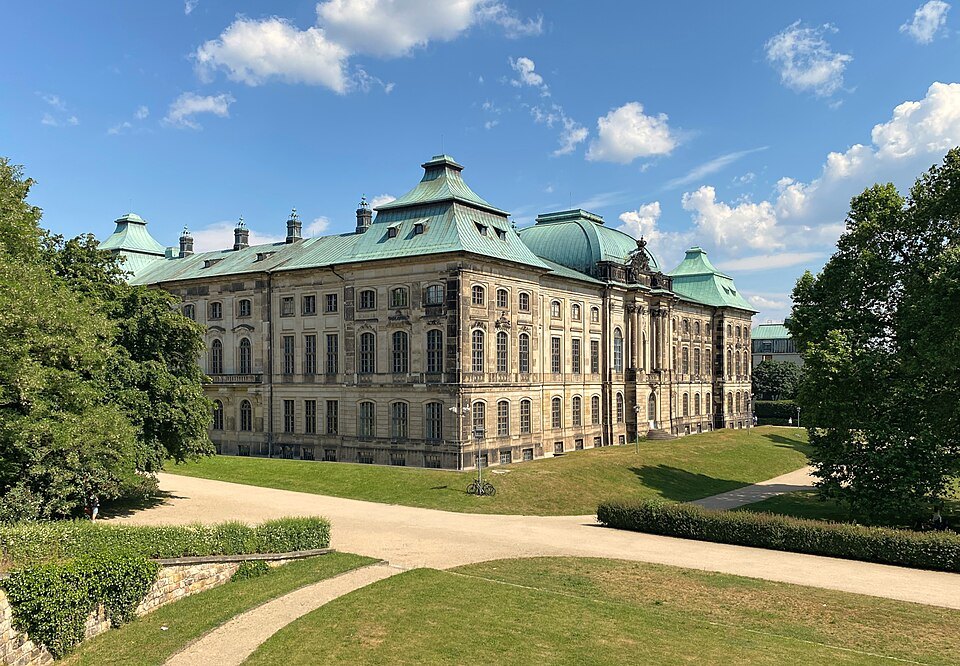
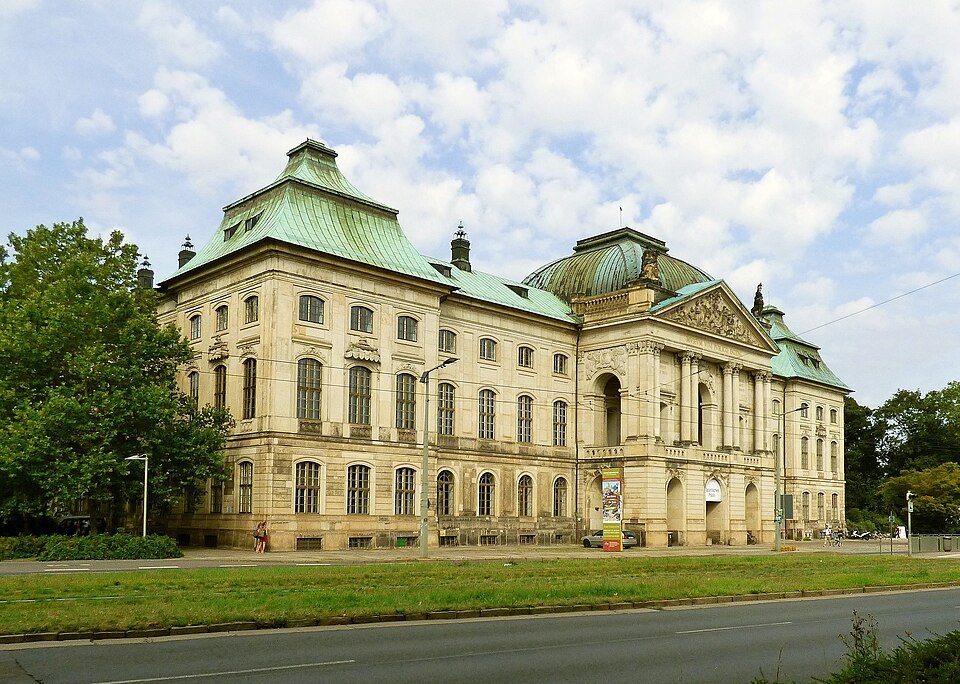
The Japanisches Palais stands on Palaisplatz in the Neustadt, its long river wing looking across the Elbe toward the Altstadt. It is a four-wing baroque building around a courtyard, with curved, stepped roofs on its corner pavilions that give it an East Asian air.
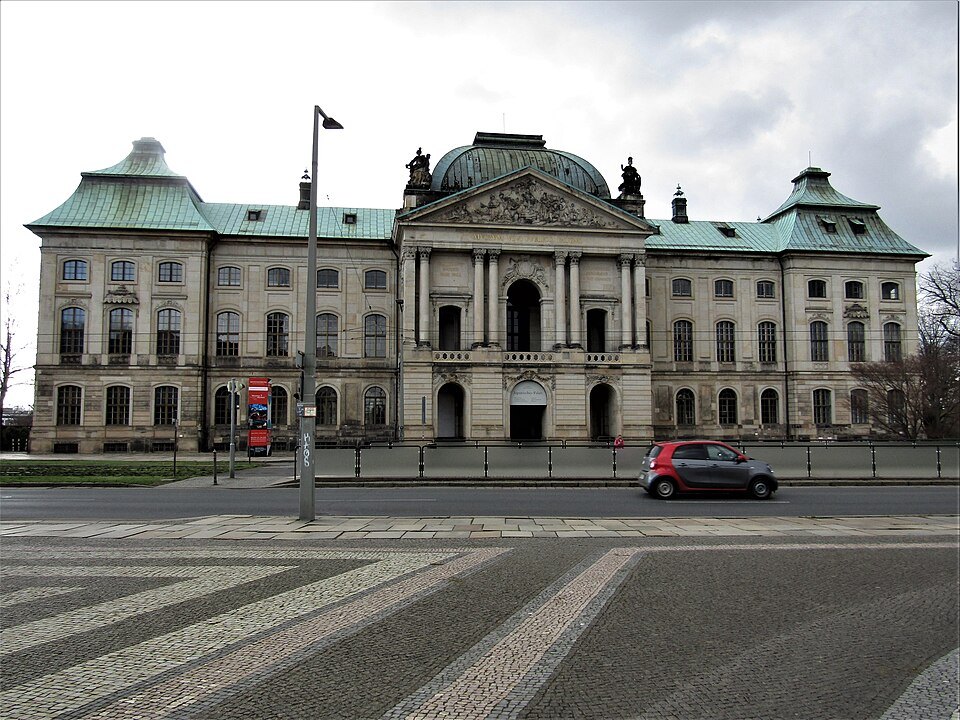
It matters for two reasons. It was the last great building project of Augustus the Strong, meant to become a palace of porcelain with rooms full of Asian and Meissen porcelain. And after that dream faded it became one of the oldest surviving museum buildings in Germany, a role announced by the Latin inscription over the entrance, Museum usui publico patens: a museum open to public use.
02From the Dutch Palace to the Japanese Palace
The core of the building goes back to 1715, a pleasure house built for Count Jakob Heinrich von Flemming; sources attribute the design to Matthäus Daniel Pöppelmann or to Johann R. Faesch. It was first called the Dutch Palace, perhaps after a Dutch envoy who lived there, more likely after its Dutch-style garden.
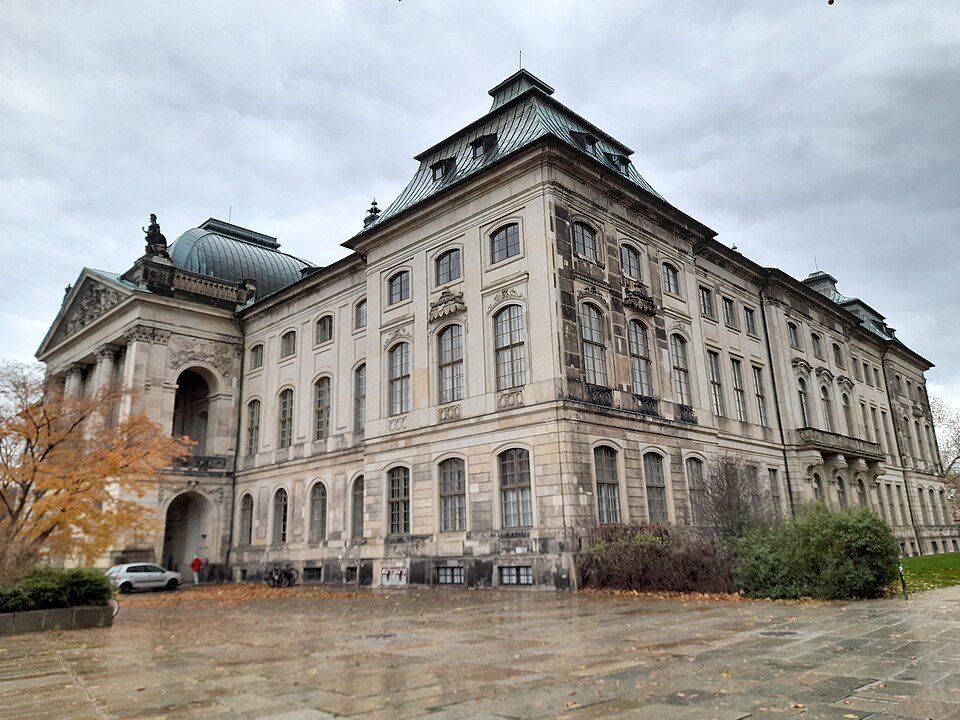
In 1717 Augustus the Strong acquired it and installed his large collection of East Asian porcelain and parts of his Kunstkammer. In September 1719 it hosted the first of the Seven Planet Festivals, celebrating the wedding of his son to the Habsburg archduchess Maria Josepha.
Augustus commissioned a full remodeling in 1725, and the main building work followed between about 1729 and 1733 under Pöppelmann, Zacharias Longuelune and Jean de Bodt. The old pleasure house became the river wing of the new four-wing palace. The name Japanese Palace was in use from 1732, inspired by the exterior decoration and the planned porcelain interiors.
03The porcelain that never moved in
The porcelain factory Augustus had founded in 1710 supplied 35,798 pieces for the palace. Johann Joachim Kändler, taken on as master modeler in 1731, and Johann Gottlob Kirchner made life-size porcelain animals at the king's wish, and in 1737 Kändler finished a three-meter porcelain carillon with 51 bells. These pieces are now shown with the porcelain collection in the Zwinger.
The decoration was meant to argue a point: a ceiling painting was planned in which Minerva hands the prize to Saxony while the Chinese, disappointed, load their wares back onto their ships. Augustus died in 1733. His son preferred paintings to porcelain, money was cut, and the building was only completed between 1738 and 1744, without the porcelain interiors that had been imagined.
04Library, museum, war
The palace was badly damaged in the Seven Years' War. Between 1782 and 1786 it was converted into a museum, and the inscription was added. From 1786 the upper floors held the electoral library, the forerunner of the Saxon State Library, which stayed until 1945; the ground floor held the antiquities collection until 1887. Gottfried Semper redesigned those rooms in 1835–36 in a Pompeian manner, and a book museum later opened in them.
In the Second World War the building burned. Accounts differ on the extent: German Wikipedia describes severe fire damage, while the state art collections call the palace completely destroyed. Bombs wrecked the surrounding garden, and parts of the library's holdings suffered.
Restoration of the exterior and a few interiors, including the entrance hall, the staircases and a library hall in the river wing, ran from 1951 to 1987. Large parts of the interior were left as a bare shell. In 2003 a German monument foundation supported the restoration of sample sections of the war-damaged painted decoration in two of Semper's former antiquity halls. From 1954 to 2012 the building also held the state museum of prehistory, since moved to Chemnitz. The garden was relaid in a much simplified form in 1984 and 1985.
05What to look at
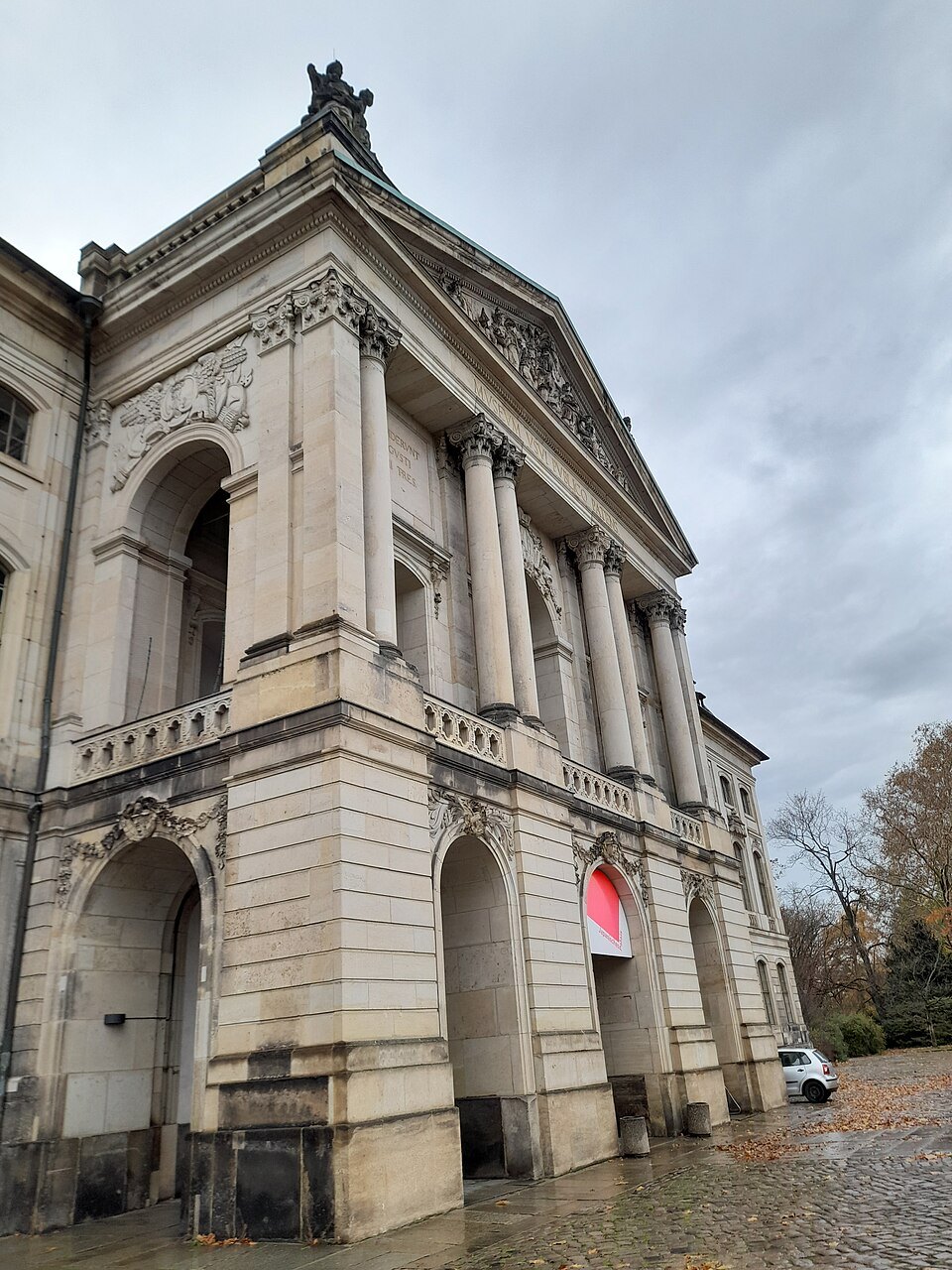
Start on Palaisplatz. De Bodt's columned centerpiece, crowned by a small dome and a triangular pediment, is monumental for Dresden, yet it sits comfortably between Pöppelmann's curved pavilion roofs. In the pediment, a relief by Johann Benjamin Thomae shows Saxons and East Asians presenting their porcelain to the goddess Saxonia, with the Saxon group on the right claiming the upper hand.
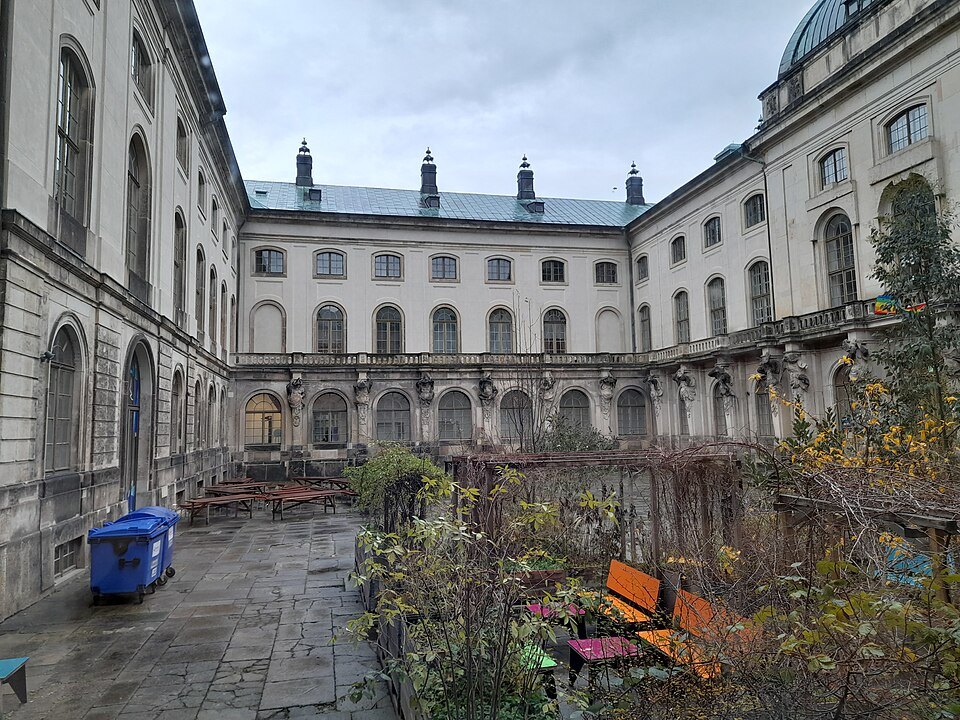
At the main entrance, stand atlantes by Johann Matthäus Oberschall. Go through into the courtyard, where herms and other figures in Asian style decorate the walls, the clearest trace of the porcelain-palace idea. Then walk round to the Palaisgarten on the river side. Two plane trees planted around 1770 or 1780 still stand there. The garden was first laid out in 1715 with the palace, terraced for the wedding celebrations of 1719 and later reshaped as an English landscape garden. The view crosses the Elbe to the Brühl's Terrace.
06How to visit
The building is used for changing exhibitions by the Museum für Völkerkunde of the Dresden State Art Collections and by the Senckenberg Natural History Collections. What is on, and which parts of the building and courtyard can be entered, changes between shows — check the state art collections' page before you go. Allow an hour for the facades, courtyard and garden, longer for an exhibition.
The palace sits on the Neustadt bank a short walk downstream of the Augustus Bridge. Combine it with the Golden Rider on the Neustädter Markt, then cross the bridge to the Hofkirche on the Altstadt side — see itineraries.