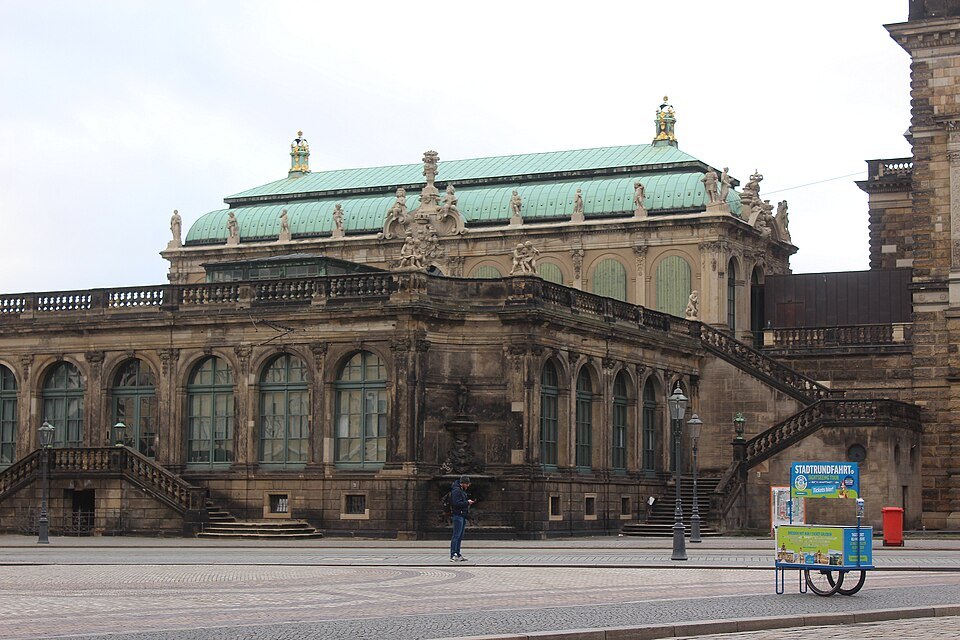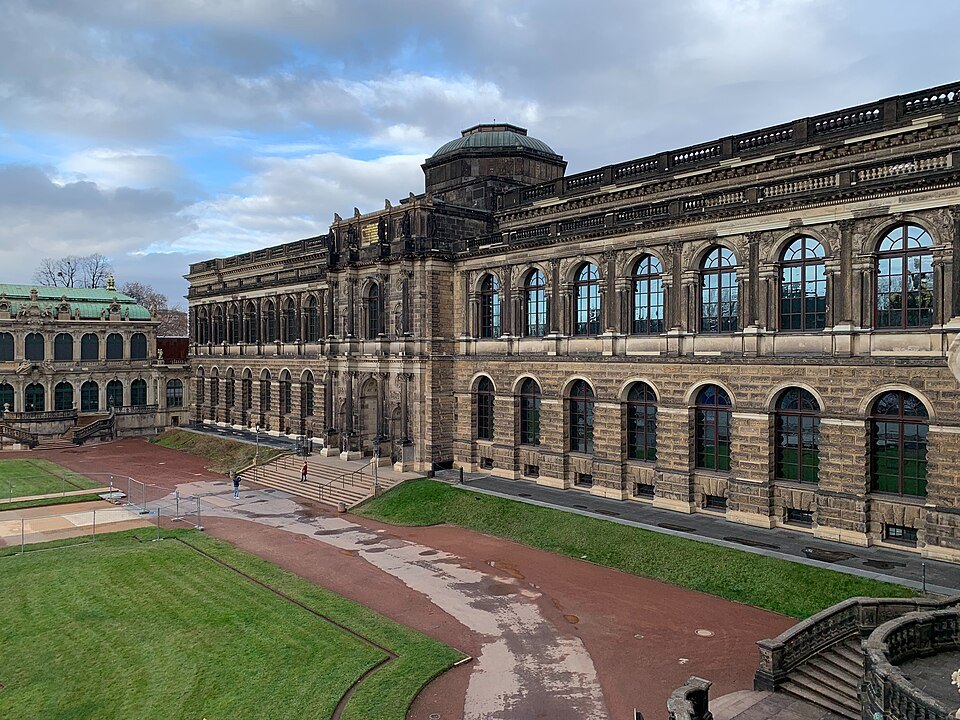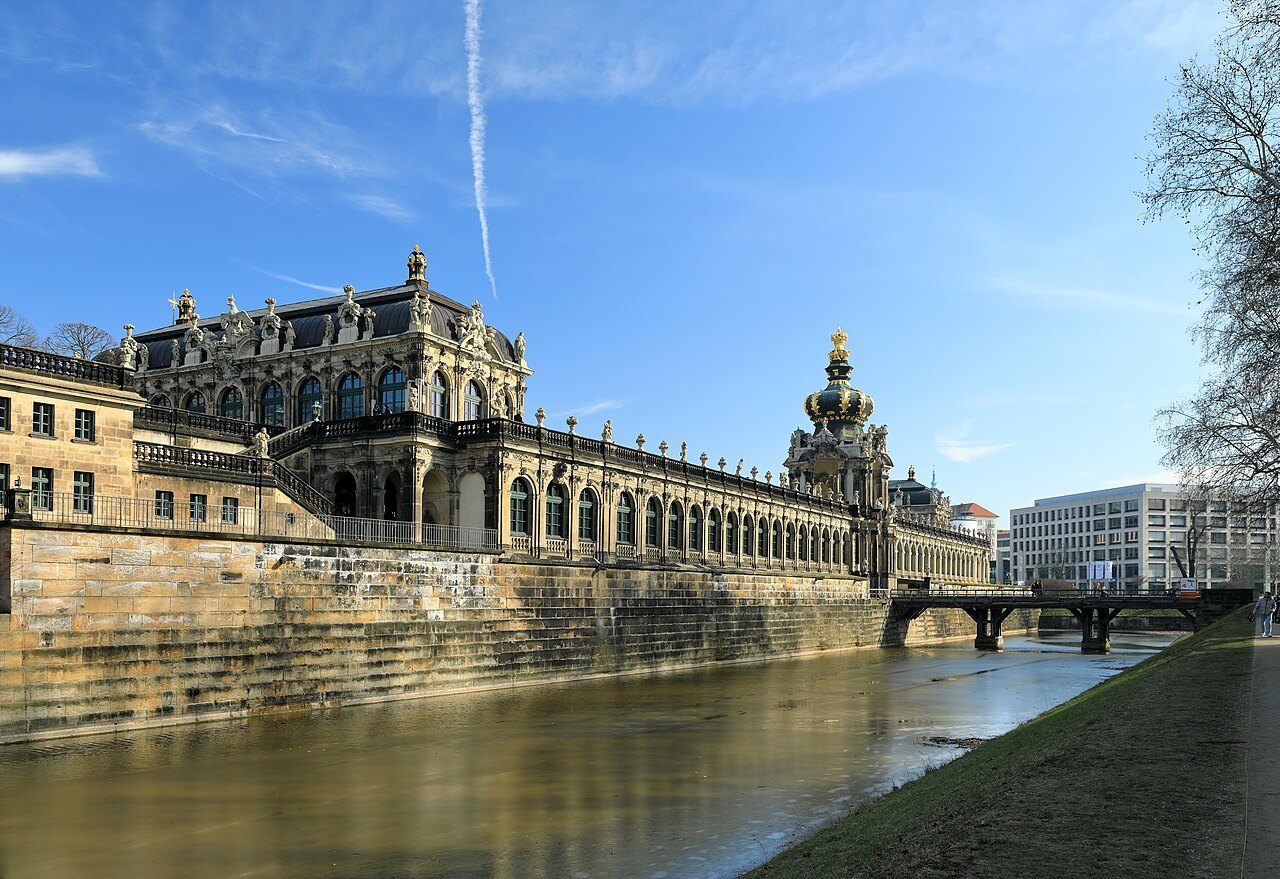
- the moat bridge
- the Kronentor
- the courtyard
- the Wall Pavilion and the Nymphenbad
- the Glockenspielpavillon
- Semper's gallery
- 01A festival court that became a museum quarter
- 02From rampart to royal stage
- 03Fire, flood and rebuilding
- 04Walking the courtyard
- 05The Old Masters
- 06Porcelain and instruments
01A festival court that became a museum quarter
The Zwinger is a baroque courtyard framed by galleries and pavilions, built from 1709 for Augustus the Strong, Elector of Saxony and elected King of Poland, by his architect Matthäus Daniel Pöppelmann, with sculpture by Balthasar Permoser. Along with the Frauenkirche, it is the most famous architectural monument in Dresden.
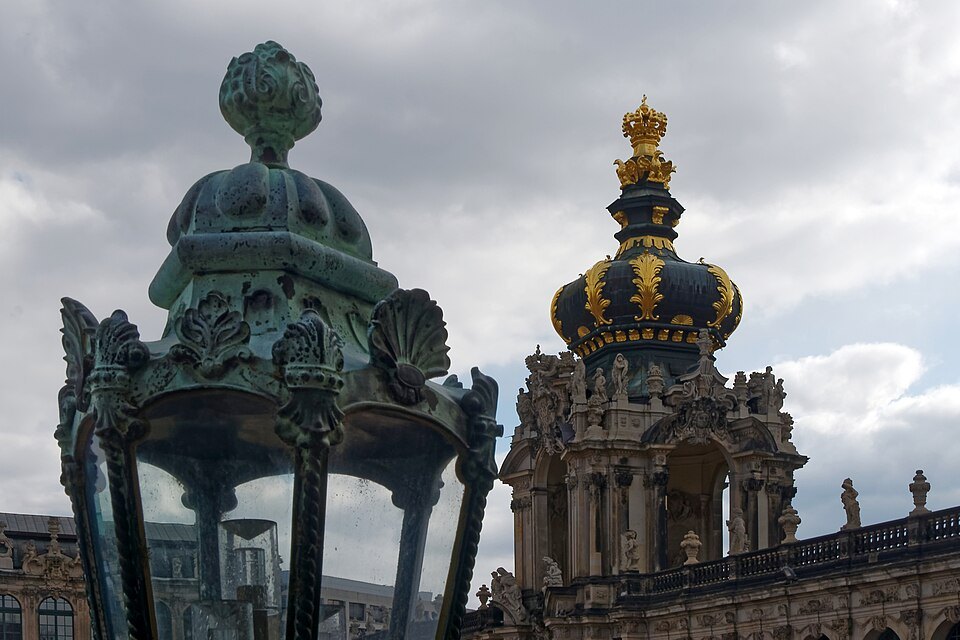
It was meant as an orangery, a garden and a stage for court festivals. Today its buildings hold three museums of the Dresden State Art Collections: the Old Masters Picture Gallery, the Porcelain Collection and the Mathematisch-Physikalischer Salon, the court's cabinet of clocks and scientific instruments. The courtyard between them links Postplatz with the Theaterplatz and the Semperoper.
02From rampart to royal stage
The name is older than the building. A Zwinger was the strip of ground between the outer and inner walls of a medieval fortification, and the Kronentor and the galleries beside it still stand on the old outer wall. Augustus came back from a grand tour of France and Italy wanting something as spectacular as Versailles, and sent Pöppelmann to study palaces and gardens in Vienna, Rome and, later, France.
The complex was inaugurated in 1719 for the wedding of the elector's son Frederick Augustus to the Habsburg archduchess Maria Josepha, with unfinished parts hidden behind temporary decoration; the work went on until 1728. The Zwinger was only ever meant as the forecourt of a vast new palace reaching towards the Elbe, so its river side was closed with a provisional wall. Augustus died in 1733, and the palace was never built.
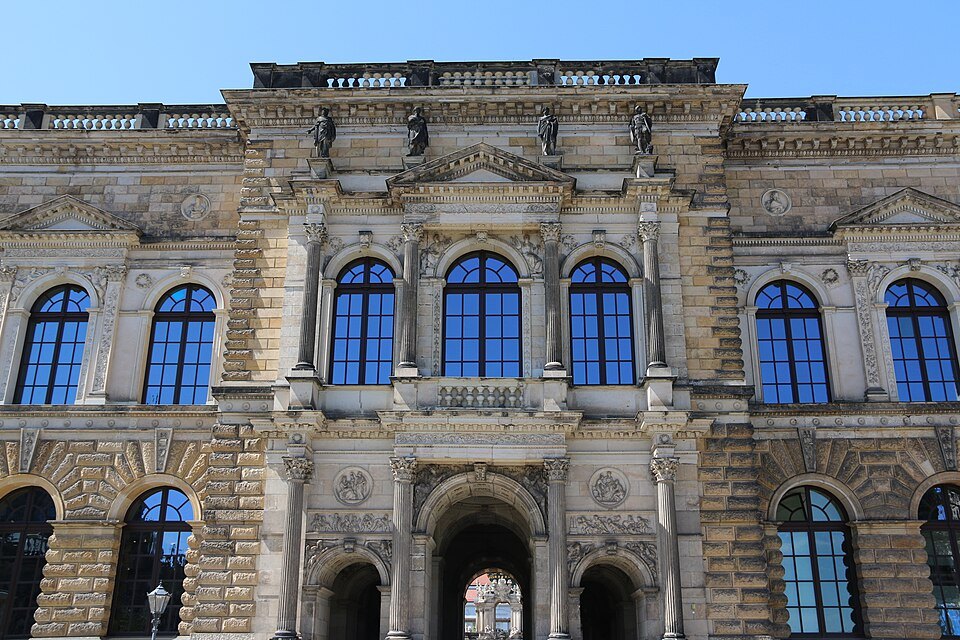
More than a century later, Gottfried Semper closed the open side with a gallery wing in the manner of the Italian High Renaissance, built from 1847 and opened in 1855 as the New Royal Museum. Its heavy, rusticated front is a sharp break with Pöppelmann's playful baroque, and it is the largest building of the complex.
03Fire, flood and rebuilding
The raids of 13 and 14 February 1945 burned out every building and wrecked the Wall Pavilion; the paintings had been moved out beforehand. The Nymphenbad is described as the one part that came through the fire nights. A Soviet soldier's note that the museum had been checked for mines survives beside the triple entrance arch of the Semper gallery, on the side facing the Theaterplatz, with a plate beside it repeating the fading words.
Rebuilding began in 1945 with the support of the Soviet military administration. Part of the courtyard reopened in 1951, and by about 1963 the Zwinger looked largely as it had before the war. The paintings, taken to Moscow and Kyiv, returned in 1955, but losses were heavy: records from 1963 counted 206 paintings destroyed and 507 missing.
In August 2002 the Elbe and its tributary, the Weißeritz, flooded the old town from two sides, and the Zwinger lay at the center of the flooding. Works of art carried down to the cellars for safety were threatened there too, the courtyard took days to pump dry, and the flood left considerable damage to the buildings and gardens.
04Walking the courtyard
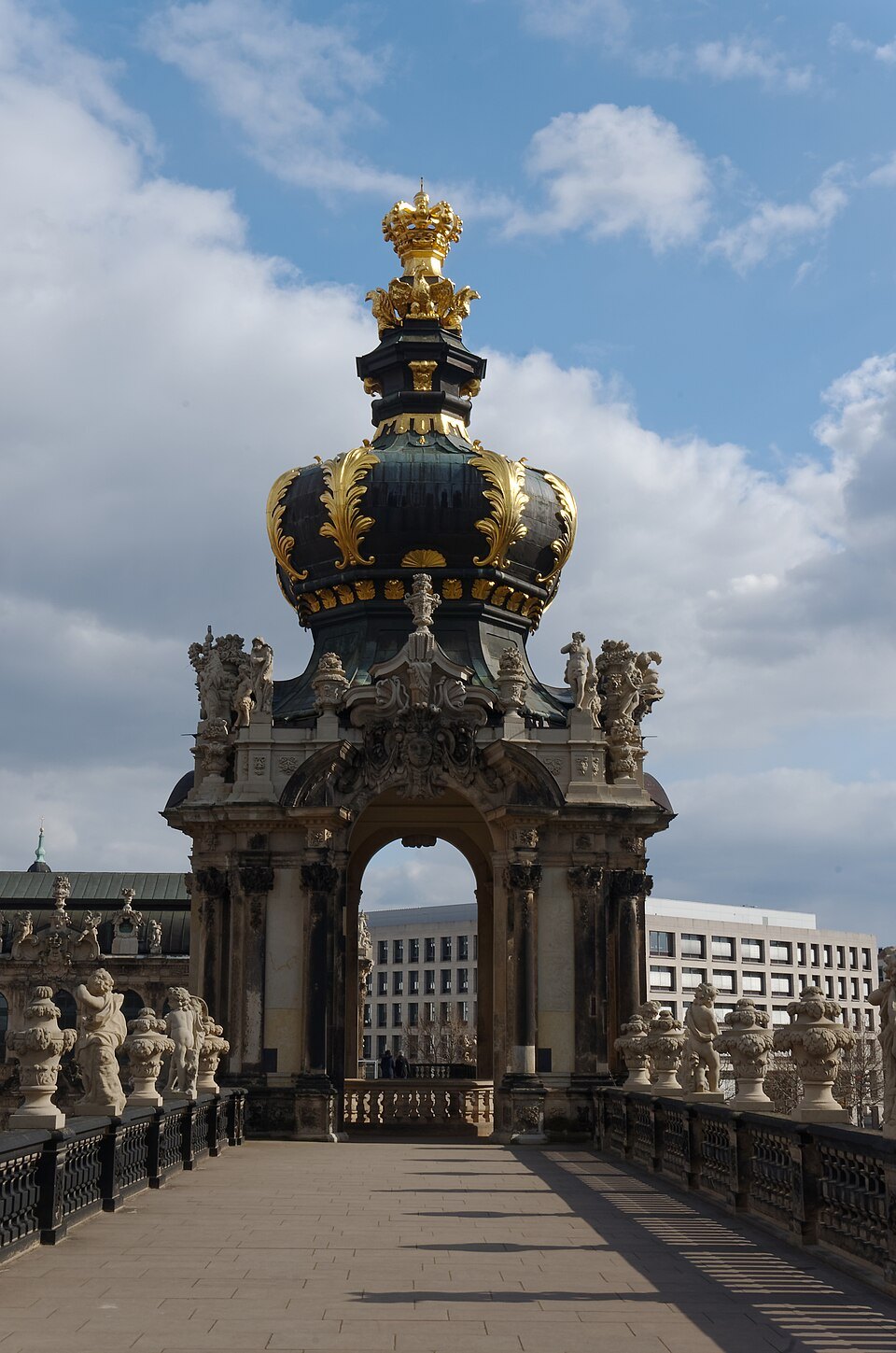
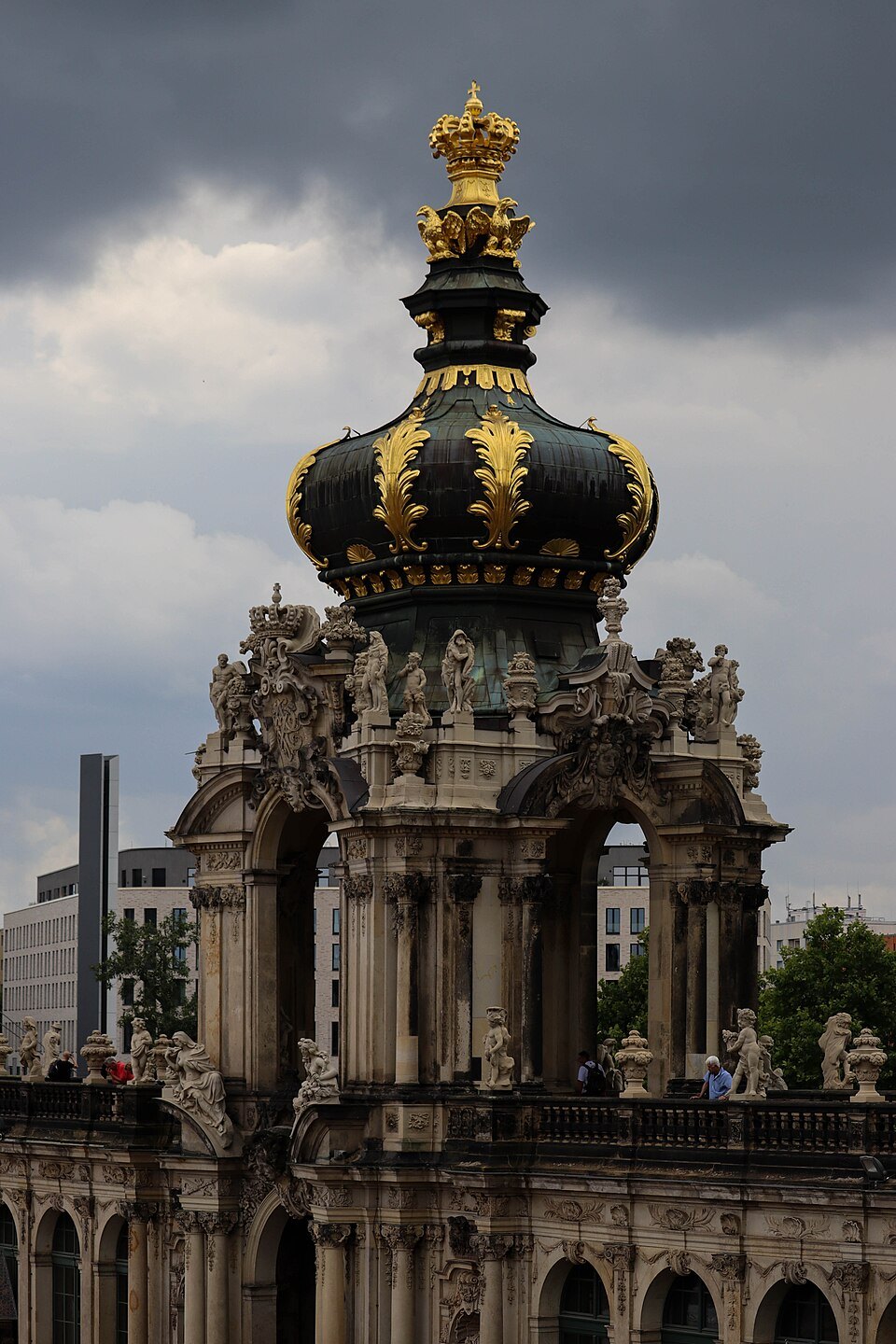
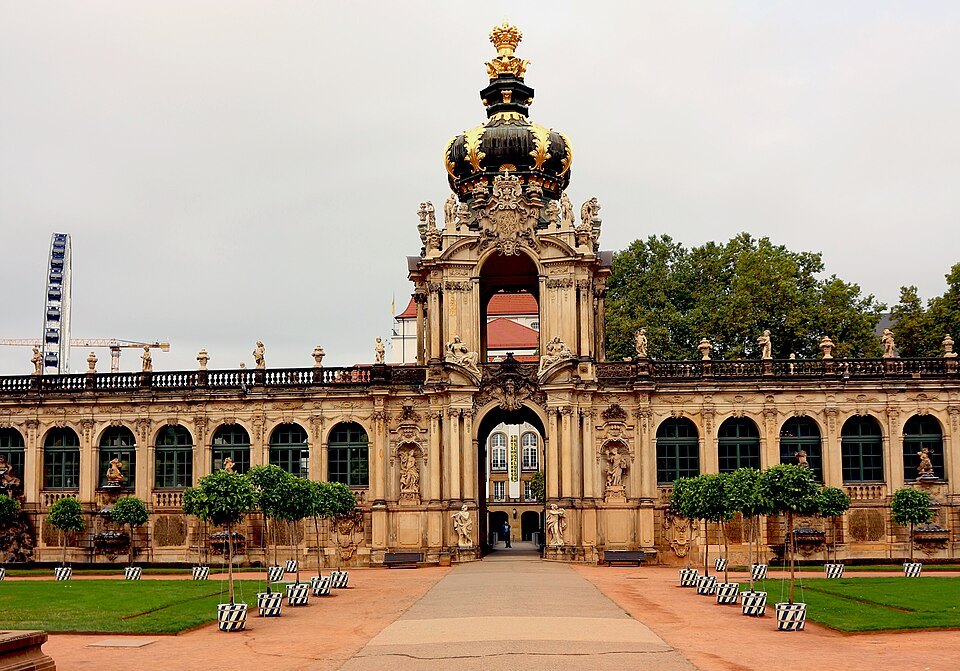
Arrive from the west, over the moat on a narrow bridge rebuilt in the form of the original wooden footbridge, which could be taken down quickly in an attack. The Kronentor, the Crown Gate, rises above it: its onion dome of partly gilded copper carries a copy of the Polish royal crown on four Polish eagles. On the courtyard side, the long galleries each have five wall fountains, and no two are alike.
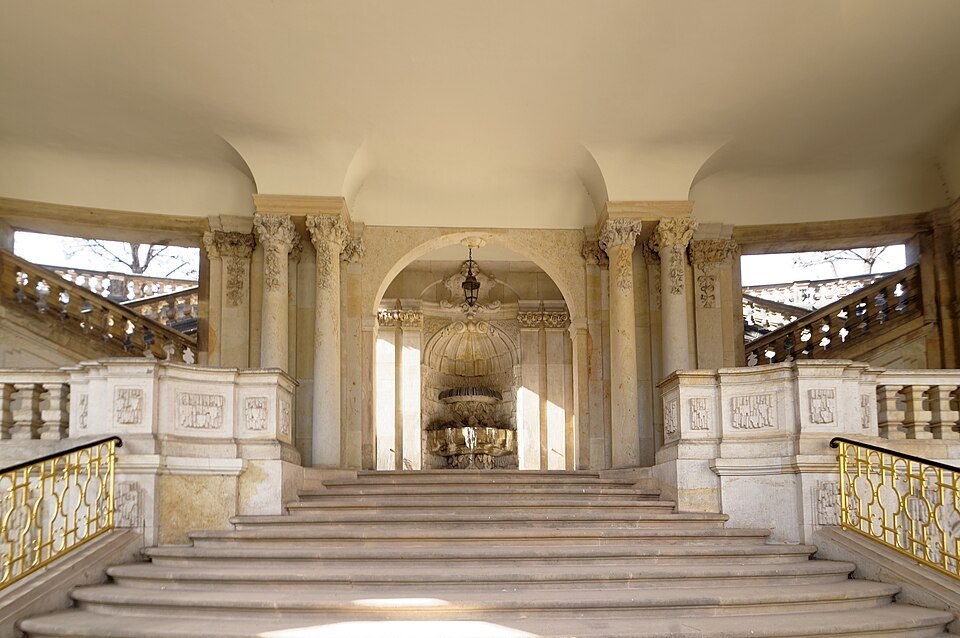
To the northwest stands the Wall Pavilion, often counted the high point of the building. Stairs climb through it to the old rampart between fountains and satyr herms, and on top Hercules carries the globe, standing in for Augustus himself; beside the gable, a young Paris holds the Polish crown instead of an apple. Tucked in beside it, behind the French Pavilion, lies the Nymphenbad, a walled fountain court open to the sky, where water falls down a cascade past Tritons towards nymphs in niches.
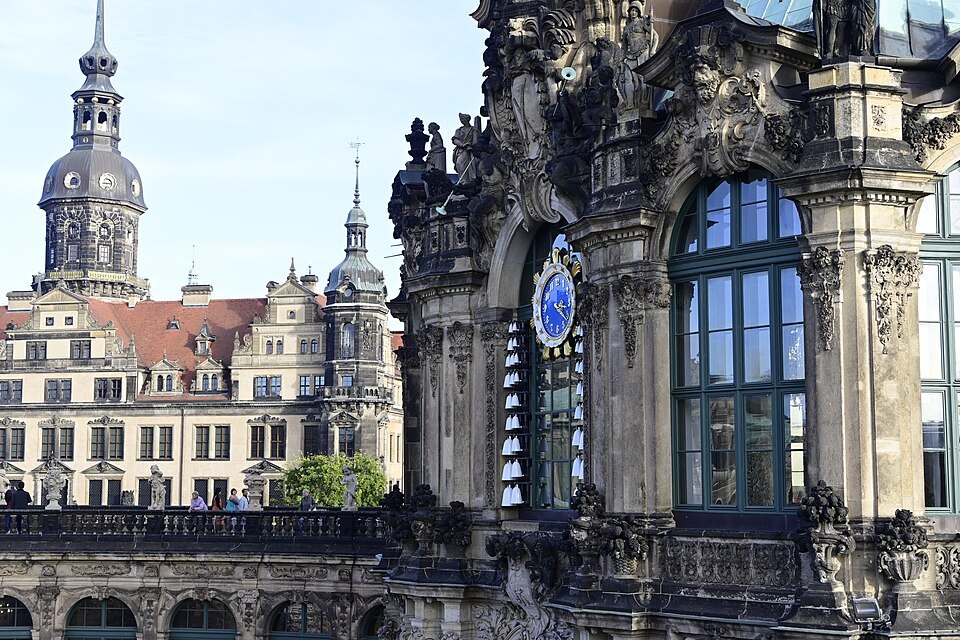
At the opposite end, the Glockenspielpavillon carries a clock and a carillon of forty Meissen porcelain bells, first installed in 1933 and rebuilt after the war; it plays on every quarter hour. Two Stolpersteine by its passage remember the two craftsmen from the Meissen porcelain manufactory who fitted it and later became victims of the Nazis. Since 2017, orange trees in blue-and-white tubs have again stood in the courtyard in the summer months.
05The Old Masters
Semper's building holds the Old Masters Picture Gallery, which since 2020 has been shown together with the Sculpture Collection up to 1800. Its centerpiece is Raphael's Sistine Madonna, painted about 1512 and bought for Dresden in 1754. The two cherubs leaning on the lower edge of the canvas began a life of their own in 1803, when they were first copied on their own, and were later reproduced on porcelain, jewelry and scrapbooks.
Several hundred paintings from the fifteenth to the eighteenth centuries hang here. Look for Titian's Tribute Money, the Sleeping Venus of Giorgione and Titian, Correggio's Madonna of Saint George, Rembrandt's Ganymede and Liotard's pastel Chocolate Girl; with 58 paintings by the elder and younger Lucas Cranach, the gallery also holds the largest Cranach collection in the world.
Sculpture is shown in dialogue with the paintings: Renaissance bronzes by Adriaen de Vries and Antonio Susini, and a small equestrian Marcus Aurelius made by Filarete in the mid-fifteenth century. The ground floor of the east wing is a hall of antiquities, and the frames follow a uniform style introduced in the eighteenth century.
06Porcelain and instruments
The Porcelain Collection is the fruit of Augustus's collecting passion, which has been called his maladie de porcelaine, his porcelain sickness. In 1717 he swapped six hundred soldiers with Frederick William I of Prussia for 151 pieces of Chinese blue-and-white porcelain, and the tall vases among them are still known as the dragoon vases. His own manufactory, founded in 1710 after Böttger's discovery, made the large Meissen porcelain animals shown here, among them a lion and an elephant.
The Mathematisch-Physikalischer Salon has been in the Zwinger since 1728, making it the oldest museum in the complex. Its instruments measured the world: Eberhard Baldewein's planetary clock of the 1560s, globes including one by Willem Blaeu, a burning mirror by Tschirnhaus from 1686, and a calculating machine made by Blaise Pascal around 1650.
07Planning a visit
The courtyard can usually be walked through without a ticket, while each museum is ticketed. The courtyard has been under long restoration work since 2021, and single galleries sometimes close for building works, so check before you go; see booking ahead. Allow at least two hours for the picture gallery alone, and more if you add the porcelain and the instruments.
The Zwinger sits between the Semperoper on the Theaterplatz and the Residenzschloss, whose west wing holds the Green Vault, so the three combine easily in a day. In summer, open-air serenade concerts are held in the courtyard, a tradition that began in 1928; for ways to fit them into a stay, see itineraries.