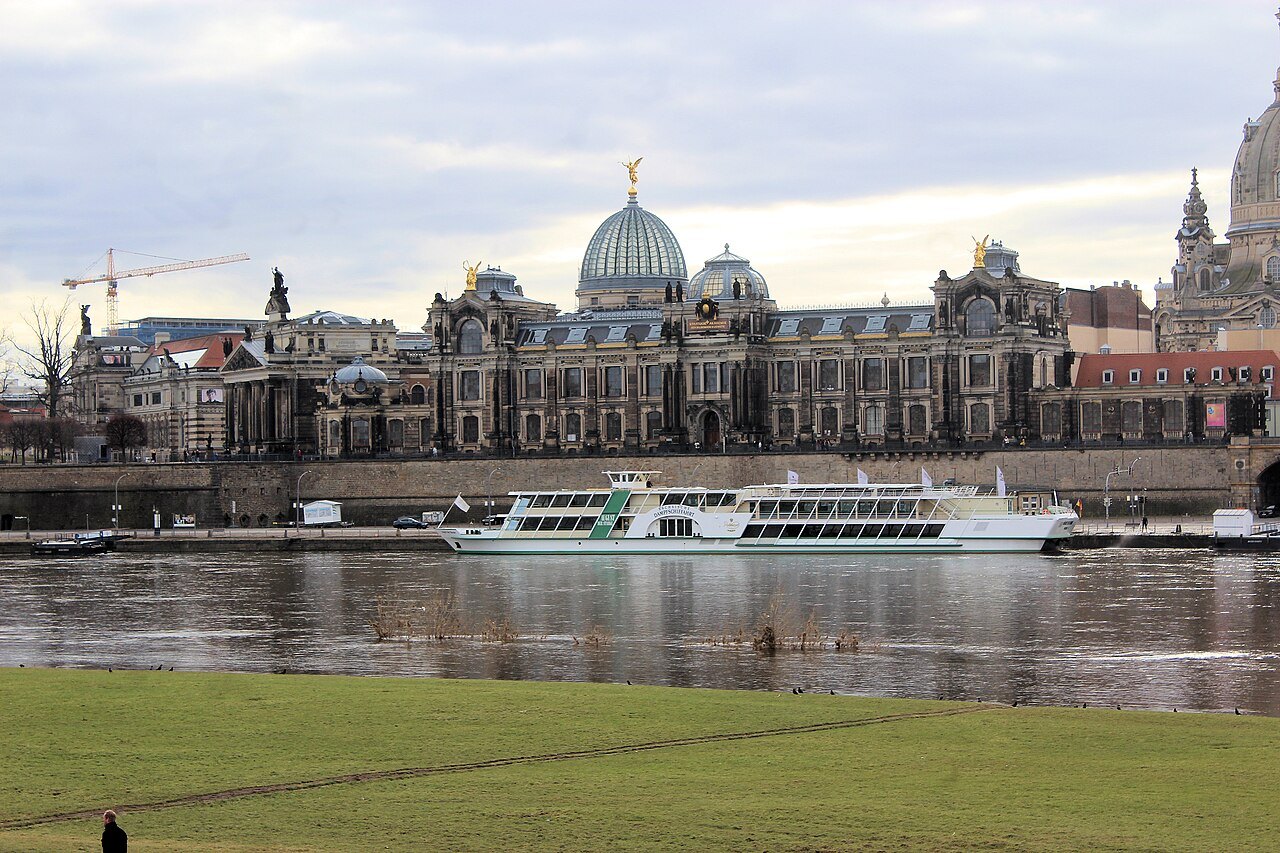
this bank
- the Schlossplatz steps and the Four Times of Day
- the Academy of Fine Arts and its lemon-squeezer dome
- the Festung Dresden vaults inside the walls
- the Albertinum
- the steamers below at the Terrassenufer
across the water
- the Neustadt bank and its meadows
- the Augustus Bridge to the Golden Rider
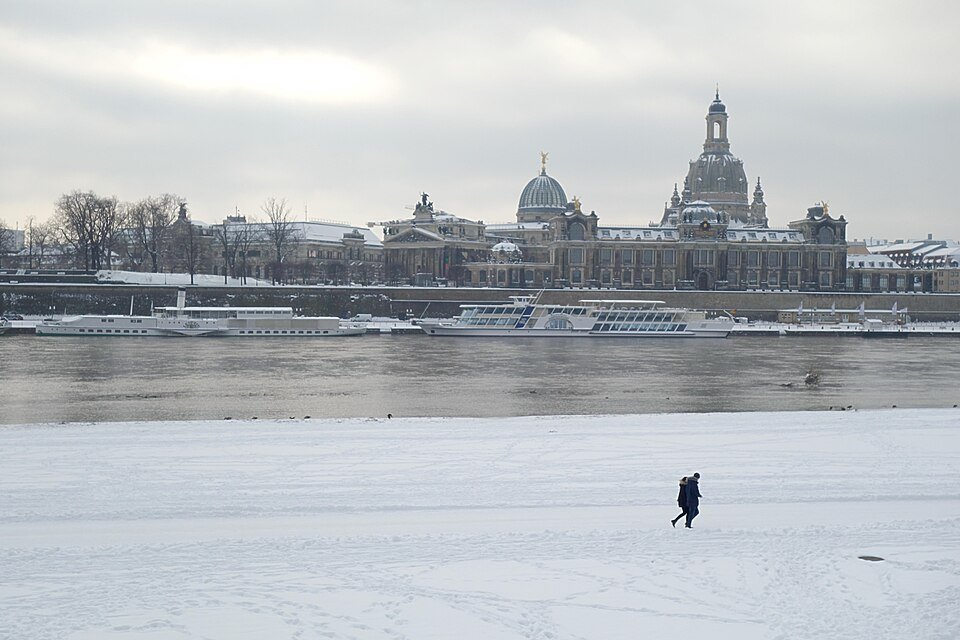
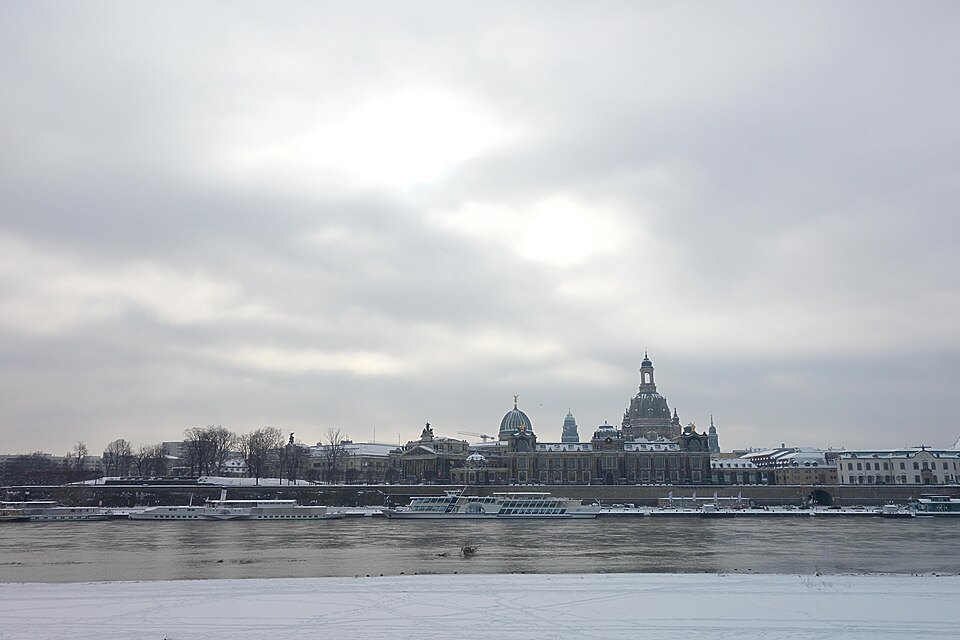
- 01The Balcony of Europe
- 02From bastion to promenade
- 03The steps and the Four Times of Day
- 04The lemon squeezer
- 05Brühl's garden and a legend
- 06The fortress inside
01The Balcony of Europe
Brühl's Terrace, the Brühlsche Terrasse, is a raised promenade about 500 meters long on top of the old city fortifications, running along the Elbe between the Augustus Bridge and the Carola Bridge. It stands up to ten meters high and is between ten and forty meters wide. Since the early nineteenth century it has been called the Balcony of Europe, a name repeated in books ever since.
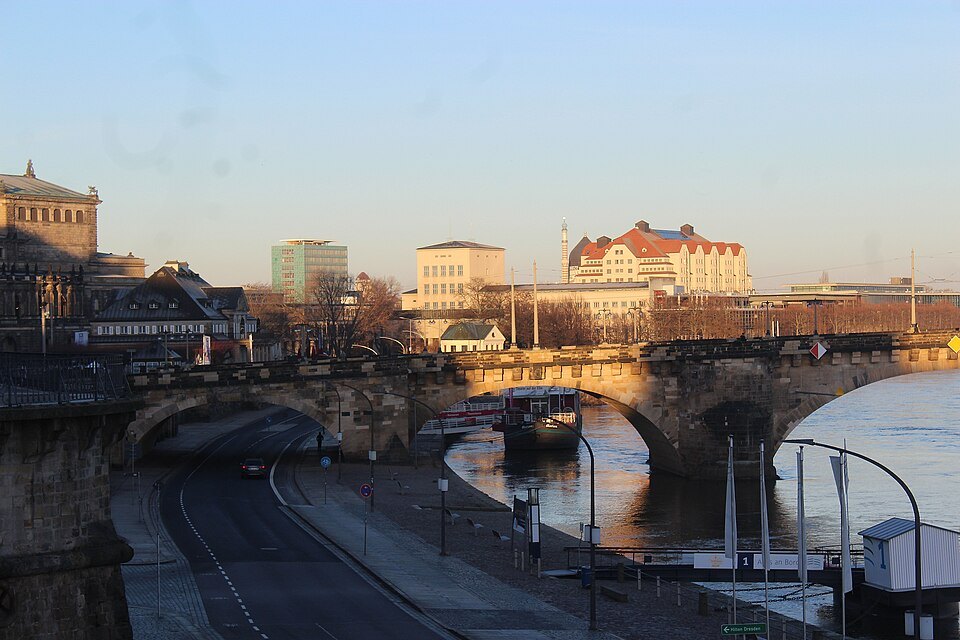
For a first visit it is the easiest way to read the city's layout: academies and museums on one side, the river, the steamers and the whole Neustadt bank on the other, and the dome of the Frauenkirche rising behind the rooftops. It is a public promenade, with no ticket needed to walk it.
02From bastion to promenade
The terrace began as a bastion. From 1546 Elector Maurice had Dresden's medieval walls rebuilt as a modern fortress on Italian and Dutch models, and the last section, finished between 1589 and 1591 as the new fortress by the brick gate, became the terrace of today.
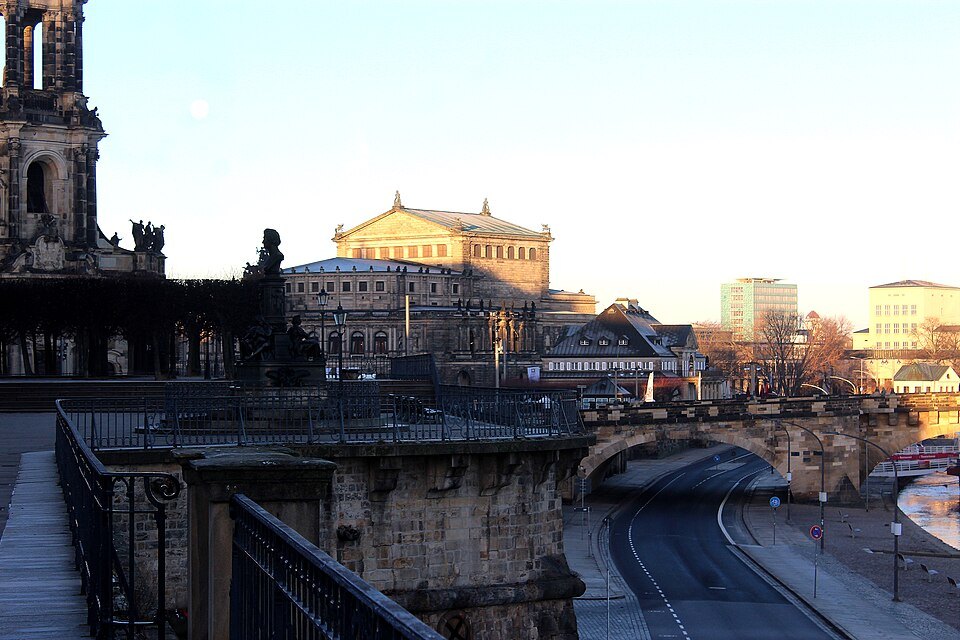
It is named after Count Heinrich von Brühl, minister to Elector Frederick Augustus II, who from 1737 had the architect Johann Christoph Knöffel build a palace, a gallery, a library, a belvedere and gardens on the ramparts. In 1747 the elector gave him the whole terrace. All that building ended the bastion's military role.
After Saxony's defeat at the Battle of Leipzig, the Russian governor-general of occupied Saxony, Prince Nikolai Repnin-Volkonsky, ordered the terrace opened to the public in 1814. Brühl's own buildings were cleared around 1900 for the ones that stand there now. The ensemble was destroyed in the bombing of February 1945 and rebuilt to look very much as it did before.
03The steps and the Four Times of Day
Most people arrive by the broad staircase from the Schlossplatz, which the architect Gottlob Friedrich Thormeyer built in only four months in 1814. It was remodeled from 1863 to take the sculpture group The Four Times of Day by Johannes Schilling, chosen in a competition held by King John: Evening and Night were set up in 1868, Morning and Midday in 1871. The originals were replaced with bronze casts in 1908.
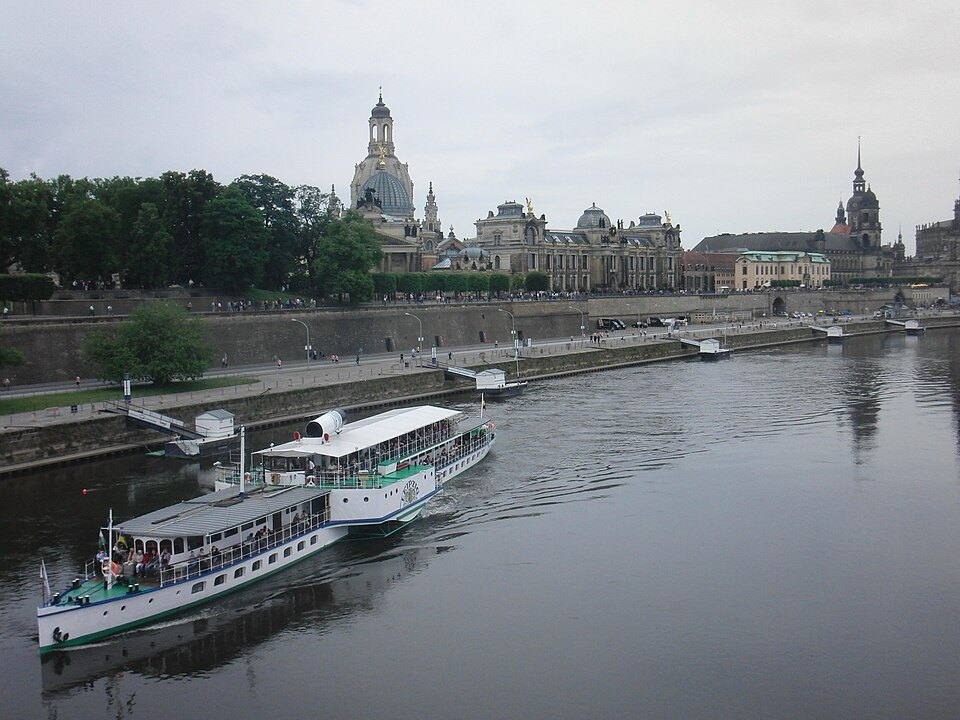
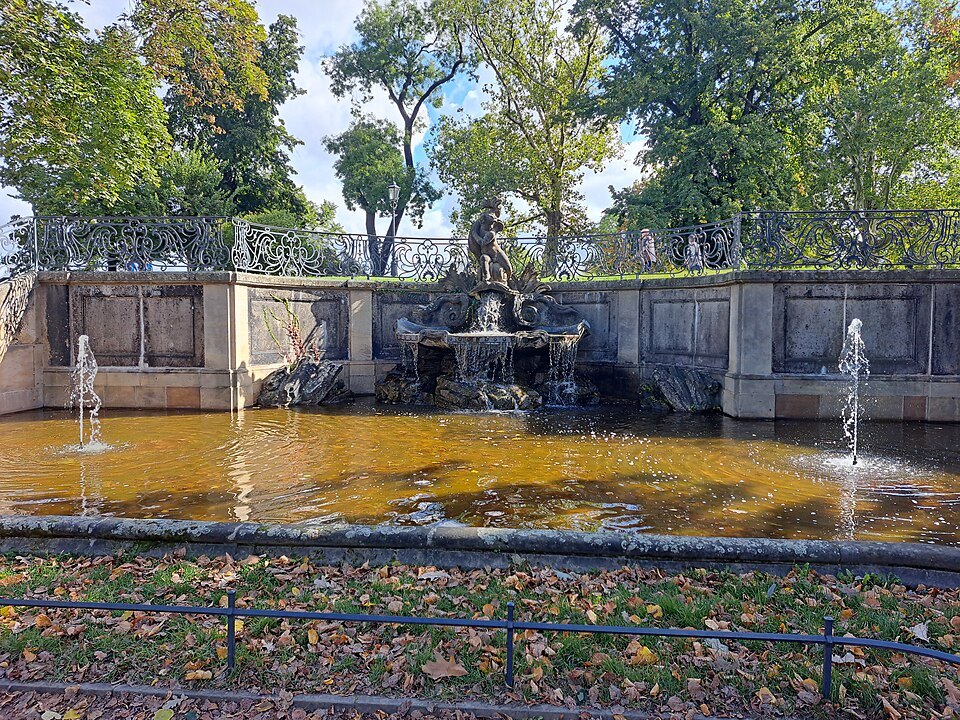
At the top, the Sächsisches Ständehaus by Paul Wallot, built in 1900, stands where Brühl's palace was. In front of it is a sandstone basin with a boy and a dolphin, an exact copy made in 1990 and 1991 of a fountain designed by François Coudray in 1750. Next comes the Sekundogenitur, built in 1897 on the site of Brühl's library, and opposite it a bust of the sculptor Ernst Rietschel by Schilling, placed where Rietschel had his studio in Brühl's garden pavilion.
04The lemon squeezer
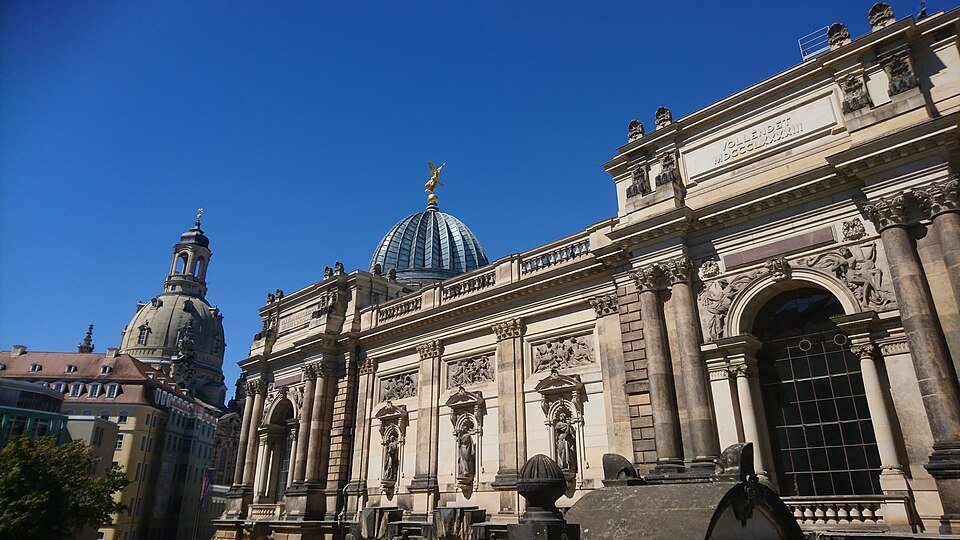
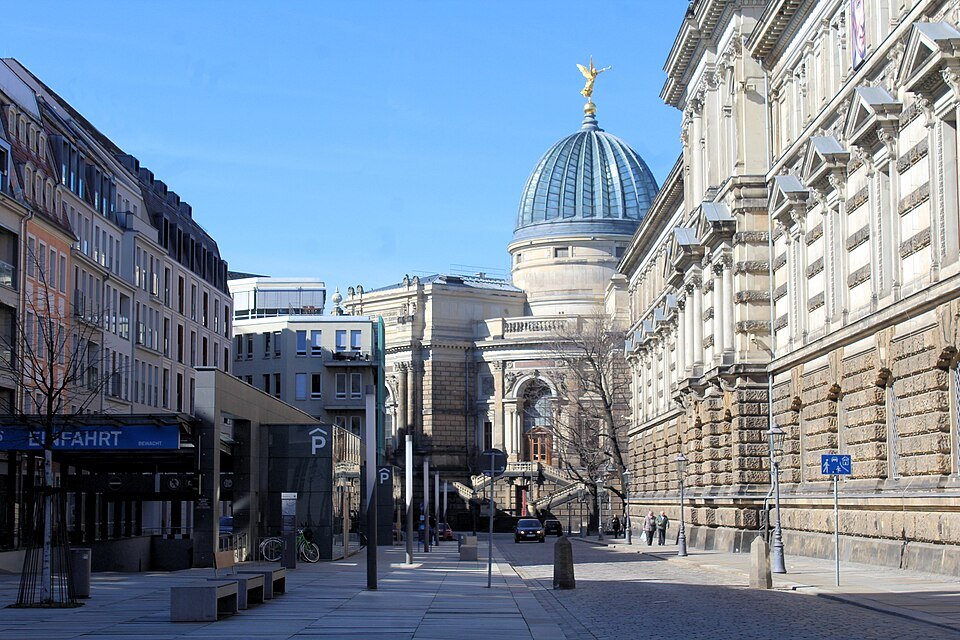
Beyond the stairs from Münzgasse rises the Kunstakademie, the Academy of Fine Arts, built by Constantin Lipsius on the site of Brühl's gallery and completed in 1894 for the Royal Academy of Fine Arts and the Saxon Art Association. Its facade on the terrace is thick with sculpture, and its huge windows light the painting studios behind them.
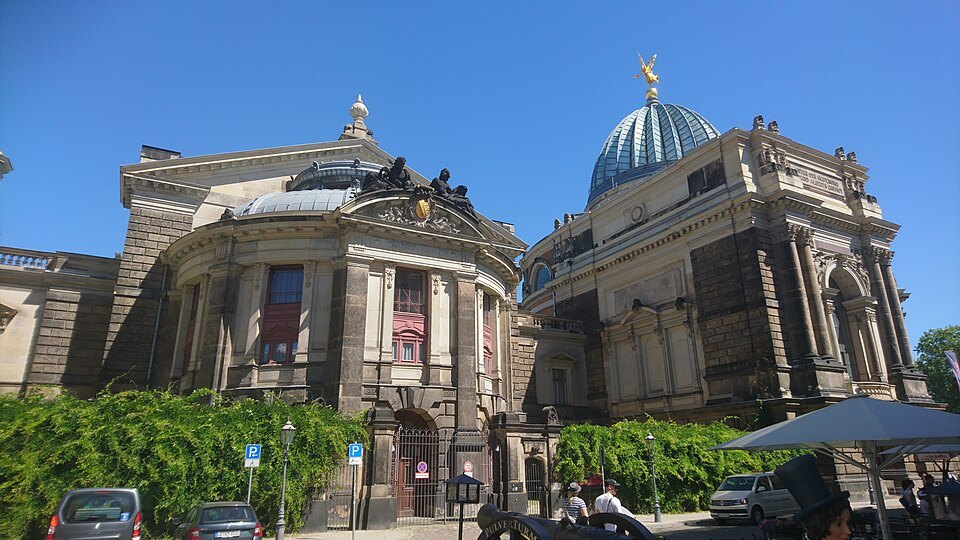
Its folded glass dome, crowned by a figure of Fame, is the one Dresdeners call the Zitronenpresse, the lemon squeezer. When it was new it was controversial, seen as competing with the dome of the Frauenkirche. The building is home to the Dresden University of Fine Arts; its eastern wing, the Kunsthalle im Lipsius-Bau, is an exhibition hall of the state art collections, and the studios can be seen only during exhibitions and events.
Between the Academy and the Albertinum, where the stairs come up from Georg-Treu-Platz, stands Schilling's bronze monument to the architect Gottfried Semper, unveiled in 1892. Set into the paving nearer the Sekundogenitur is Vinzenz Wanitschke's bronze globe Earth and Planets of 1988, ringed by medallions naming the fortress bastions, which were given the names of planets in 1721.
05Brühl's garden and a legend
At the eastern end, on the Jungfernbastei, a small park keeps the remains of Brühl's garden. Here are the Dolphin Fountain and two sphinxes by Johann Gottfried Knöffler, a sandstone stele of 1982 for Johann Friedrich Böttger with a medallion of Meissen porcelain, and a steel and bronze monument of 1990 to the painter Caspar David Friedrich. At the corner above the Terrassenufer stands the Moritz Monument, set up by Elector Augustus for his brother Maurice.
Note Near the Böttger monument, a mark in the handrail of the railing is pointed out as the fingerprint of Augustus the Strong, pressed there to show his strength. Enjoy the story but do not believe it: the railing was put up around 1900, long after his death in 1733.
06The fortress inside
The terrace is not solid. Inside its walls survive the vaults of the Renaissance fortress, including the Ziegeltor, a brick gate on the river side that was later walled over, and they are shown as the Festung Dresden museum. The entrance is at the foot of the stairs from Georg-Treu-Platz, below the Academy.
The state palaces and gardens organization of Saxony presents the fortress in a multimedia show called Festung Xperience, with 360-degree projections and three-dimensional sound in the old vaults. It takes just under an hour and is aimed at visitors aged six and up; check the operator's website for days and tickets, as the museum closes one day a week and on some extra dates.
The fortress walls still do a job. They form part of the city's flood defenses, and when the Elbe rises, the gates under the terrace are sealed with steel barriers to protect the Neumarkt behind. The river starts to reach the base of the old walls only in a serious flood, when the gauge passes about five meters.
07Walking it
Allow half an hour to walk the terrace from end to end, and far longer with the monuments and the fortress. Start at the Schlossplatz steps opposite the Hofkirche and walk east with the river on your left, ending by the Albertinum; the Neumarkt is a few steps south of there, and the Fürstenzug is a street away from the top of the steps.
The view north takes in the whole Neustadt bank, with the landing stages of the paddle steamers directly below at the Terrassenufer; see the Elbe for the river and its meadows. Late afternoon, when the sun is in the west over the river, is a good time for the view across the water.