- 1739–1755builtChiaveri's court church, consecrated 1751
- 1945lostroof and vaults fell in
- 1962–1965rebuiltrestored; sources give 1962 or 1965
- 01The cathedral by the bridge
- 02A church built as a counterweight
- 03No bells, no processions
- 04Outside: seventy-eight saints
- 05Inside: altarpiece, pulpit and organ
- 06The Wettin crypt
01The cathedral by the bridge
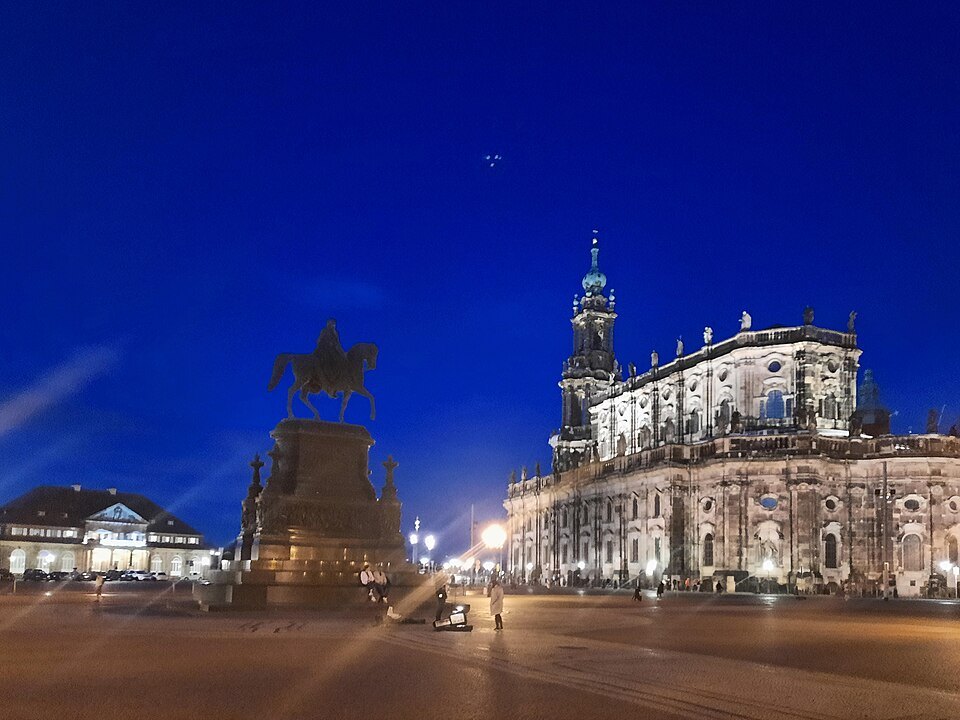
The Katholische Hofkirche, the Catholic Court Church, stands on the Altstadt riverbank between the Schlossplatz and the Theaterplatz, at the foot of the Augustus Bridge. Since 1980 it has been the cathedral of the Catholic diocese seated in Dresden, officially the Cathedral of the Holy Trinity, but it is still widely known as the Hofkirche.
It is worth a visitor's time for its story as much as its art. Alongside the dome of the Frauenkirche, its tower has shaped the city's silhouette since the eighteenth century, and inside are an altarpiece by Anton Raphael Mengs, a pulpit by Balthasar Permoser, the last organ of Gottfried Silbermann, and the burial vaults of the Saxon royal house.
02A church built as a counterweight
In 1697 Augustus the Strong converted to Catholicism to win the crown of Poland, in a state whose people were Lutheran. He promised freedom of religion and heard Mass discreetly in the palace chapel, and he supported the Protestant citizens as they built the Frauenkirche, about three hundred meters away, from 1726.
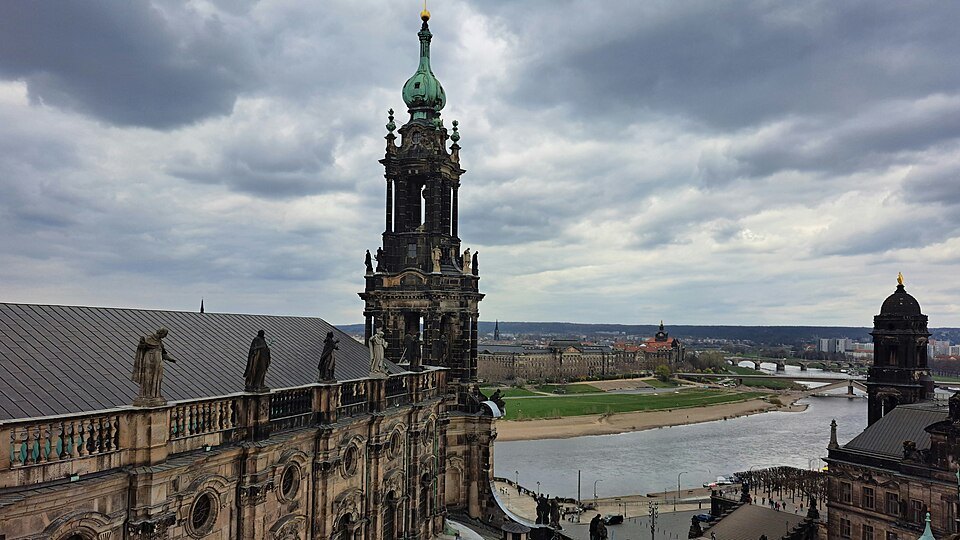
His son, Frederick Augustus II, who ruled Poland as Augustus III, went further. He commissioned the Roman architect Gaetano Chiaveri in 1736, at first under such secrecy that the project was spoken of only as "a certain building." Construction began in 1739, the church was consecrated on 29 June 1751, and the work was completed around 1755. English-language sources often give the dates as 1738 to 1751.
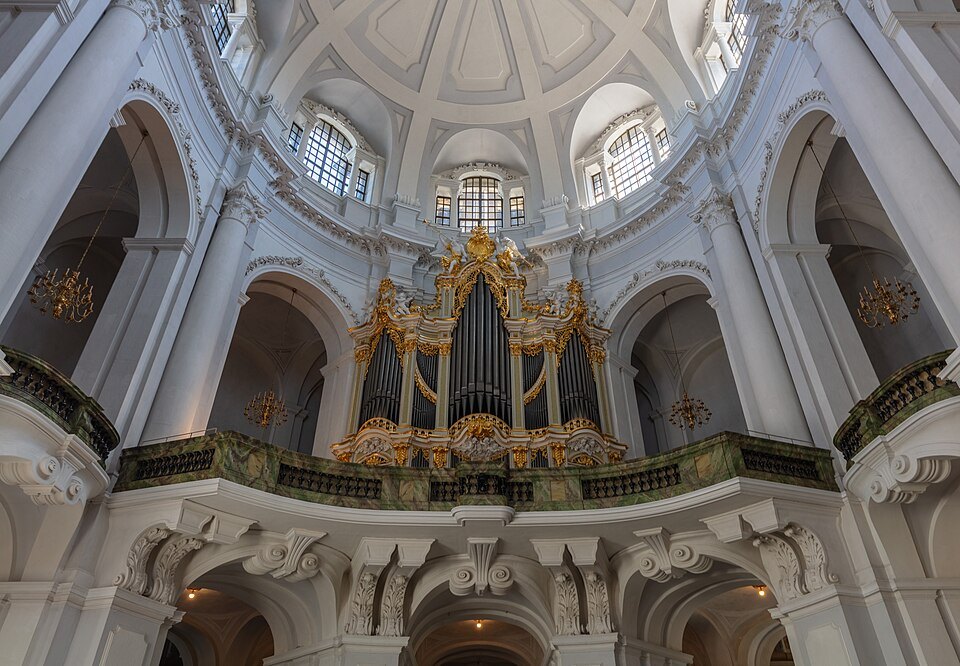
Chiaveri left Dresden in 1748 before it was finished, and local architects altered parts of his design, adding Rococo forms to the organ gallery and the royal boxes. The main axis does not face east: the site dictated the plan, so the choir points southwest.
03No bells, no processions
The church was built for the court, not for a Catholic city. Saxon law allowed Catholics their services but, in a phrase of the time, only without bells. A large bell cast in 1747 had to wait in the arsenal until religious equality came in 1806, and more bells were added the next year.
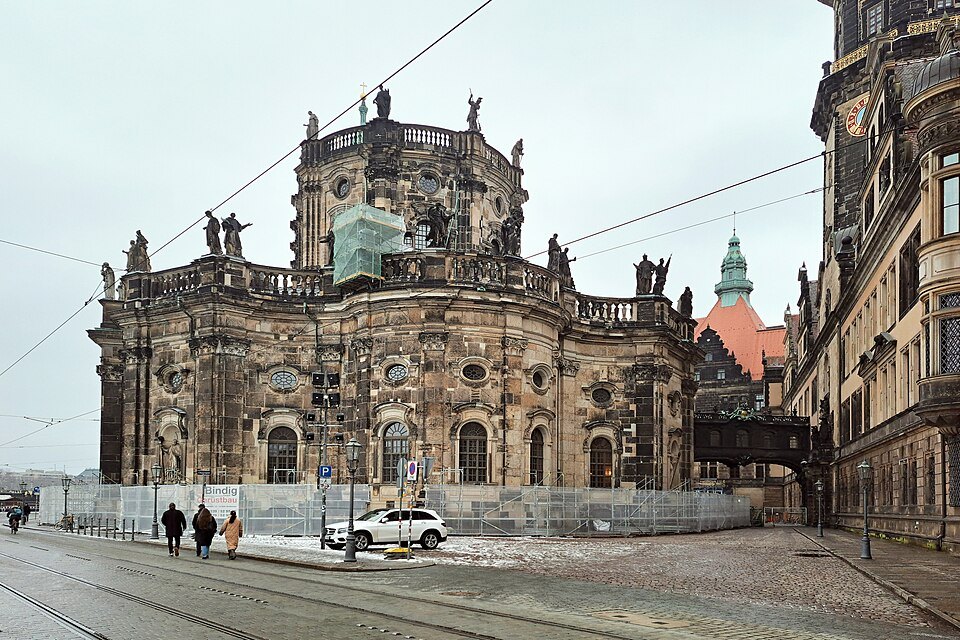
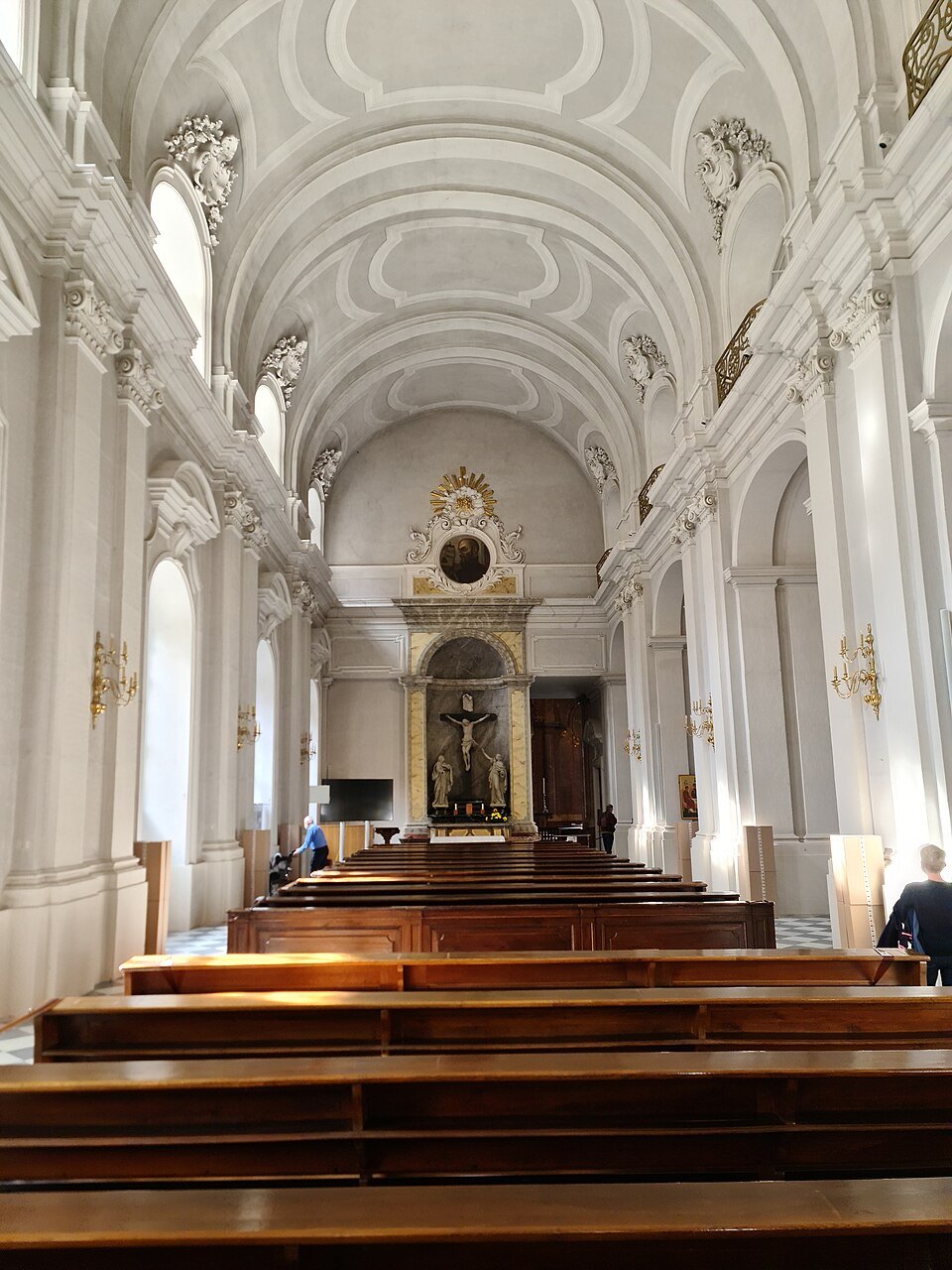
Processions outside were forbidden too, so Chiaveri built one indoors: a processional walkway runs around the nave inside the building. An enclosed bridge at upper-floor level crosses the lane to the Residenzschloss, so the royal family could reach its church without going into the street.
04Outside: seventy-eight saints
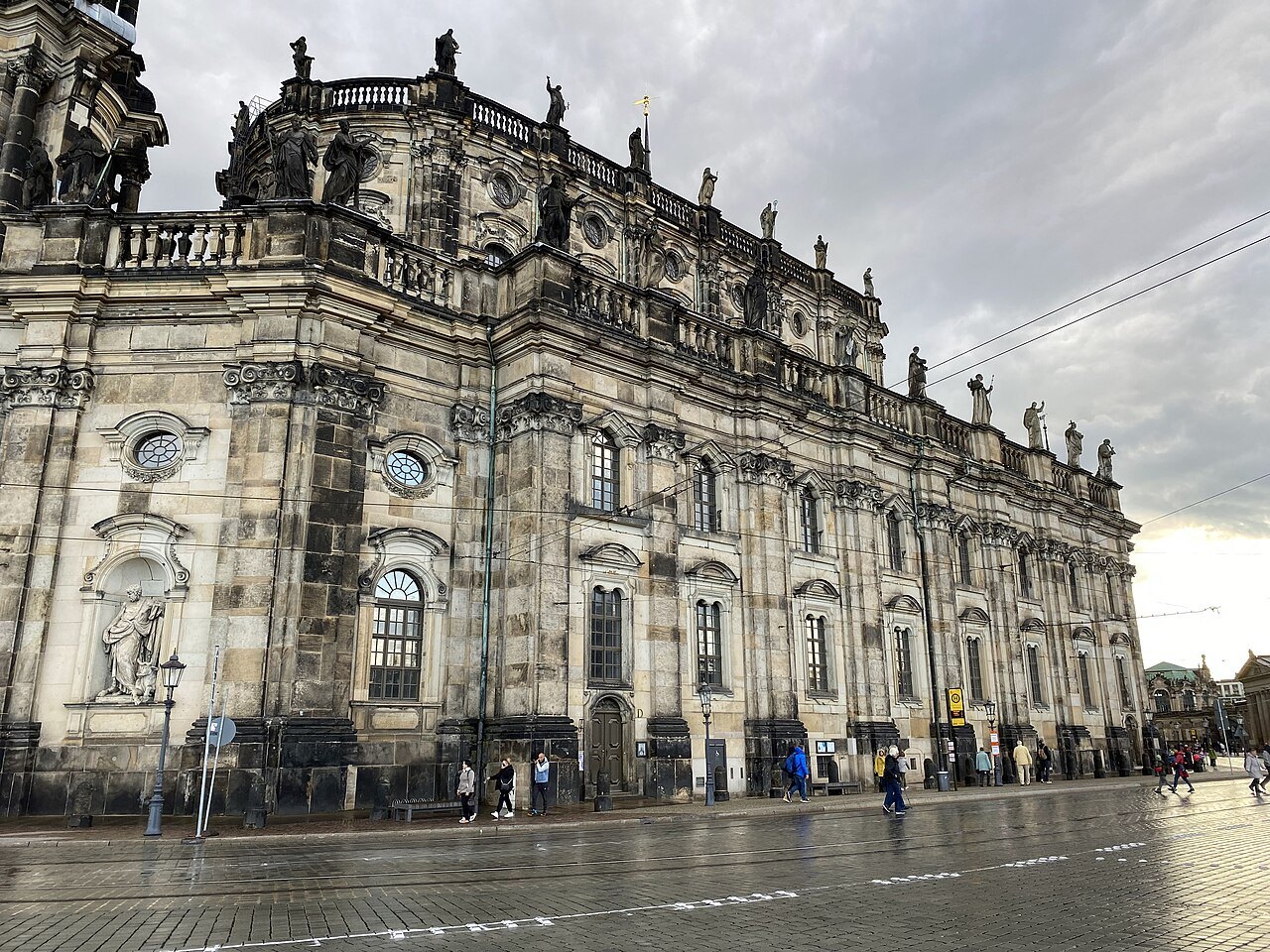
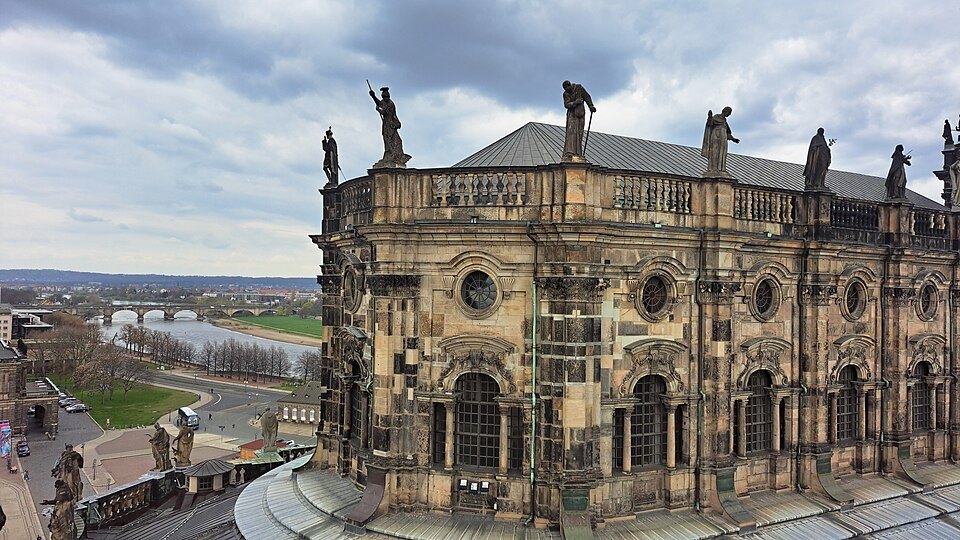
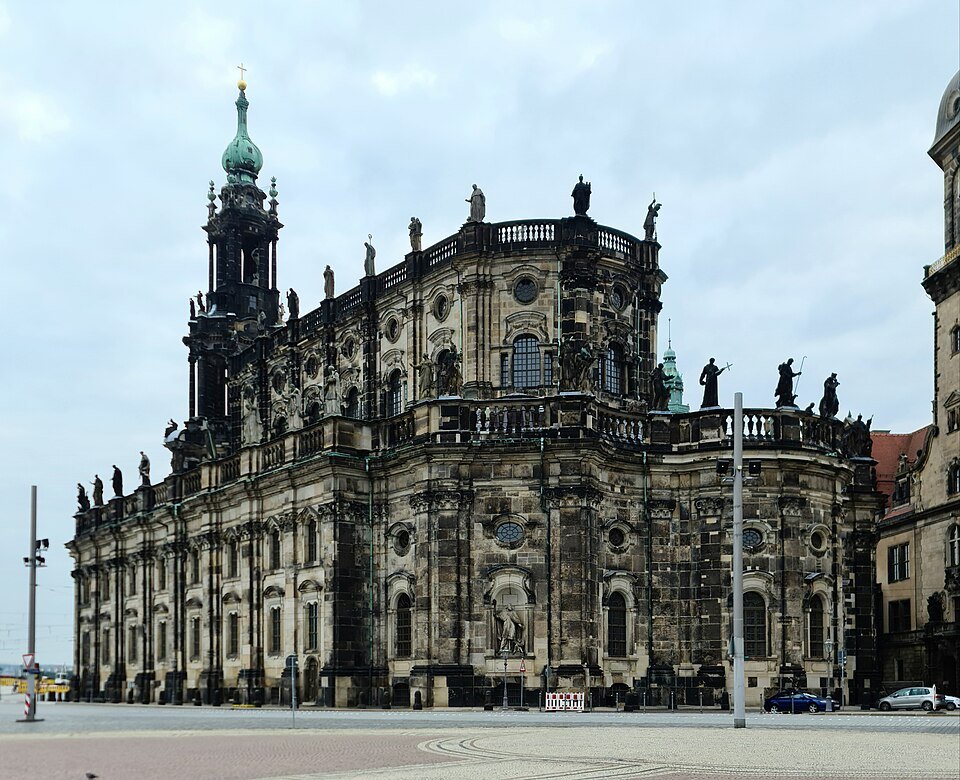
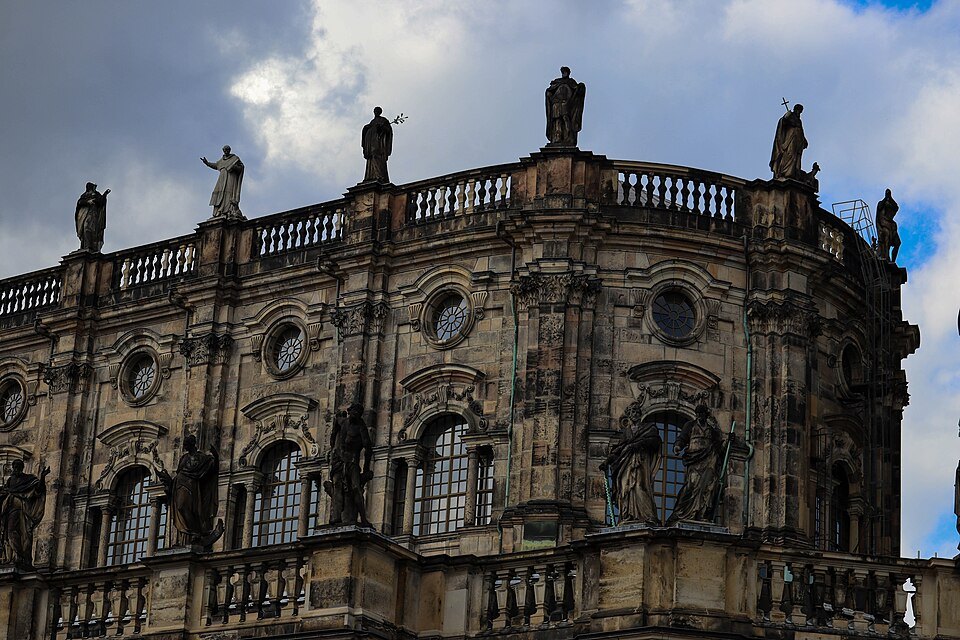
Look up at the balustrades. Seventy-eight statues of saints, by the Italian sculptor Lorenzo Mattielli and the Dresden sculptors Paul and Jakob Mayer, line the roofs and fill the niches. The four Evangelists flank the main entrance, Peter and Paul stand above it, and the saints higher up include Benno, whose mitre is kept as a relic in one of the corner chapels, and Stanislaus of Kraków.
High on the tower, about 86 meters tall, a gilded inscription begins D.O.M., for Deo Optimo Maximo, to God, the best and greatest. Walk along the side of the church and the plan becomes clear: a tall central nave surrounded on all sides by a lower aisle, with the tower attached to the aisle rather than the nave. Measured by floor area, the church is counted as the largest in Saxony.
05Inside: altarpiece, pulpit and organ
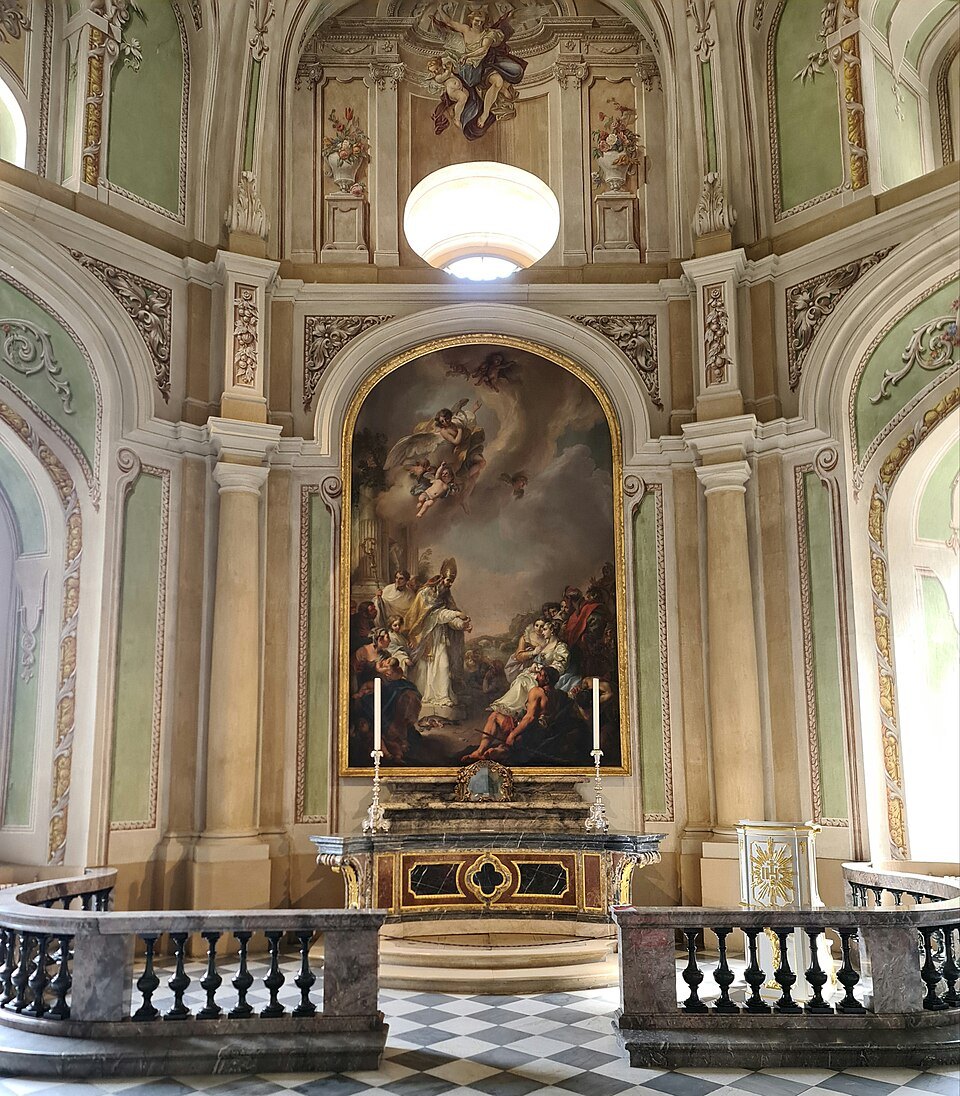
The high altar carries a huge Ascension painted by Anton Raphael Mengs, begun in Rome in 1752 and brought to Dresden in 1765, about ten meters tall. Two side-altar paintings are also by Mengs. The white-painted pulpit by Balthasar Permoser, the sculptor of the Zwinger, is older than the church: it was carved in 1712 for the earlier court chapel and moved here in the 1740s.
The Silbermann organ is the latest of Gottfried Silbermann's four Dresden organs and the only one to survive. He signed the contract in 1750 but was ill, handed the work to his pupil Zacharias Hildebrandt, and died in 1753; the organ was consecrated in 1755. In 1944 its pipes were taken to safety; the carved case burned in 1945 and was later reconstructed from photographs. After a further restoration it was rededicated in 2002.
In the northeast corner chapel, whose Baroque ceiling painting burned in 1945, a memorial to the victims of 13 February 1945 holds a modern Pietà of Meissen porcelain by the sculptor Friedrich Press; the chapel was dedicated to their memory in 1976.
06The Wettin crypt
Four connected vaults beneath the church hold the tombs of 49 members of the Albertine Wettins, with their spouses and children. The oldest, the Founders' Crypt, holds Augustus III and Maria Josepha, the last Queen of Poland. The kings of Saxony are buried here too, down to Frederick Augustus III, the last.
The heart of Augustus the Strong rests in a capsule in the Founders' Crypt; his body lies in Wawel Cathedral in Kraków. Since the church became a cathedral, a bishops' crypt has been added alongside. Burials began within days of the consecration in 1751, when the coffins of three children of the electoral couple were brought down; further vaults followed in 1823 and around 1900, all linked by passages.
07Damage, rebuilding and visiting
Several high-explosive bombs struck the church in February 1945. The roof and the vaults collapsed and parts of the outer walls were destroyed. East Germany restored it, with the work finished by the early to mid-1960s depending on the source, and the difference in stone color on the nave still shows where the damage was. The bridge to the palace was rebuilt after reunification.
The church can be entered during the day outside services. The crypt is seen on public guided tours of the church and crypt, which last about 45 minutes and are generally given in German; no advance booking is needed, and the meeting point is under the organ gallery. The Silbermann organ is heard at services, in organ concerts and in the city's organ cycle, and the Dresden Kapellknaben, a boys' choir founded for the court in 1709, sing on Sundays and feast days outside school holidays.
Allow half an hour for the church alone, more with the crypt tour. It sits between the palace and the Semperoper, and Brühl's Terrace begins just across the Schlossplatz. One of the Sunday Masses is celebrated in Polish, a reminder of the old link between Saxony and Poland.