- 01A parade on a palace wall
- 02Scratched plaster, then porcelain
- 03Through the fire of 1945
- 04How to read it
- 05The crowd at the end
- 06Seeing it well
01A parade on a palace wall
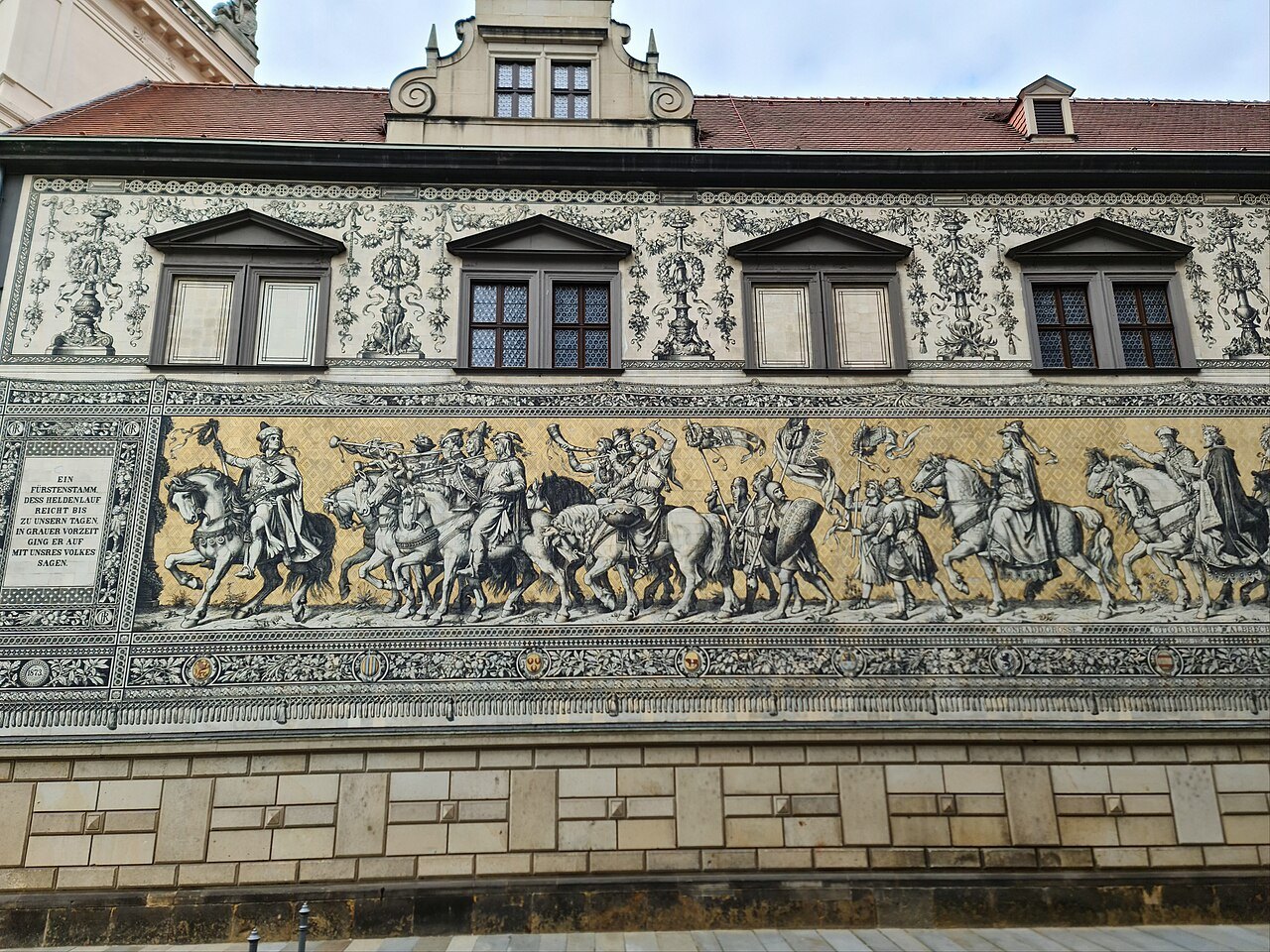
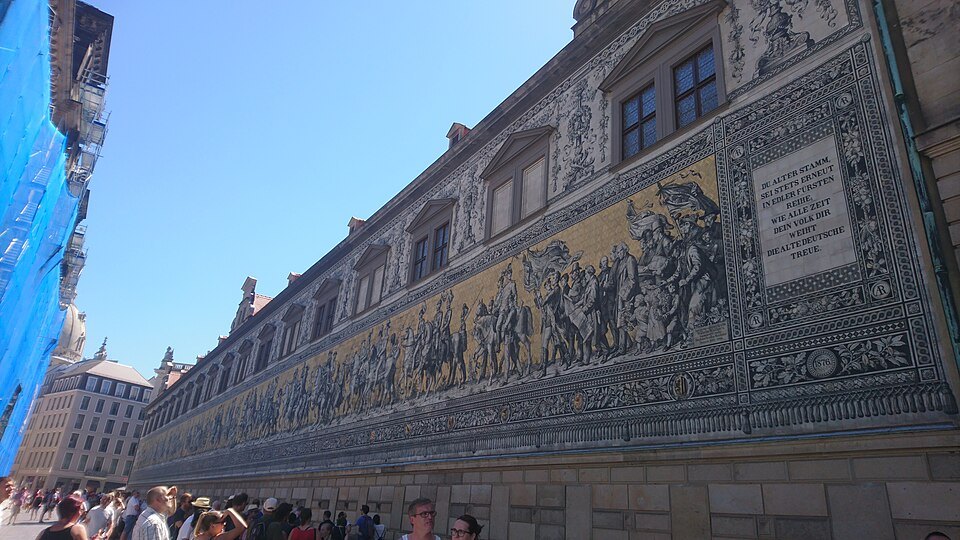
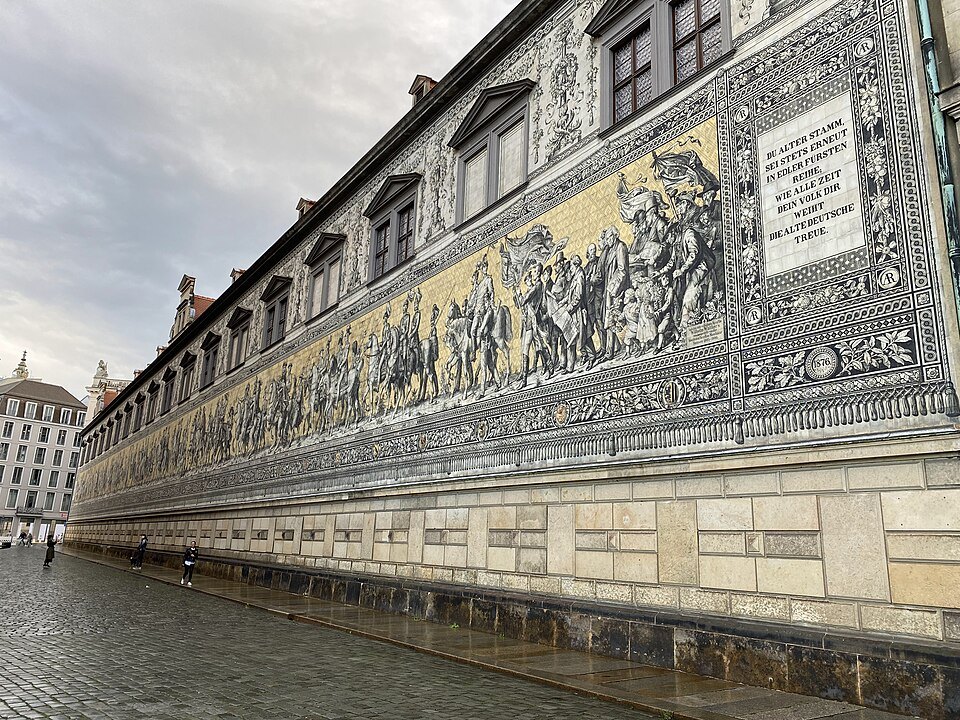
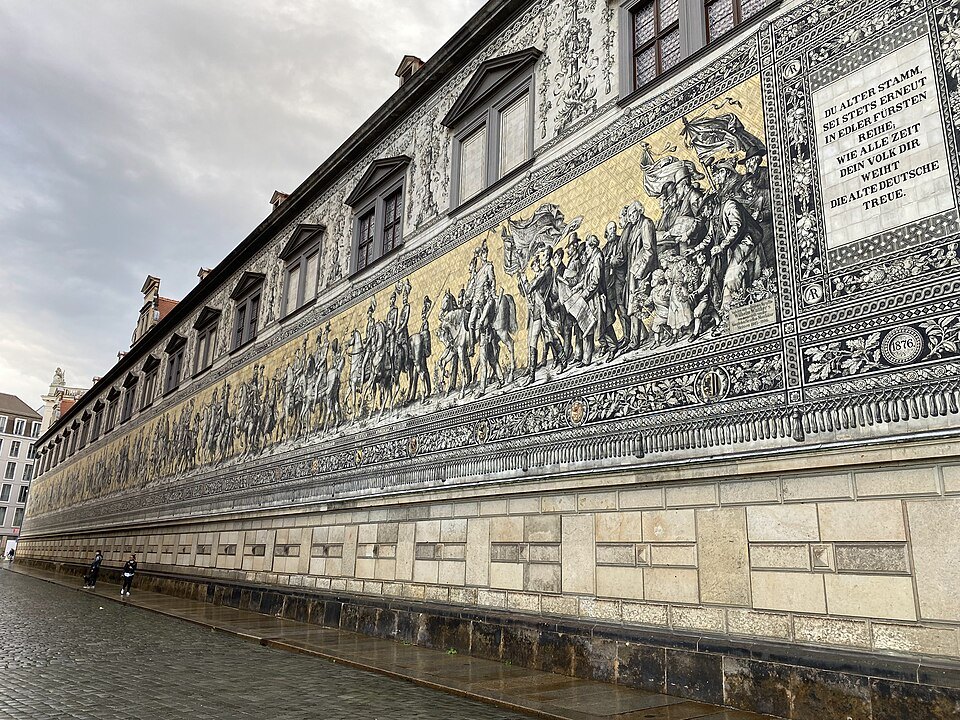
The Fürstenzug, the Procession of Princes, is a mounted parade of Saxony's rulers laid out along the outer wall of the Stallhof, the stables courtyard of the Residenzschloss. It runs along Augustusstraße between the Georgentor and the Johanneum, close to the Neumarkt, and it is often described as the largest porcelain artwork in the world.
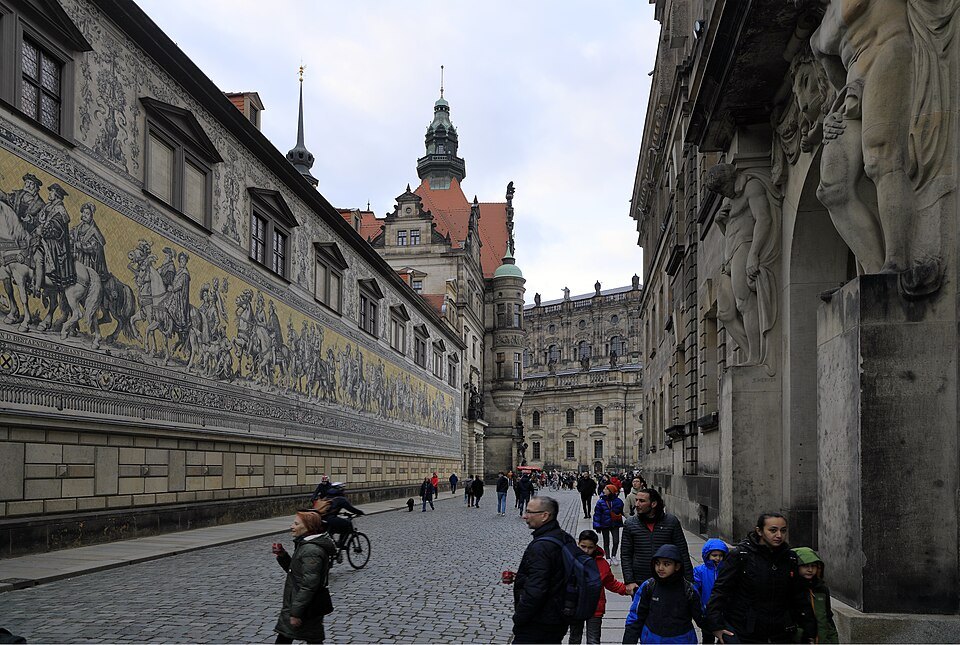
The wall is about 102 meters long and ten and a half meters high, broken by eighteen windows along its upper edge. The picture is made of roughly 23,000 tiles of Meissen porcelain, each about twenty centimeters square. Totals vary between sources: the city's tourism office says more than 24,000, and about 25,000 were made in all, many of them used up in trials.
For a visitor it is the quickest introduction to Saxon history: eight centuries of the House of Wettin in a single walk, every ruler named, with courtiers, soldiers, artists and children walking alongside. It is a street wall, not a museum, so there is no ticket.
02Scratched plaster, then porcelain
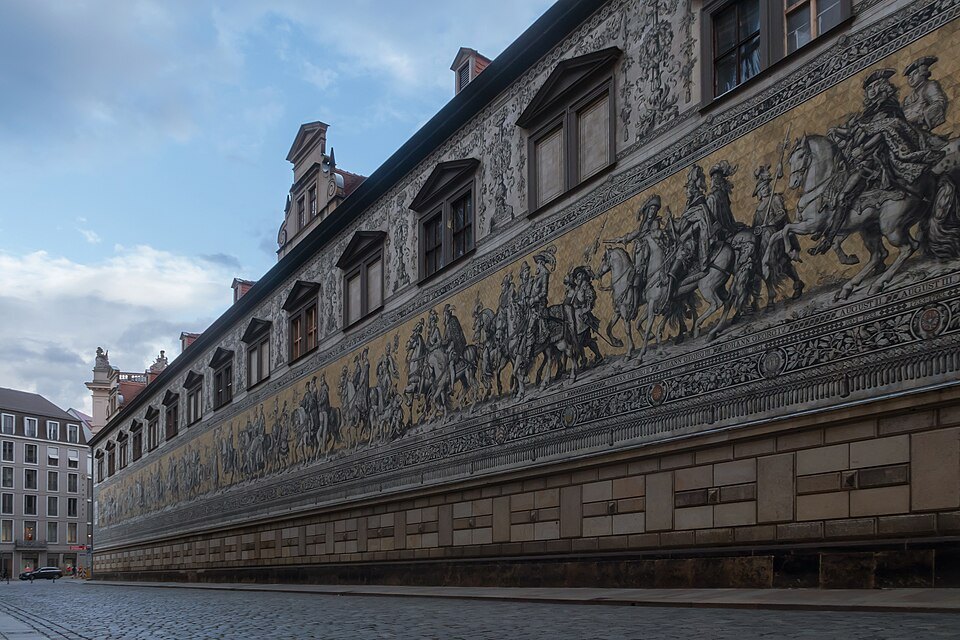
A painted decoration already covered this wall by 1589, but it had weathered away by the nineteenth century. In 1865 the history painter Wilhelm Walther proposed a festive procession of the Saxon rulers, timed for the 800th anniversary of the Wettin dynasty in 1889. He drew the design full size in charcoal and then carried it out as sgraffito, a technique of scratching through layers of plaster, finishing in July 1876.
The black-and-white frieze was admired but could not stand the weather, and by 1901 Walther was repairing serious damage. Between 1904 and 1907 it was replaced with porcelain tiles made by a new process: pressed, fired, ground to size, painted from Walther's original cartoons and fired again. Ten painters and many assistants worked on the tiles from November 1904 to March 1906.
Every tile was marked on the back with letters and numbers so it could go into exactly the right place. Fixing began in April 1907 and was finished in August. King George died while the work was under way; his successor, Frederick Augustus III, agreed that the picture, already historic, should stay as it was rather than be extended to include him.
03Through the fire of 1945
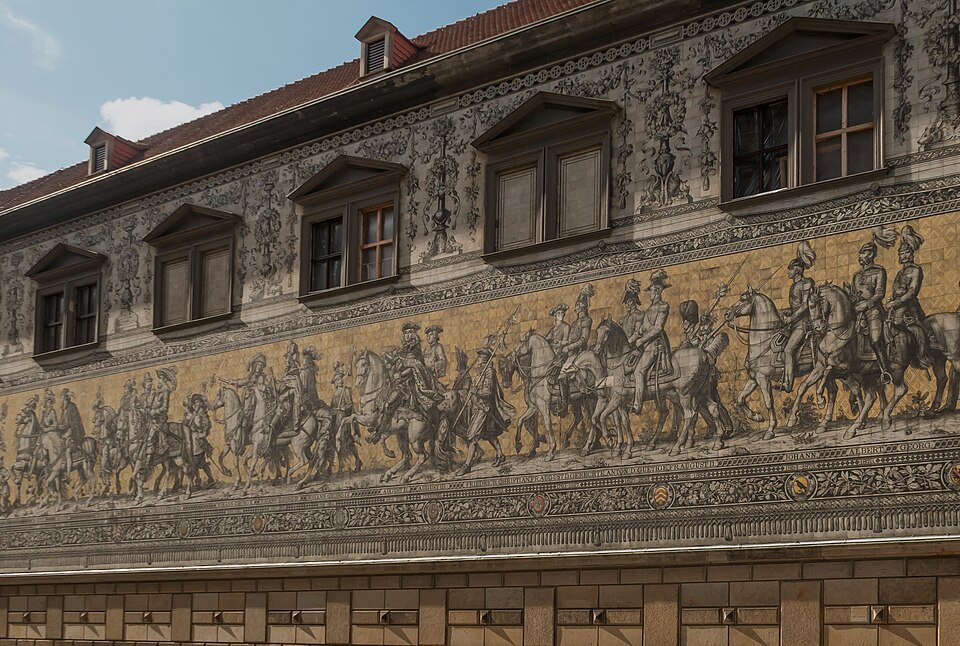
In the air raids of February 1945 the porcelain withstood the heat of the fires largely undamaged, while the buildings around it burned. That is why the wall looks older than the rebuilt streets nearby: it is the original work of 1907, not a reconstruction.
It was cleaned and restored in 1978 and 1979, when 212 tiles destroyed in the war were replaced and another 442 less damaged tiles were renewed. A sandstone inscription at the left end of the wall records the completion of that restoration in 1979.
04How to read it
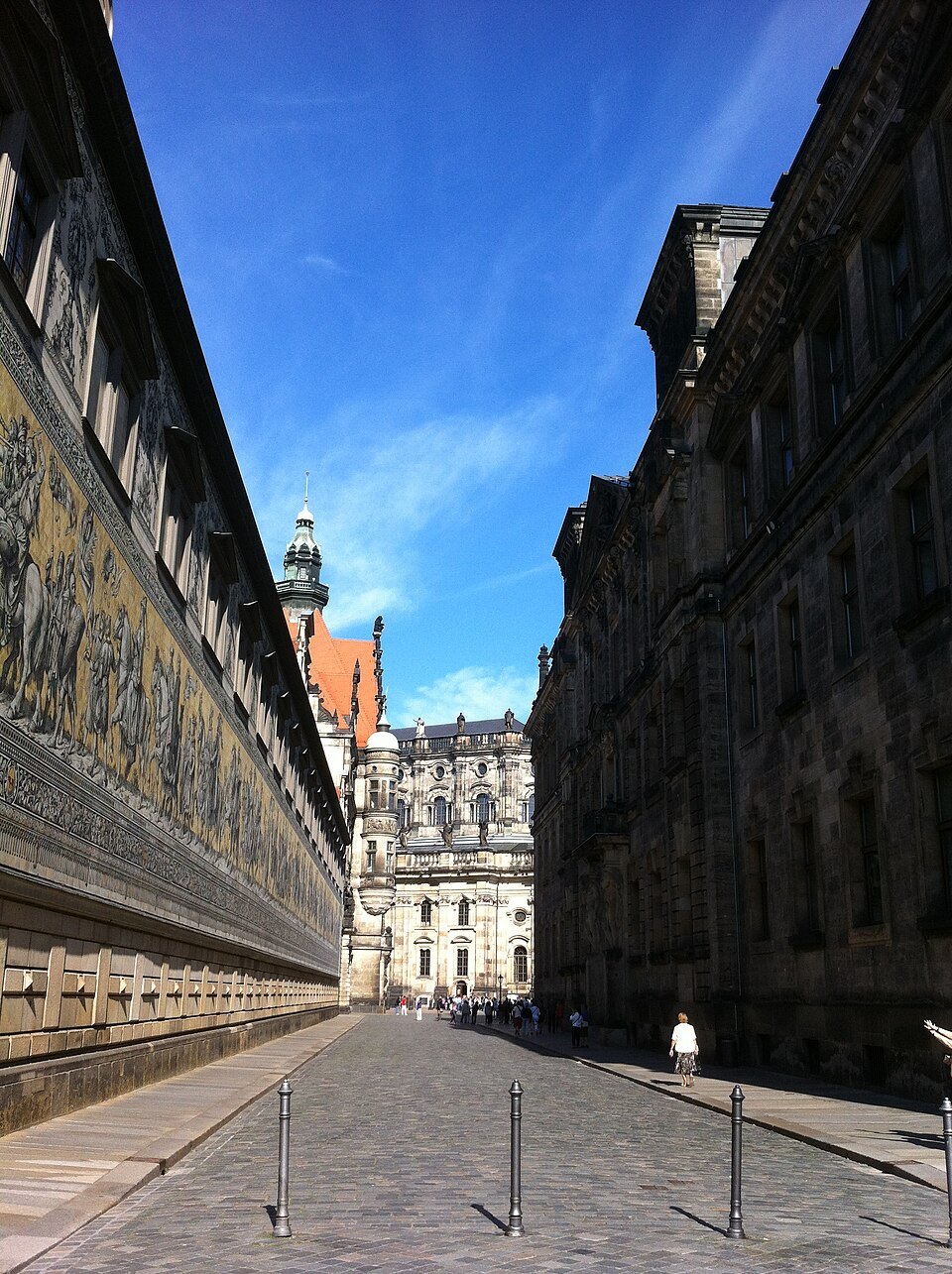
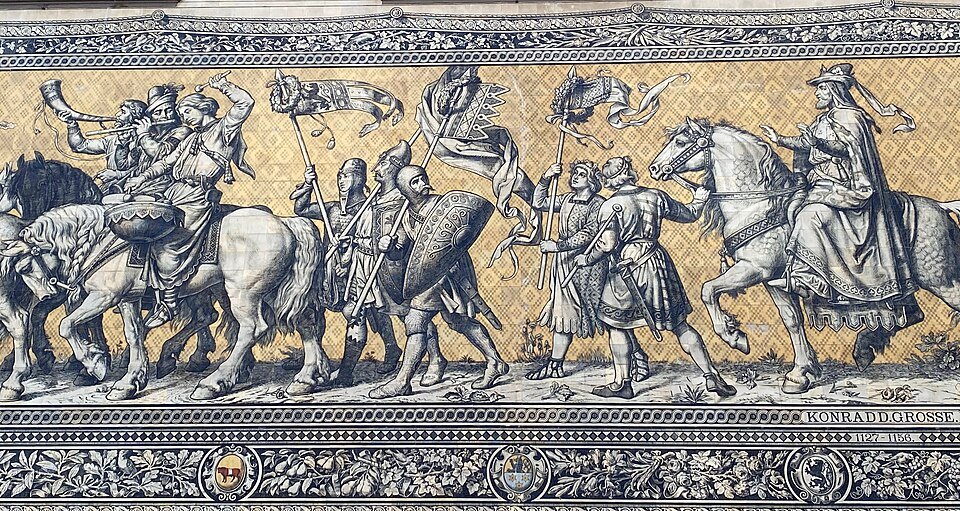
The procession moves from left to right as you face the wall. A herald on horseback opens it, half turned toward the riders behind him, followed by fanfare players, a drummer and banner bearers. Then come the rulers in order of reign, each with his name and years beneath him, from Conrad the Great, margrave from 1127, to King Albert, who was still reigning when the frieze was designed, so only the year he took the throne is given.
Behind Albert rides his brother George, added in advance while still a prince, so he has no dates. Two rulers are missing: Henry I of Eilenburg, from around 1089, and the last king, Frederick Augustus III. Everyone wears the dress of his own century, so armor, hats and weapons change as the line moves on; the first firearm, a wheel-lock pistol, hangs from the saddle of John George I.
Walther filled the wall with small clues. Henry the Illustrious carries a cittern on his back, a nod to the age of the minnesingers. Under a hind hoof of Augustus the Strong's horse lies a trampled rose, probably a discreet allusion to the fate of Countess Constantia von Cosel. The only figure shown speaking is the charcoal burner Georg Schmidt, who rescued the kidnapped Prince Albert; he walks behind Duke Albert.
05The crowd at the end
The last stretch is where the procession stops being about princes. First ride soldiers for the five branches of the Saxon army: grenadier, gunner, uhlan, guard cavalryman and rifleman. Then comes a crowd on foot, among them a pupil of the Kreuzschule, who is Walther's own son, a student of Leipzig University, a student of the Dresden technical college and the architect Hermann Nicolai.
Next walk the painters Carl Gottlieb Peschel and Julius Hübner, Walther's teacher, who passed the commission on to him and is shown holding the design; the sculptors Johannes Schilling and Ernst Hähnel; and the painter Ludwig Richter, beside a group of children in his own style. The girl in the middle of that group is the only female figure in the whole procession.
Behind them come a librarian and scholar, the ministry official who championed the project, a Saxon miner and a Saxon farmer, two of Walther's workmen, a carpenter and a mason, and finally, last of all, Wilhelm Walther himself. In total there are 94 people, 45 on horseback and 49 on foot, plus two greyhounds; sixteen of them look straight out at the viewer.
06Seeing it well
Allow twenty minutes to walk the length slowly, and longer to hunt for details. Start on the far side of Augustusstraße to take in the whole frieze, then walk close along the wall. The picture is framed as a hanging tapestry, held at the top by 38 painted buttons and trimmed below with tassels, and its border hides 45 birds and nine butterflies among the leaves.
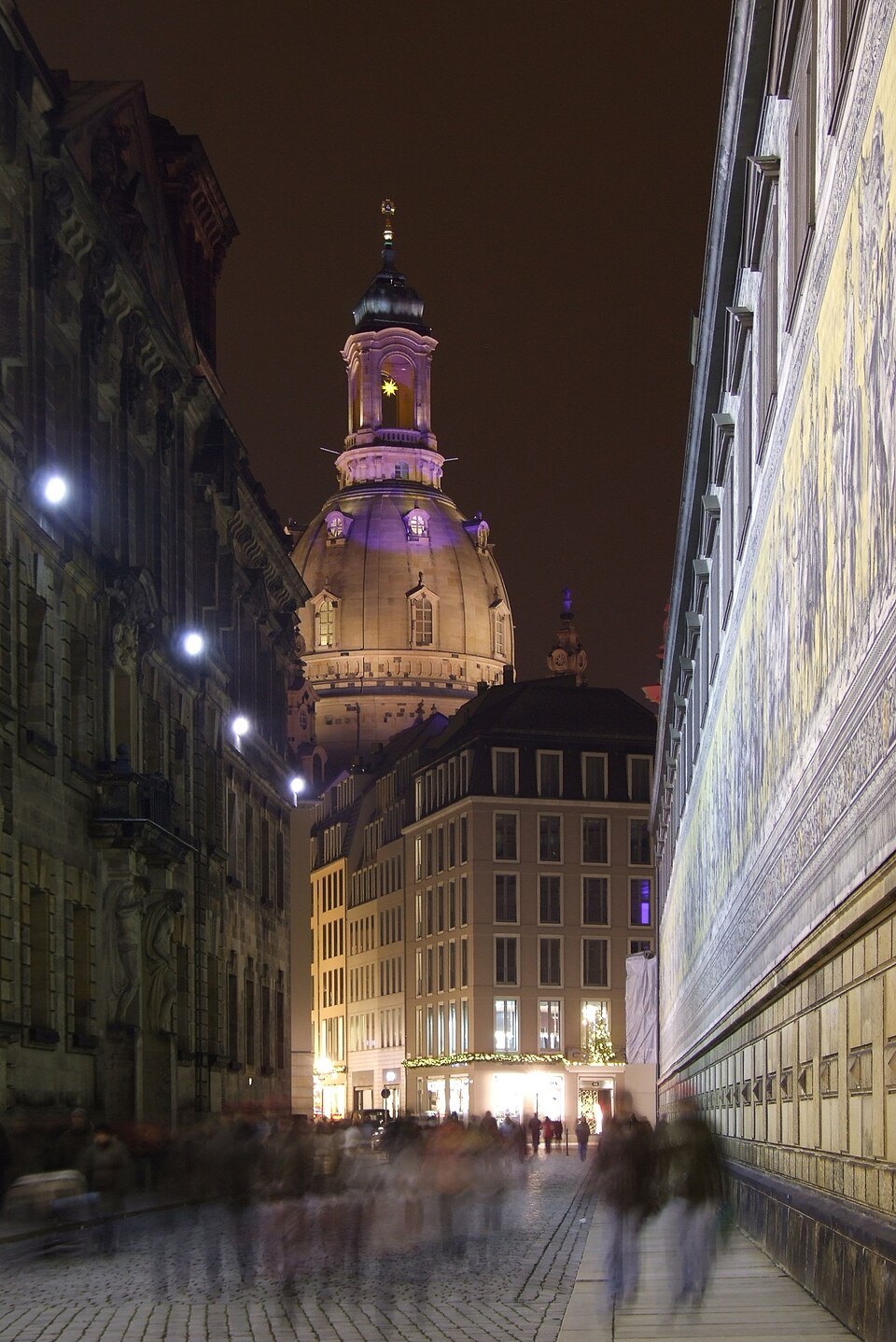
Guided city walks through the Altstadt include it, so groups often gather in front of the wall. It sits on the natural route between the palace and the Neumarkt: the Frauenkirche is a short walk from one end, and the Schlossplatz at the other end leads to the steps of Brühl’s Terrace and the Hofkirche.
Behind the wall, the Stallhof itself, once used for tournaments on horseback, is now a venue for cultural events and a medieval-style Christmas market in winter; see when to come for the season. For a longer route through this part of the city, see itineraries.