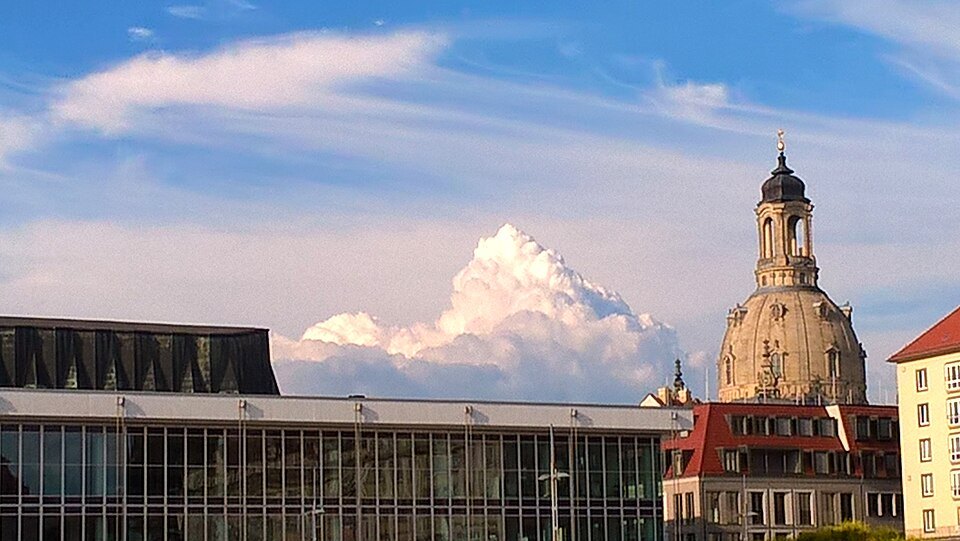
- 1726–1743builtGeorge Bähr's stone bell
- 1945lostcollapsed two days after the raid
- 1994–2005rebuiltabout 45% historic stone
- 01The church at the center of the city
- 02A citizens' church and its stone bell
- 03Collapse, ruin and the call to rebuild
- 04Read the dark stones
- 05Inside: the scarred altar and the painted dome
- 06Visiting and the climb to the lantern
01The church at the center of the city
The Frauenkirche, the Church of Our Lady, rises over the Neumarkt in the Altstadt. It is a Lutheran church, but not a cathedral and not a parish with its own congregation: it describes itself as an open church for Dresden's people and its visitors, with daily devotions, Sunday services and a heavy calendar of concerts.
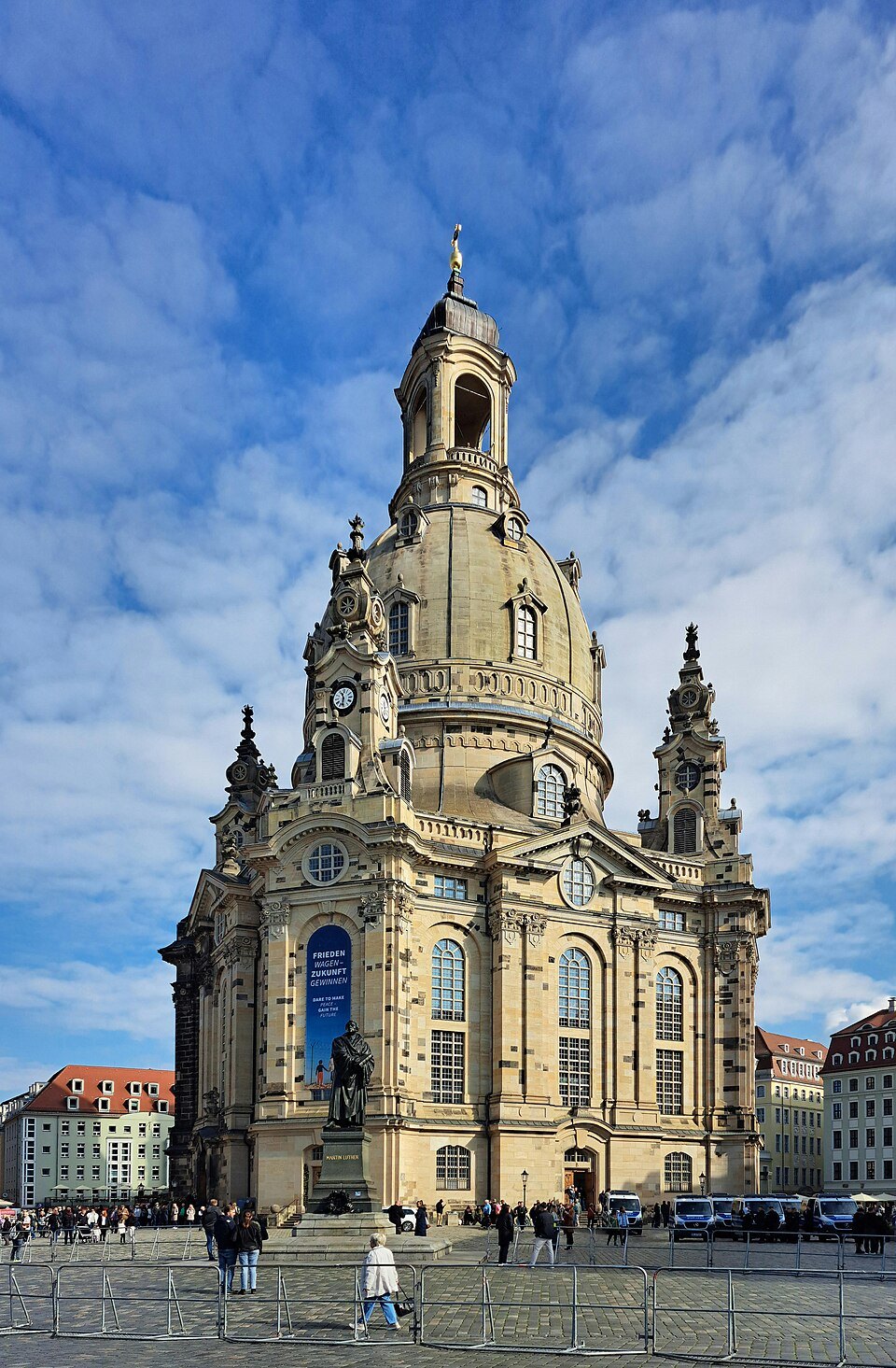
For a first-time visitor it is the key to the whole city. Its dome defined the skyline painted by Bernardo Bellotto in the eighteenth century, its ruin stood for the destruction of 1945, and its rebuilding, funded largely by private donations from many countries, became a symbol of reconciliation between former enemies. See the rebuilt city for the wider story.
02A citizens' church and its stone bell
A church dedicated to Our Lady stood here from the Middle Ages, outside the old town walls in a graveyard. In the 1720s the city council replaced it with something far larger, designed by the city's master carpenter George Bähr. The foundation stone was laid on 26 August 1726, and the cross went onto the lantern in May 1743. Bähr had died in 1738 and never saw it finished.
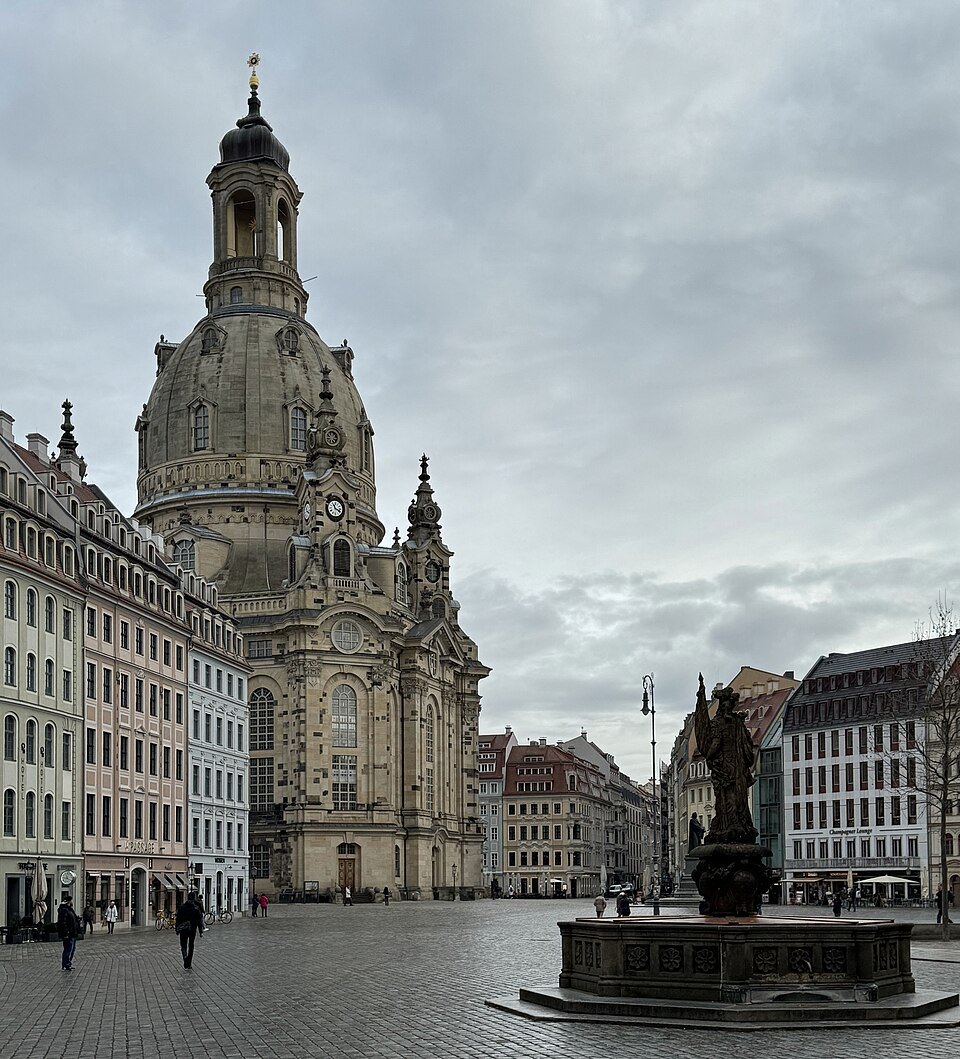
The timing mattered. Augustus the Strong had converted to Catholicism to become King of Poland, yet he backed this Lutheran church, a reassurance to a Protestant city. Bähr placed altar, pulpit and font in full view of the whole congregation, and topped the building with a dome built entirely of sandstone, which the church calls the steinerne Glocke, the stone bell.
In 1736 Gottfried Silbermann built an organ for the church, and Johann Sebastian Bach gave a recital on it that December. During the Seven Years' War, witnesses said Prussian cannonballs bounced off the dome. The composer Heinrich Schütz had been buried in the porch of the older church, and Bähr himself was buried at his new one.
03Collapse, ruin and the call to rebuild
The church survived the first nights of the bombing that began on 13 February 1945. About three hundred people who had sheltered in its crypt got out. Then, on the morning of 15 February, the eight inner pillars, weakened by the heat of the firestorm, gave way and the dome came down, leaving only fragments of the choir and one corner tower standing.
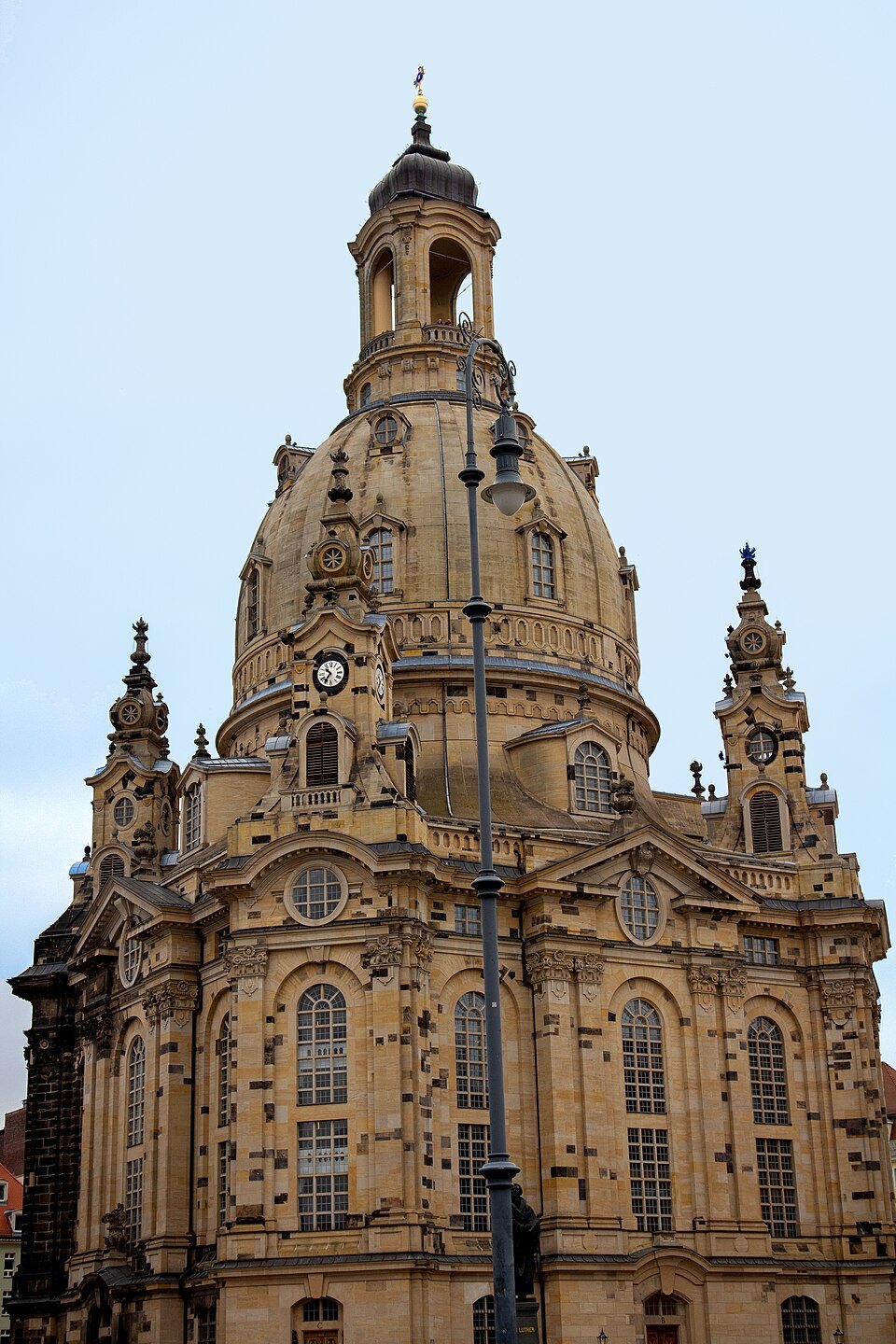
For nearly fifty years the heap of rubble lay in the middle of the city. East Germany declared it a memorial against war in 1966. In 1982 Dresden Christians called for a silent commemoration at the ruin on the anniversary of the raid, and people came with candles and flowers; the gatherings grew through the 1980s.
In February 1990 a group of citizens published the Ruf aus Dresden, an appeal for a faithful rebuilding paid for by donations from around the world. The rubble was cleared and every fragment measured and catalogued from 1993, the first stone was laid on 27 May 1994, and the church was consecrated again on 30 October 2005.
04Read the dark stones
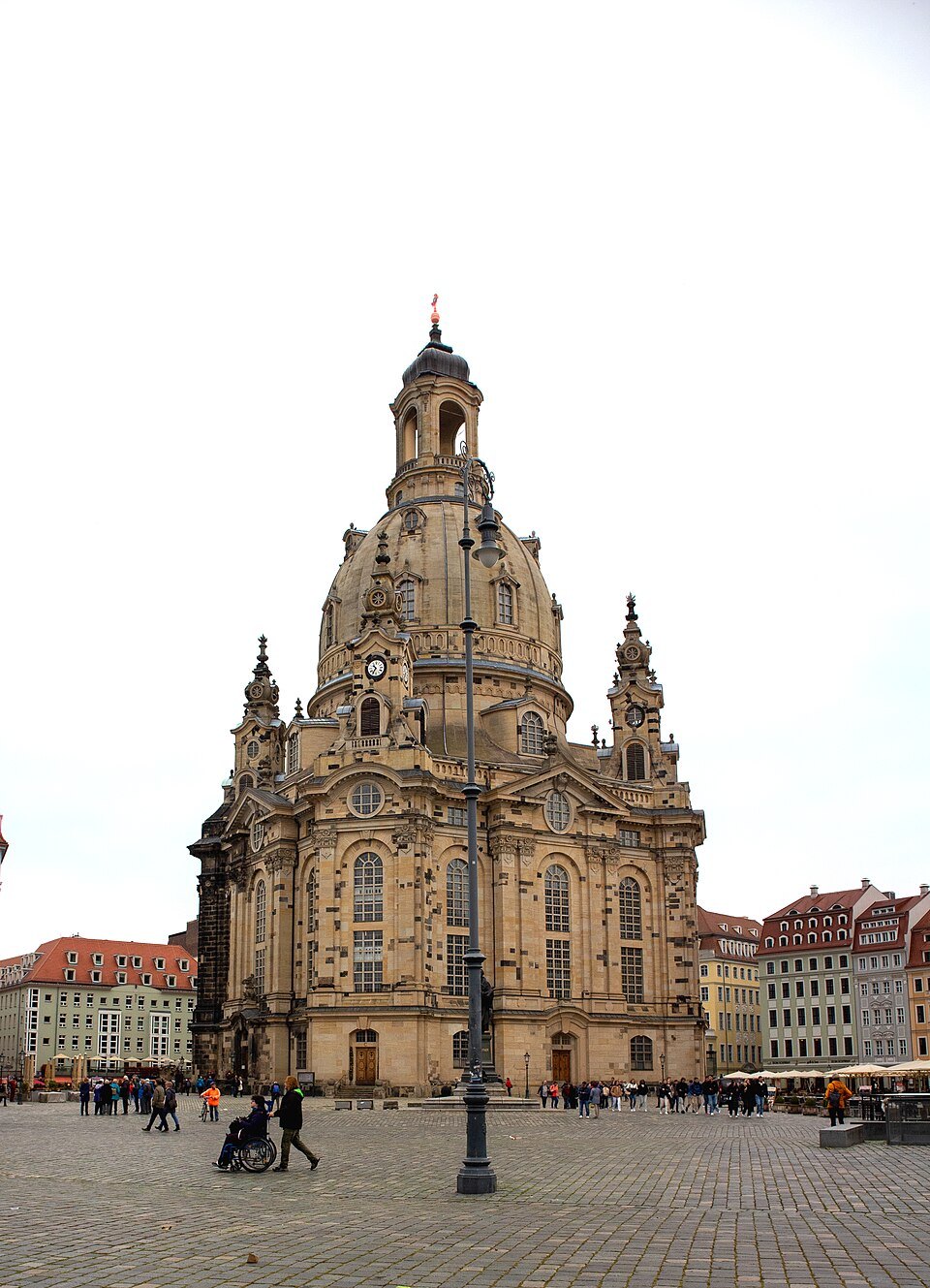
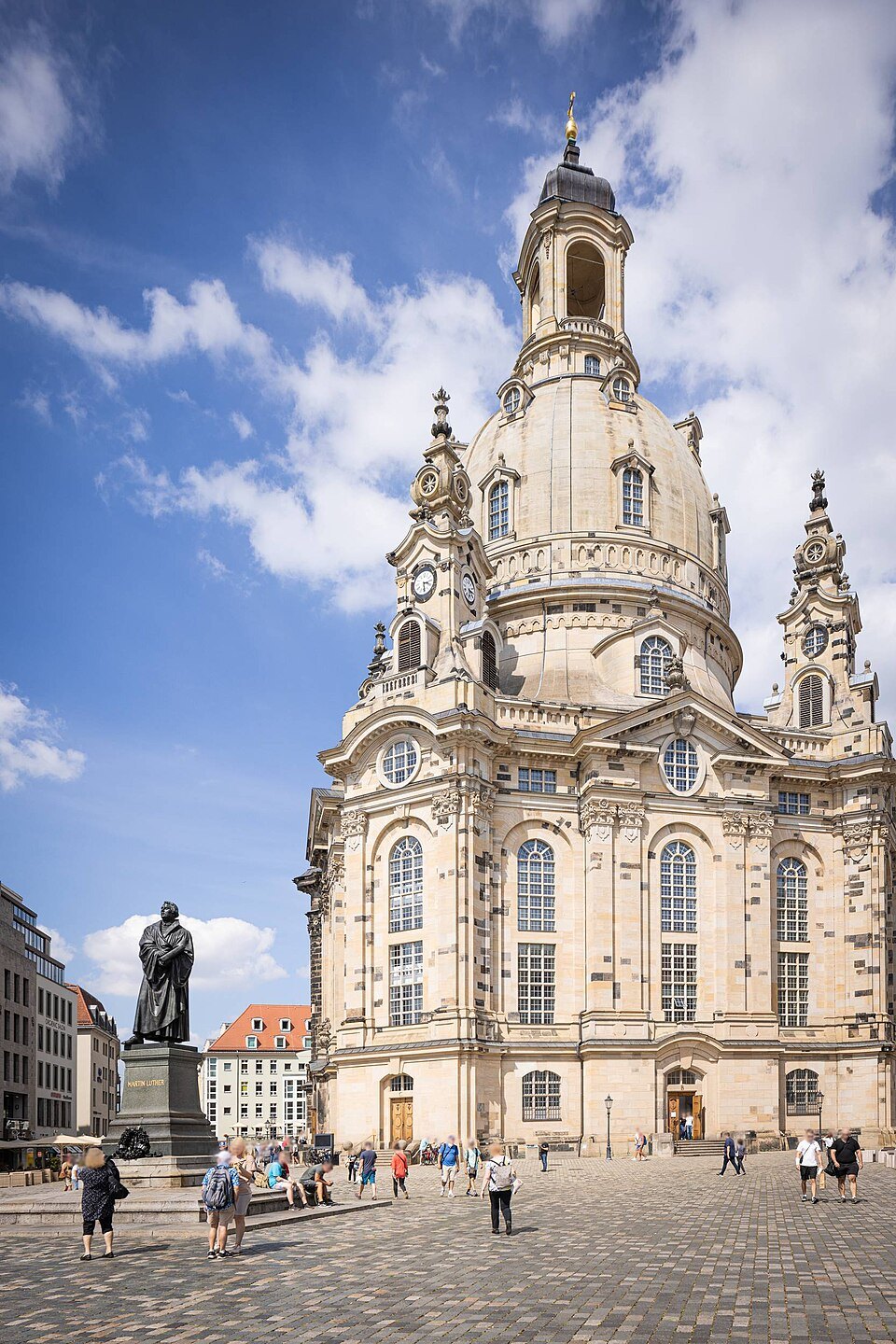
Look at the walls before going in. The blackened blocks scattered through the pale new sandstone are stones of the old church, recovered from the rubble and set back as close as possible to where they came from. The dark color is a natural patina of iron in the sandstone; the new stone will darken too, until the difference fades.
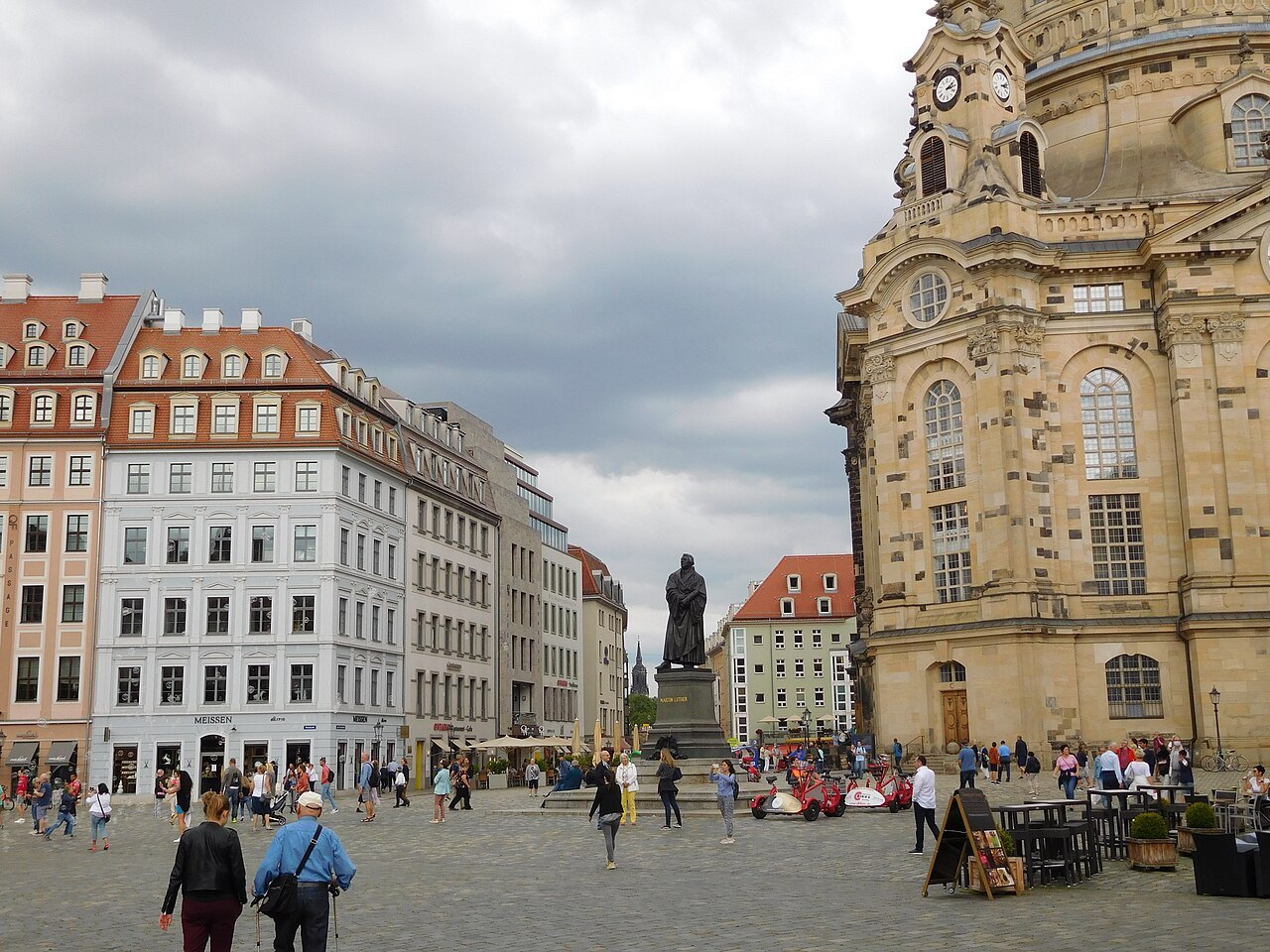
The church counts about 45 percent historic stone in the building as a whole, including the lower church and the ruin fragments that were built into the new walls, and 8,425 old blocks reused, 7,110 of them in the facade. The dome itself is entirely new stone. In front of the church stands the bronze statue of Martin Luther by Adolf von Donndorf, from 1885. It was badly damaged in 1945 and has been restored to its place.
05Inside: the scarred altar and the painted dome
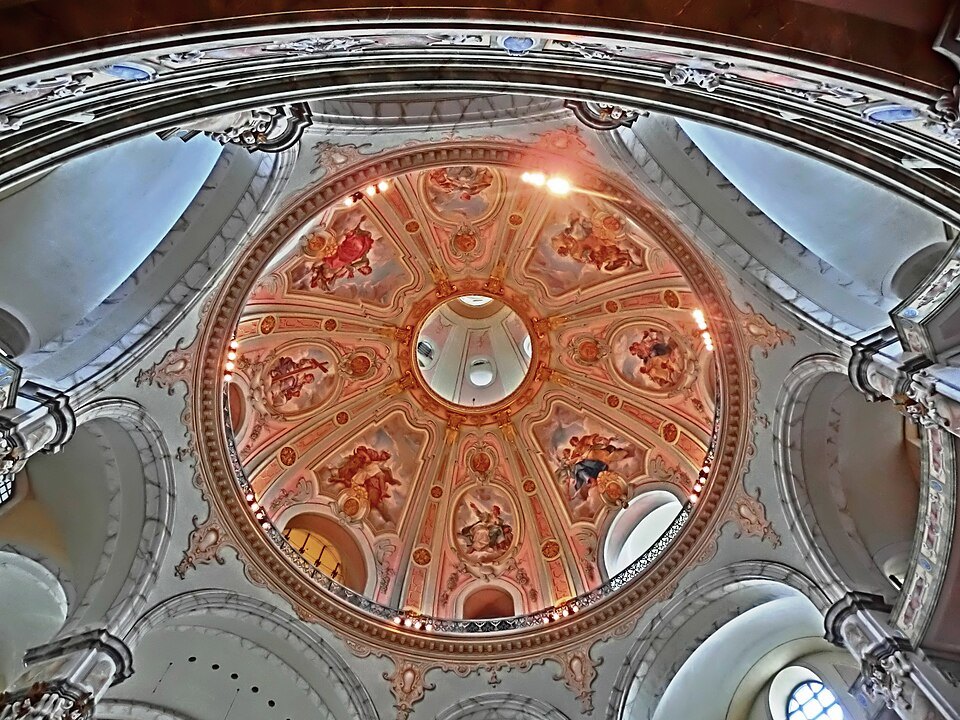
The interior is pale and luminous, with galleries in tiers around eight pillars and the inner dome painted with eight scenes, the four Evangelists and four virtues, reconstructed after the originals by Giovanni Battista Grone. Above the altar rises the organ, a new instrument by the Strasbourg builder Daniel Kern with 68 stops, completed in 2005 in place of the lost Silbermann.
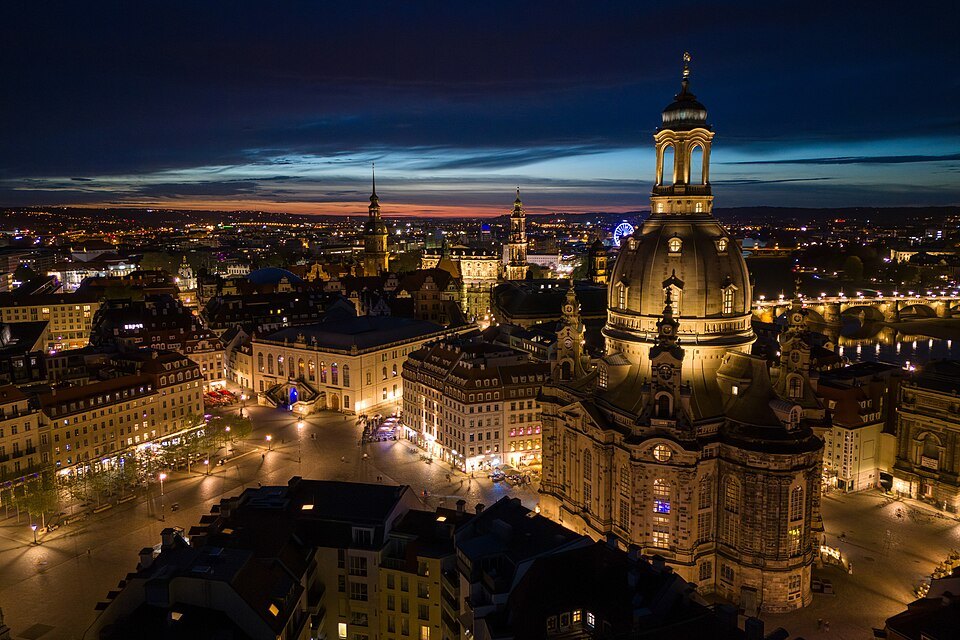
The altar by Johann Christian Feige shows Christ on the Mount of Olives. It was partly protected in 1945 when debris from the shattered organ fell on it, and it was rebuilt from 1,642 fragments, around 80 percent original material, with its damage deliberately left visible. On it stands the cross of nails from Coventry, given as a sign of reconciliation.
The old tower cross was found, twisted and charred, in the rubble in 1993 and is kept inside the church. The new gilded cross on the lantern was paid for by donations from Britain and made by a London goldsmith whose father had flown in the raids on Dresden. Below the main church, the lower church holds an altar stone of black Irish limestone by Anish Kapoor.
06Visiting and the climb to the lantern
The church can be visited free of charge as an open church when there is no service, concert, rehearsal or wedding, and those interruptions are frequent, so check its calendar before planning a day around it. Allow half an hour for the interior; a concert or an organ devotion is the best way to hear the space.
Note The climb to the lantern is separate and ticketed, starting from its own entrance. Stairs in a corner tower lead up about 29 meters, with windows looking into the church; narrow steps then reach a stepless ramp that winds two and a half times around the dome at a steep gradient, followed by two more flights, one of them a steep ladder-like stair. The platform is 67 meters up. The church warns that these historic spaces do not meet modern building standards and asks climbers to take particular care.
The view runs over the rooftops of the Altstadt and across the river to the Neustadt. Combine the church with the Fürstenzug and the Brühl's Terrace, both a few minutes' walk away. Each year on 23 December a Christmas vespers is sung in the open air in front of the church, a tradition that began in 1993 before the altar freshly recovered from the rubble.