- No. 1the Historic Green Vaulttime-slot tickets, no photography
- No. 2the New Green Vaultthe Dresden Green Diamond
- No. 3the Turkish Chambera silk tent twenty meters long
- No. 4the Riesensaalarmor in the Giants' Hall
- 01The palace and its treasure houses
- 02From castle to royal palace
- 03The Historic Green Vault
- 04The New Green Vault
- 05Armor, silks and state rooms
- 06Around the outside
01The palace and its treasure houses
The Residenzschloss, the Royal Palace, was home to the electors (1547–1806) and kings (1806–1918) of Saxony from the Albertine line of the House of Wettin for almost four hundred years. It is one of the oldest buildings in Dresden, and its courtyards and fronts carry every style from the Middle Ages to the neo-Renaissance.
Today it is a museum complex of the Dresden State Art Collections. Inside are the Historic Green Vault and the New Green Vault, together the largest treasure collection in Europe, the Armoury with its Turkish Chamber, the Coin Cabinet, the Cabinet of Prints, Drawings and Photographs, and the rebuilt state apartments of Augustus the Strong.
02From castle to royal palace
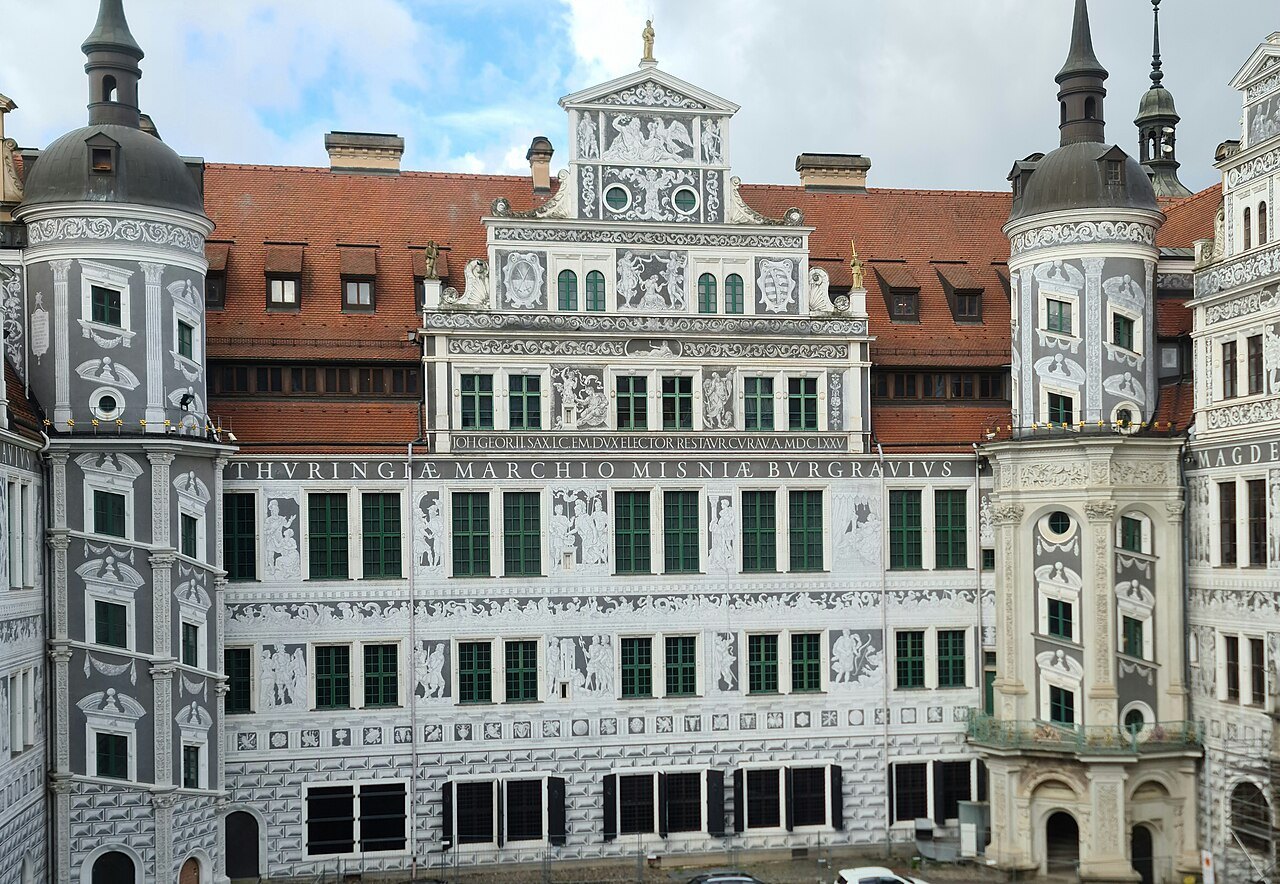
A castle stood here by the early thirteenth century. Around 1400 the Hausmannsturm tower was begun, and between 1468 and 1480 the complex became a closed four-wing building. When Duke Moritz became elector in 1547, he doubled the great courtyard to the west in Renaissance style; a painted inscription band around the courtyard still names him with all his titles.
After a fire in 1701, Augustus the Strong rebuilt much of the palace in baroque style, finishing the state apartments for his son's wedding in 1719 and creating the Green Vault between 1723 and 1729. The tower had already been raised in the 1670s to just over a hundred meters, the tallest in Dresden until 1945. For the 800th anniversary of the Wettin dynasty, the palace was remodeled again between 1889 and 1901 in neo-Renaissance style.
On 13 February 1945 the palace burned down to its outer walls, and three of the Green Vault's rooms were destroyed. The treasures had been moved to safety; the Red Army then took them to the Soviet Union, and they came back in 1958. Work began slowly in the 1960s, rebuilding for the museums has run since 1986, and the tower regained its spire in 1991.
03The Historic Green Vault
The name comes from the malachite-green column bases and capitals of four vaulted rooms built for Moritz in the sixteenth century, a fireproof strongroom for documents and jewels. Augustus the Strong turned it into a sequence of treasure chambers designed by Pöppelmann and opened it to visitors. Rebuilt on the ground floor of the west wing and reopened in 2006, it shows some 3,000 objects as they stood in 1733, freely placed on consoles in front of mirrored walls, without glass cases.
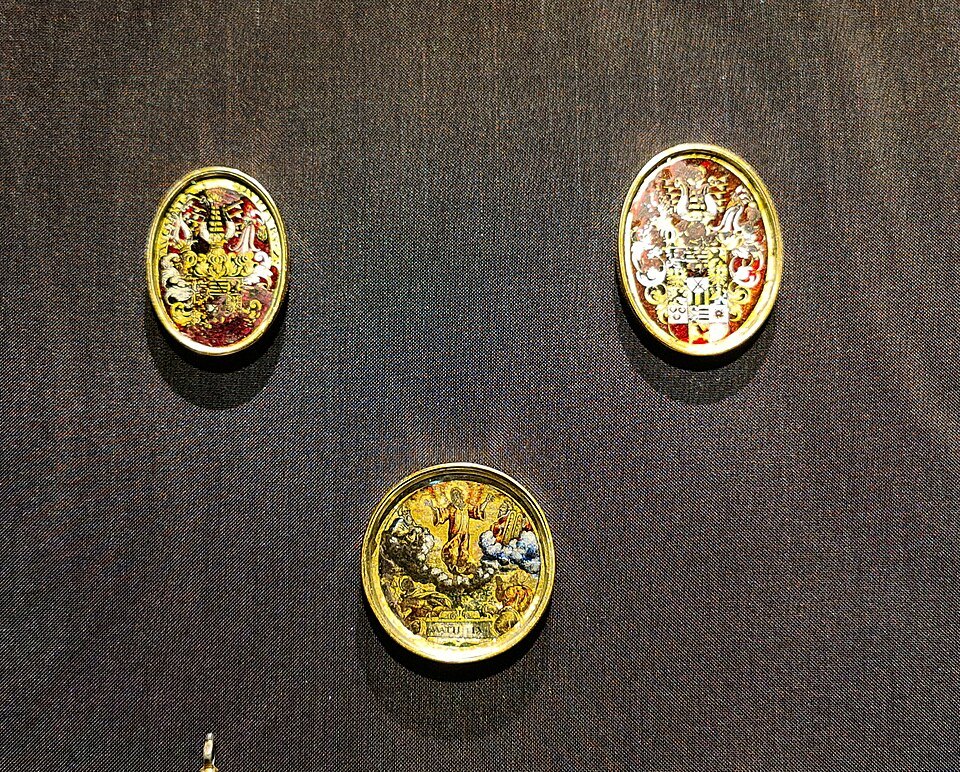
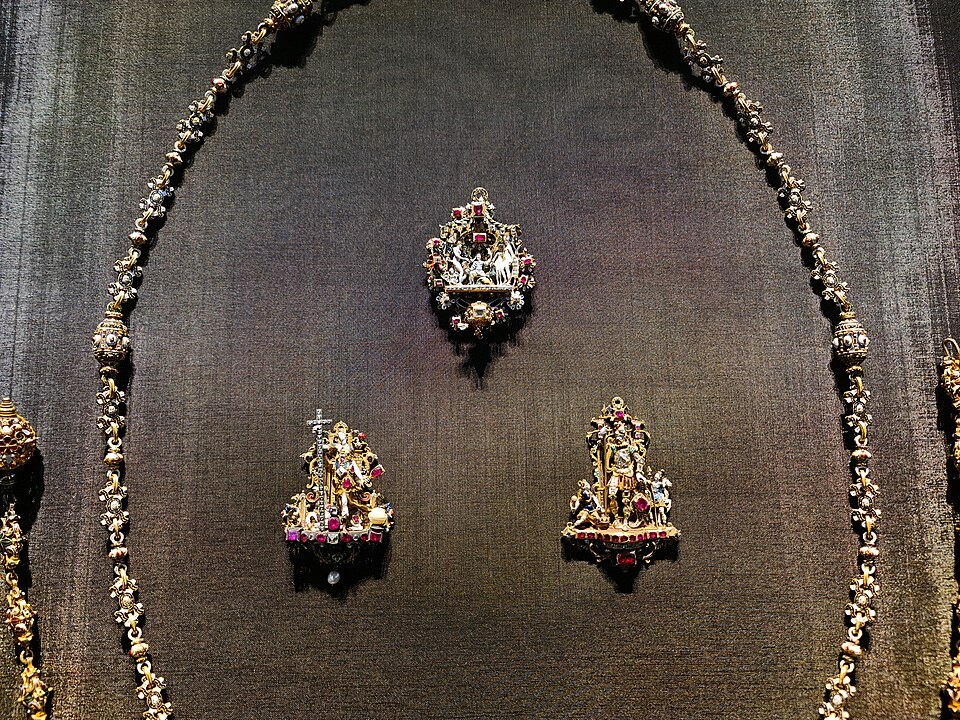
The rooms are arranged by material: the Amber Cabinet, the Ivory Room, the White Silver and Silver-Gilt Rooms, and the Hall of Treasures, almost entirely mirrored. In the Jewel Room stands the Moor with Emerald Cluster by the court goldsmith Johann Melchior Dinglinger and Permoser, probably of 1724, presenting Colombian emeralds given to the Saxon elector in 1581; nearby rises the Obeliscus Augustalis, over two meters tall and set with some 240 cut stones and figures.
Note Entry is by time-slot tickets bought in advance, with a limited number sold on the day, and photography is not permitted in the Historic Green Vault. Coats and bags go into the cloakroom or lockers. In November 2019 thieves broke into the Jewel Room and took pieces from the jewel garnitures; police recovered 31 objects in December 2022, but not the epaulette with the diamond known as the Saxon White, and five men were convicted in 2023.
04The New Green Vault
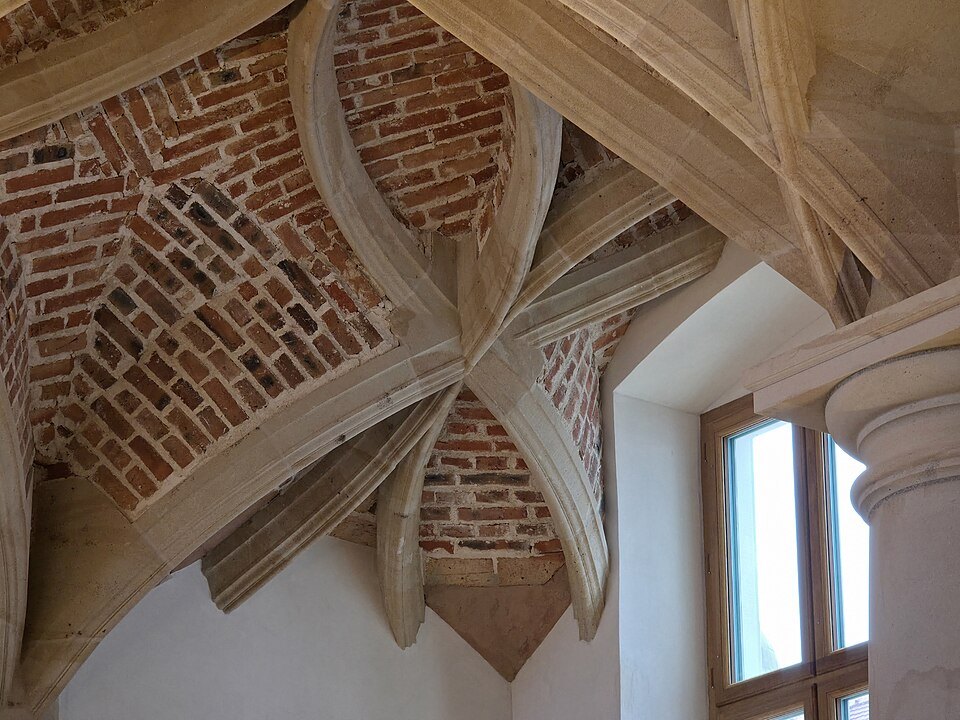
One floor up, the New Green Vault opened in 2004 and does the opposite: some 1,100 objects stand in plain rooms, in about 200 cases under artificial light, so that single pieces can be examined close up. It is not limited by time slots.
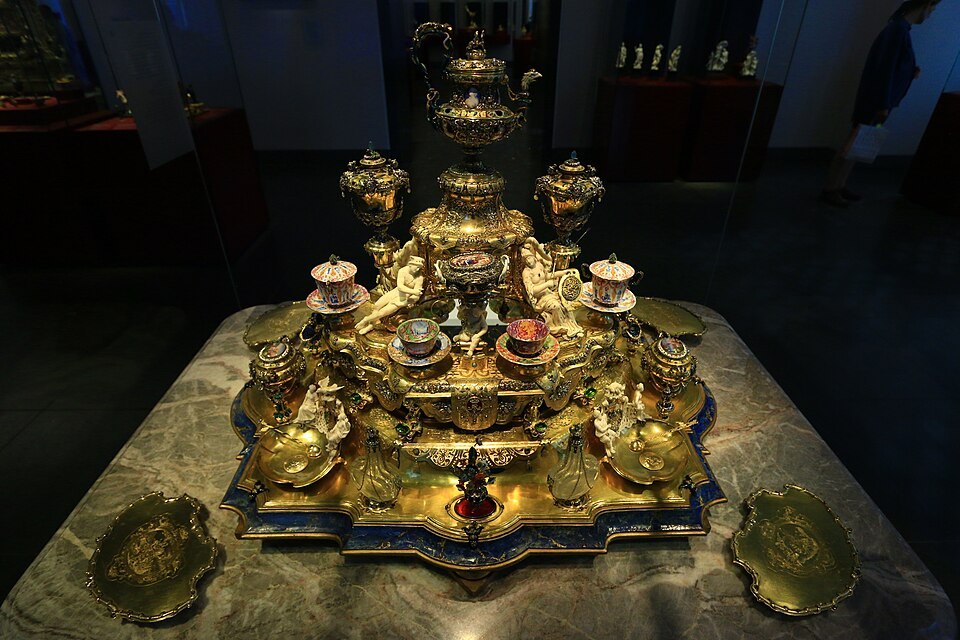
The Dinglinger Hall holds the Court at Delhi on the Birthday of the Great Mogul Aurangzeb, a table centerpiece made between 1701 and 1708 by Dinglinger, his brothers and assistants, with about 137 tiny figures and thousands of diamonds, rubies and emeralds; neither Augustus nor his goldsmith had ever been to India. Nearby are his Golden Coffee Service of 1697 to 1701 and the Bath of Diana, and in the Micro Cabinet a cherry stone carved before 1589 with 185 faces, of which about 113 can actually be made out.
The small Watzdorf Cabinet holds the Dresden Green Diamond, a naturally green stone of 41 carats. Augustus III bought it at the Leipzig fair in 1742, and since 1768 it has been the center of a hat clasp set with two large and 411 smaller diamonds. It was on loan in New York during the 2019 break-in.
05Armor, silks and state rooms
The Riesensaal, the Giants' Hall, is the largest room in the palace, almost sixty meters long and thirteen wide. Since 2013 it has held part of the Armoury, whose parade armor, swords and firearms grew from the arms of the Saxon dukes and electors; look for the parade armor made for King Erik XIV of Sweden. A gallery of the electors' guns fills the Long Passage.
The Turkish Chamber, open since 2010, shows about 600 Ottoman objects from the sixteenth to the nineteenth centuries. At its center is a seventeenth-century tent of silk and gilded leather, twenty meters long, eight wide and six high, which reached Dresden in 1729. Eight life-size horses carved of wood show off opulently decorated saddles and bridles; Augustus even sent members of his court to Constantinople to buy.
The State Apartments, built for the wedding of 1719 and destroyed in 1945, reopened on 28 September 2019, three hundred years after their first opening. The suite runs from the corner state room through two antechambers to the audience chamber and the state bedroom, hung with crimson silk velvet embroidered in gold, with the throne, silver furniture from Augsburg and the coronation robes; the Tower Room shows Meissen porcelain.
06Around the outside
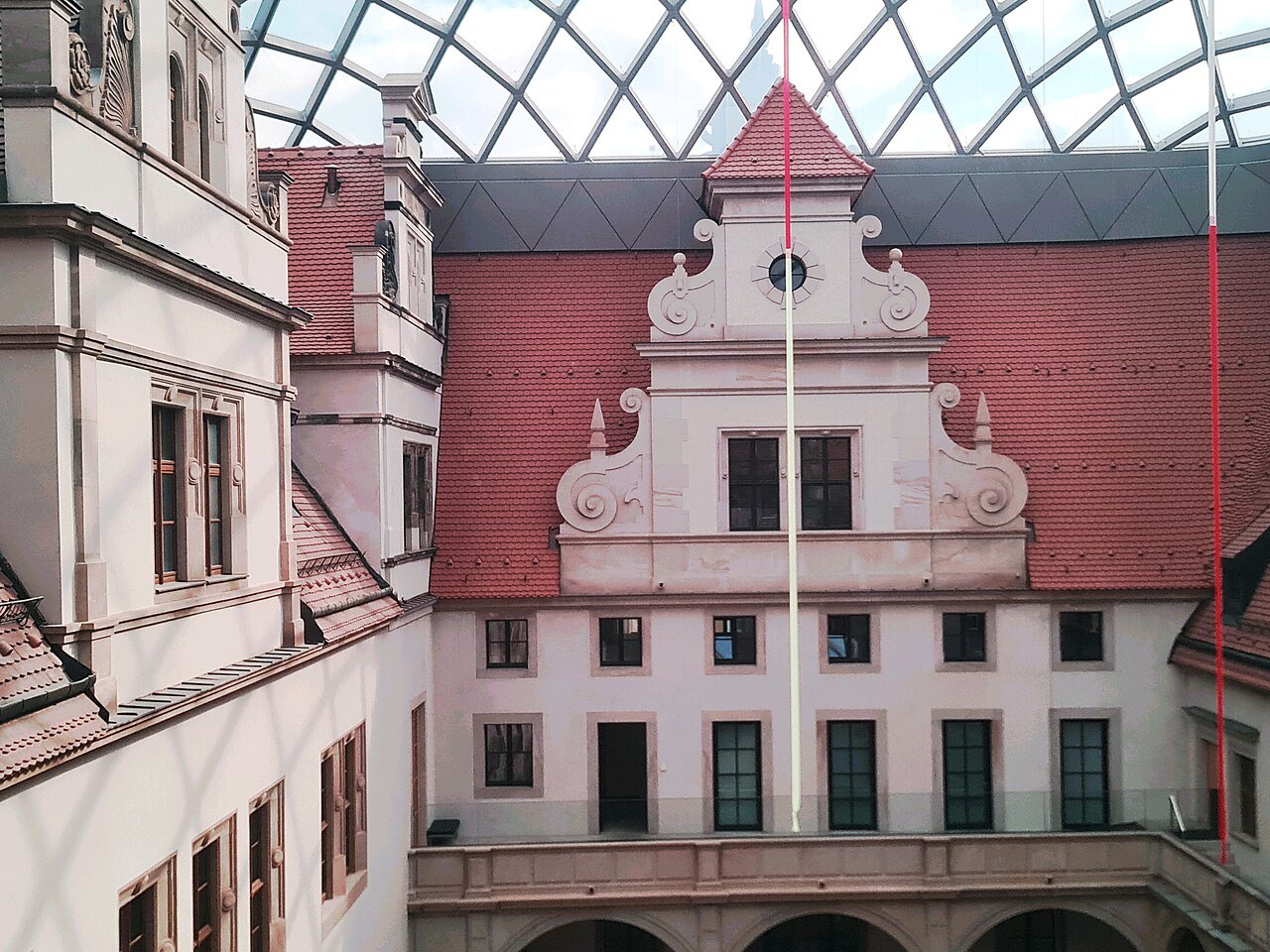
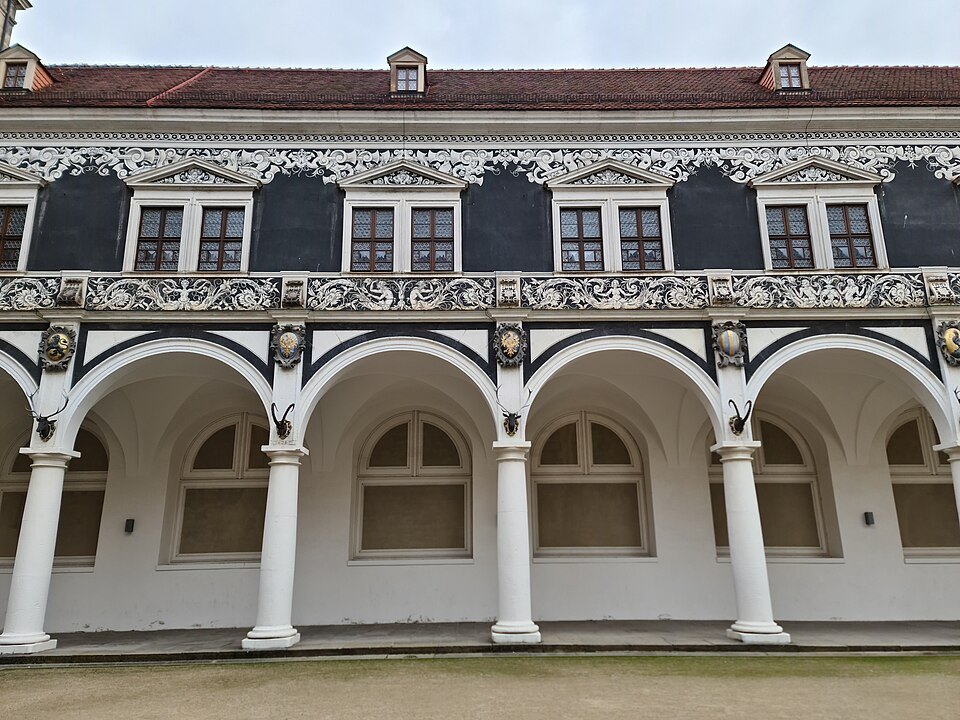
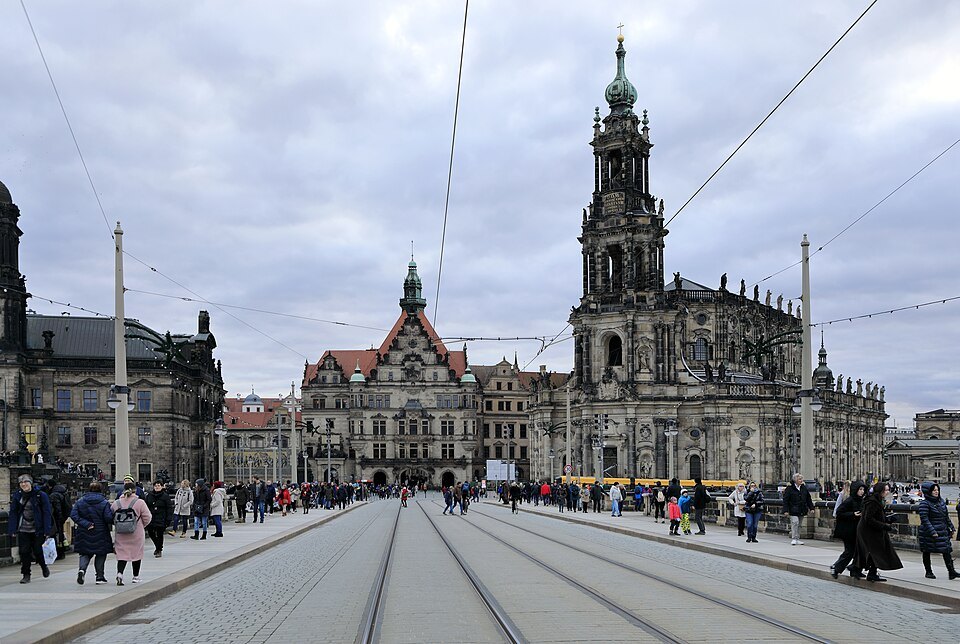
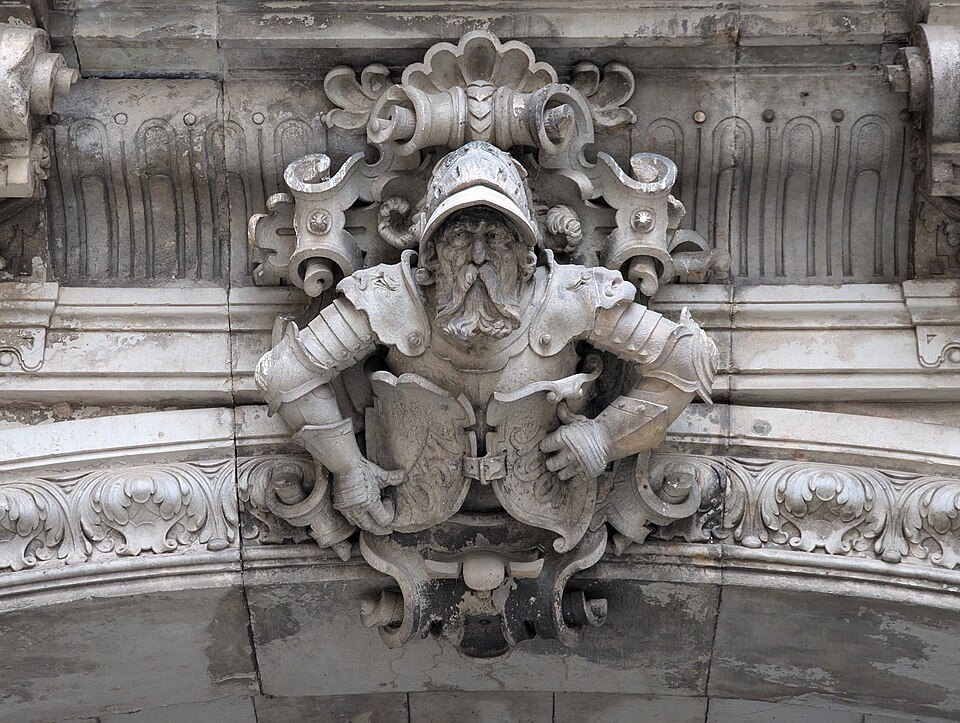
Walk into the Großer Schlosshof, the great courtyard, whose facades are decorated in sgraffito, and look up at the Renaissance loggia with its reconstructed frescoes. The smaller courtyard next to it is covered by a transparent membrane roof designed by Peter Kulka and serves as the visitor foyer.
On the Schlossplatz side, the Georgentor received its present neo-Renaissance front in 1899, and an arch of the old Elbe bridge survives underneath it. A wooden passage of 1899 links the palace with the Hofkirche. Along the outer wall of the Stallhof, on Augustusstraße, runs the Fürstenzug, the procession of Saxon rulers transferred between 1904 and 1907 onto about 23,000 Meissen porcelain tiles.
07Planning a visit
Book the Historic Green Vault first, and build the day around its slot: tickets for the palace's other exhibitions are sold online and at the museum ticket offices. See booking ahead. Allow at least half a day for both Green Vaults, the Armoury and the Turkish Chamber; the state apartments and the Coin Cabinet can easily add another hour.
The palace stands between the Zwinger, across Sophienstraße from its west wing, and the Neumarkt with the Frauenkirche, so it fits into a first day in the Altstadt. The state museums do not all close on the same weekday, so check before you plan — see itineraries.