- 01Augustus in gold
- 02Three decades in the making
- 03Taken down, put back, regilded
- 04What to look at
- 05The square around him
- 06Up the Hauptstraße
01Augustus in gold
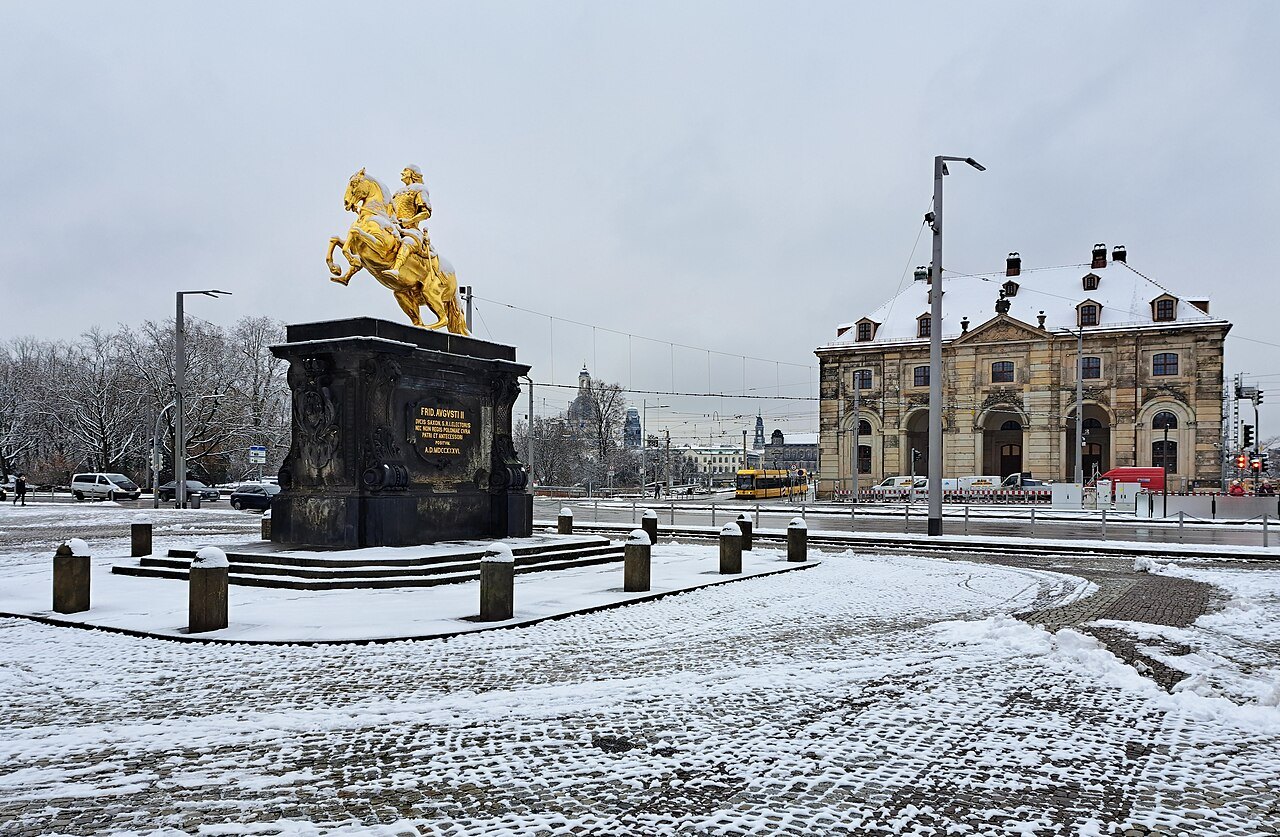
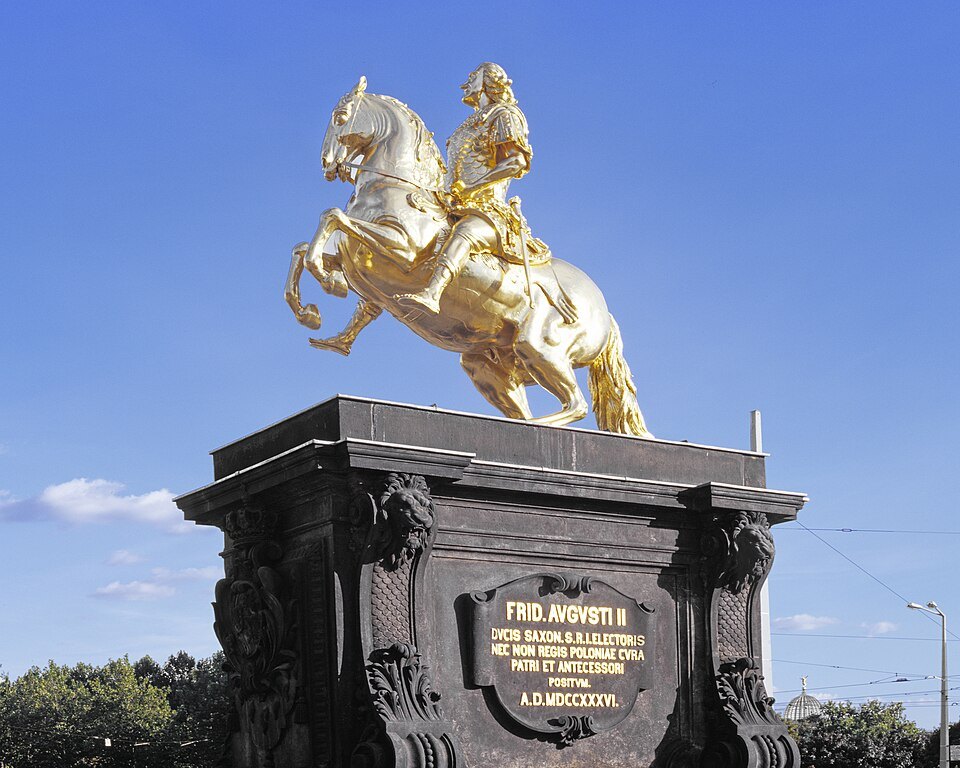
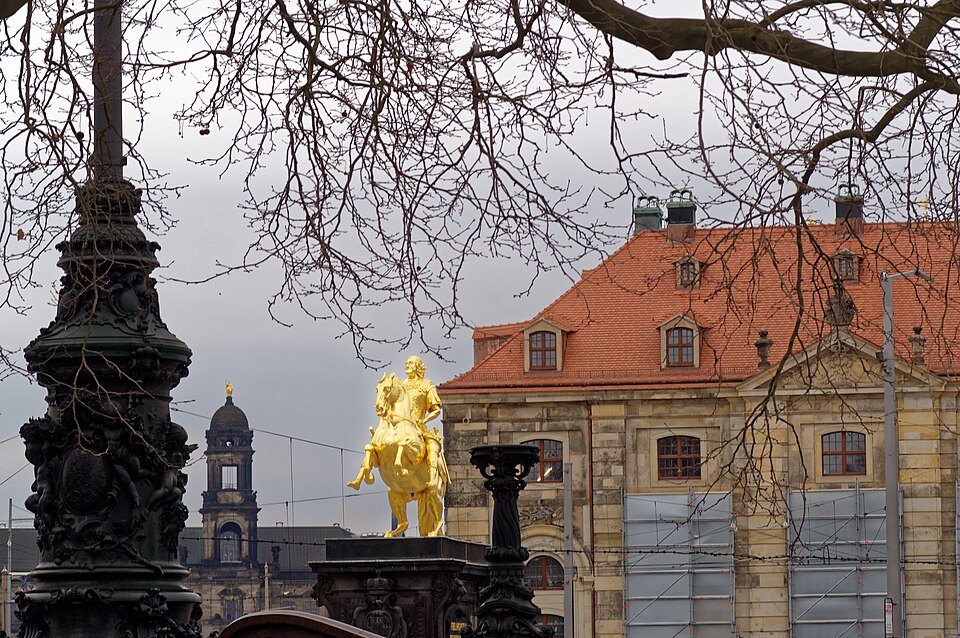
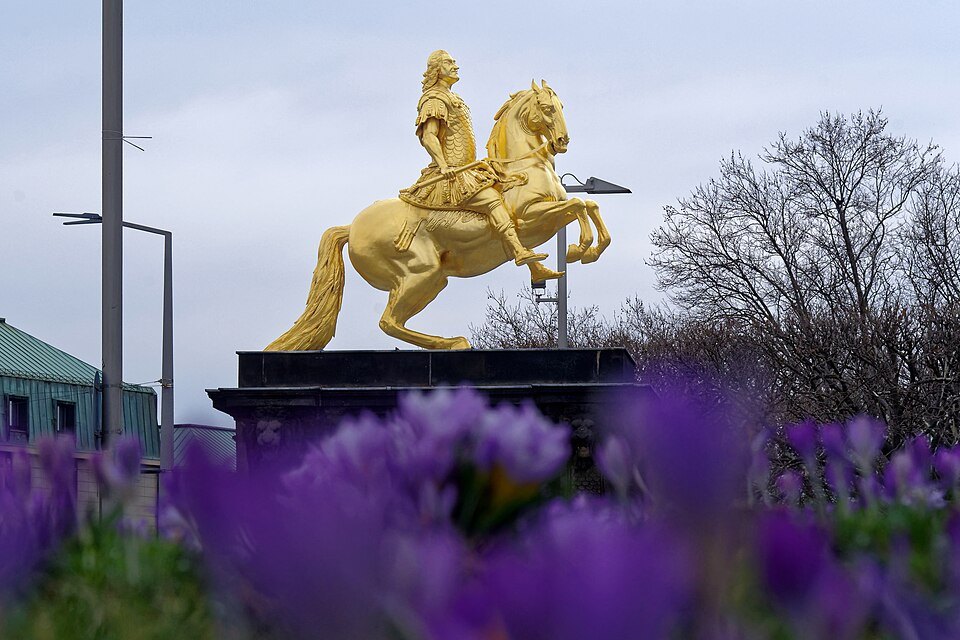
The Goldener Reiter, the Golden Rider, is Dresden's best-known monument: Augustus the Strong (1670–1733), Elector of Saxony and King of Poland, dressed as a Roman emperor in armor on a rearing horse and covered in gold leaf. He stands on the Neustädter Markt, the square at the northern end of the Augustus Bridge, where the road from the Altstadt arrives in the Neustadt.
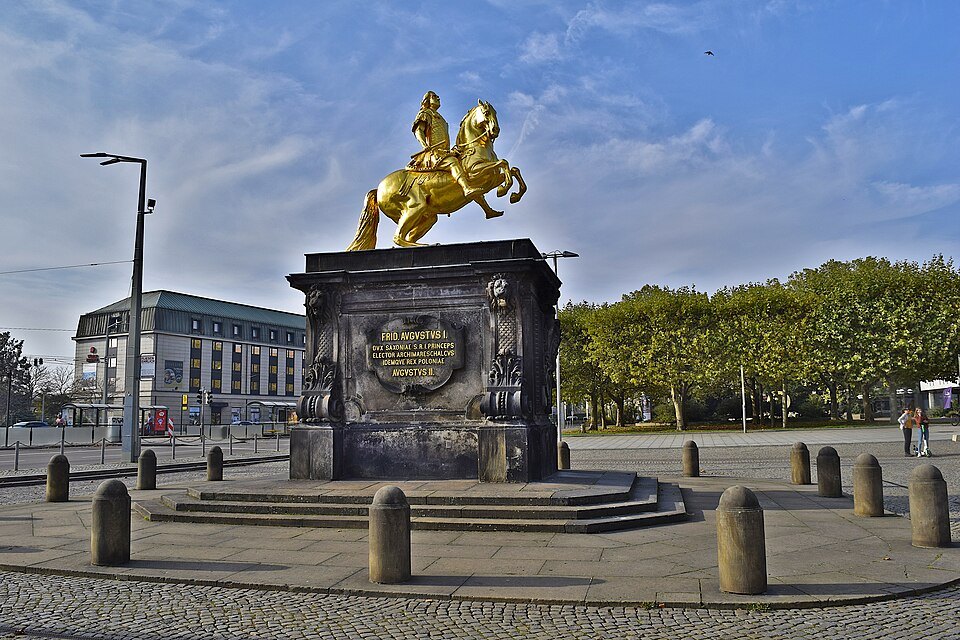
The statue marks the entrance to the Innere Neustadt, the baroque New Town that Augustus had rebuilt after a fire, and it points straight up the long, tree-lined Hauptstraße. It is also a city emblem: a prize of the Dresden film festival is named after it, and Dresden's bakers print it on their quality seal for Christmas stollen.
02Three decades in the making
Augustus wanted an equestrian statue of himself early. In 1704 he asked the sculptor Balthasar Permoser for a design, but nothing was built. The idea survived, and over the following years Zacharias Longuelune, François Coudray, Jean Joseph Vinache, Paul Heermann and Johann Christian Kirchner all produced designs or models. At first the statue was meant for the court of honor of a new baroque palace planned beside the Zwinger.
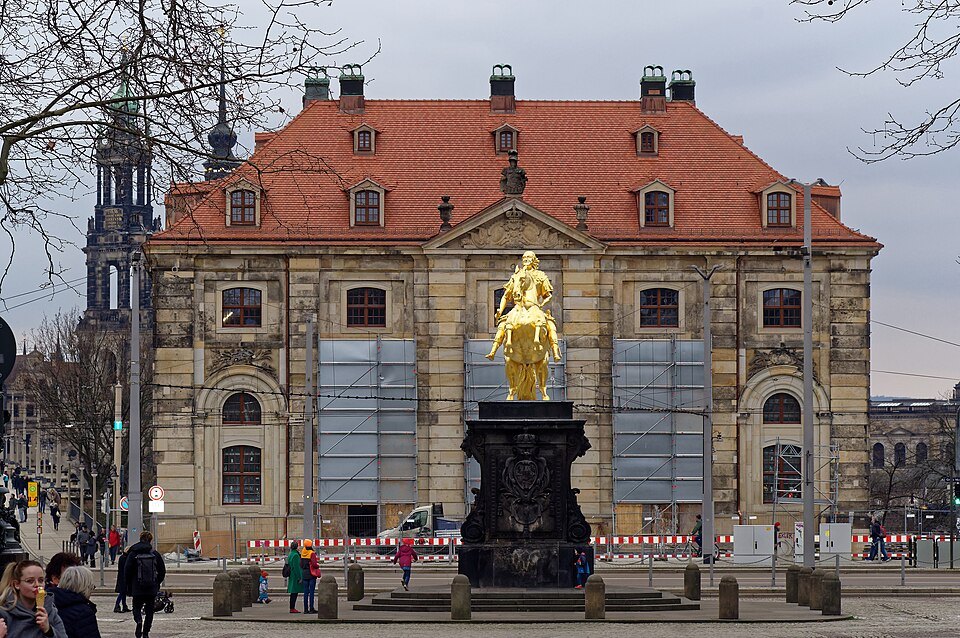
In 1730 a model was set up on the newly rebuilt Augustus Bridge as a trial. Longuelune then proposed the market square in front of his new guardhouse, the Blockhaus, as a worthy site, fitting because the layout of the Innere Neustadt counts among Augustus's lasting achievements. Vinache's design won. Every attempt to cast it in bronze failed, so the smith Ludwig Wiedemann hammered it out of copper between 1732 and 1734 and fire-gilded it.
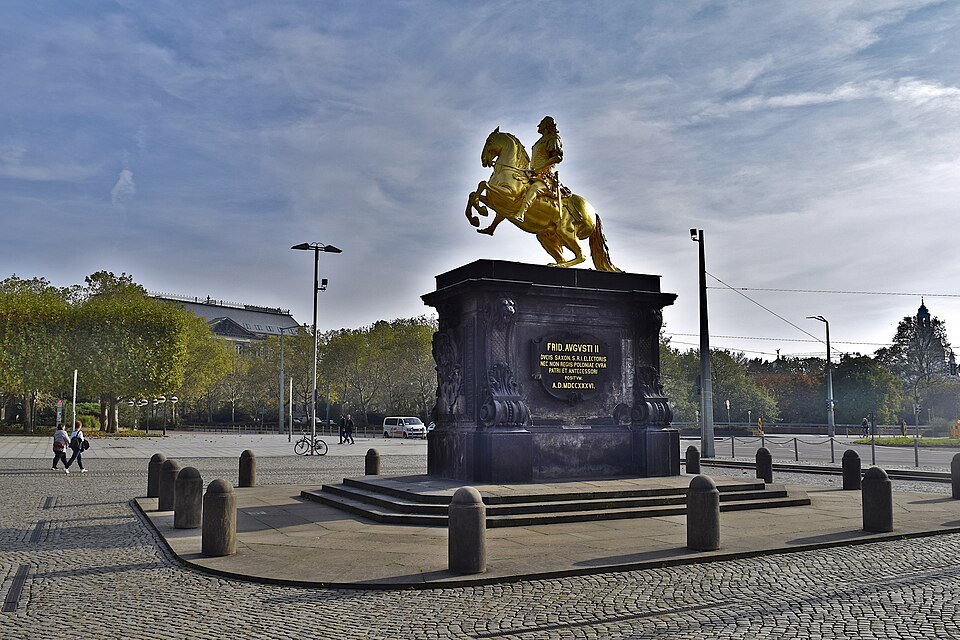
Augustus died on 1 February 1733, before the work was done. The monument was unveiled on 26 November 1736 under his son, with its pedestal still unfinished. The architect Constantin Lipsius restored the statue in 1884 and completed the pedestal, with its Latin inscriptions, in 1885.
03Taken down, put back, regilded
In 1943 and 1944 the statue was dismantled and moved into storage, which kept it out of the air raids that destroyed the square and every building around it. The sculptor Walter Flemming reassembled and restored it between 1953 and 1956, and it went back on its pedestal in 1956 for the city's 750th anniversary.
It was regilded with 187 grams of gold leaf in 1965. A fuller restoration between 2001 and 2003 ended with oil gilding using about 500 grams of gold leaf in all. Since 2011 the statue has been damaged by vandals several times; in the first attack the scabbard of the sword was broken off.
04What to look at
The pose borrows from the Roman statue of Marcus Aurelius on the Capitol, which was also once gilded. Riding experts still debate the movement. The horse is usually described as rearing in a courbette, which is a leap; some argue it may show the calmer posata instead, which would suit a statue better. The city's tourism office describes the horse as a Lipizzaner stallion.
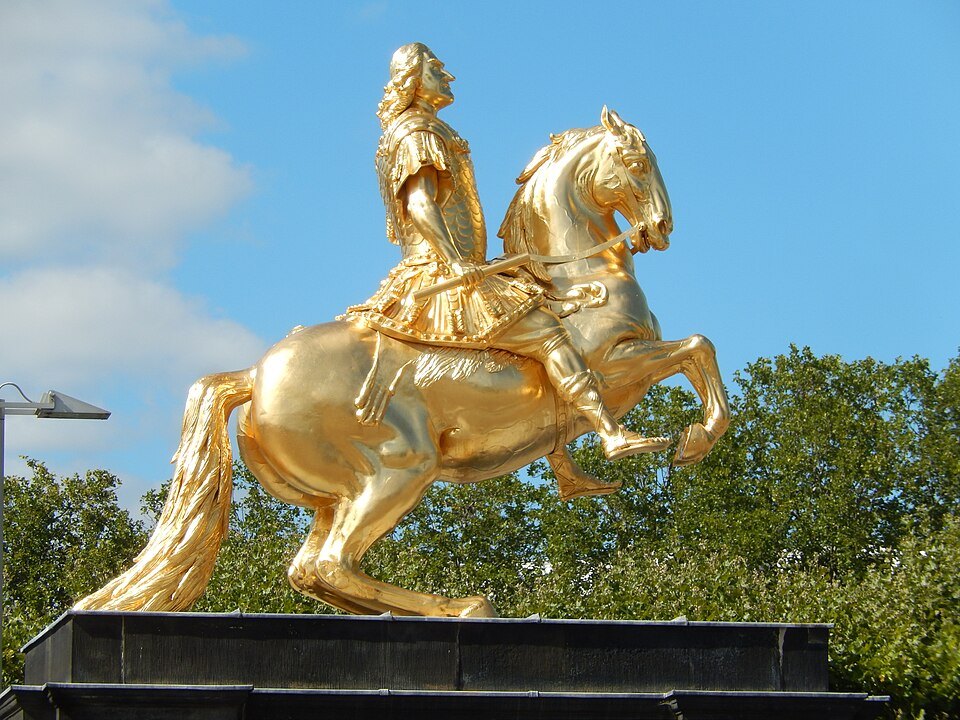
Notice where he is heading. Augustus rides toward the northeast, and the usual explanation is that he faces the Kingdom of Poland, whose crown he secured in 1697. Walk around the pedestal: the main Latin inscription is on its east side and the dedication on the west.
05The square around him
The Neustädter Markt is older than it looks. It probably began before 1200 as the village square of a Slavic settlement that became Altendresden, and it was enlarged after the fire of 1685. The bombing of 1945 destroyed it completely. It was rebuilt in the 1970s with East German prefabricated housing and made a pedestrian zone, and in 2021 the whole ensemble, those buildings included, was listed as a protected monument.
Two sandstone nymph fountains by Johann Benjamin Thomae, made around 1740, stand near the entrance to the Hauptstraße, beside two twenty-meter bronze flagpoles by Heinrich Epler from 1893. The flagpoles commemorate a visit by Emperor Wilhelm I and carry reliefs of him and King Albert of Saxony. At the foot of the bridge, Longuelune's Blockhaus of 1730 has been turned into a museum of twentieth-century avant-garde art.
06Up the Hauptstraße
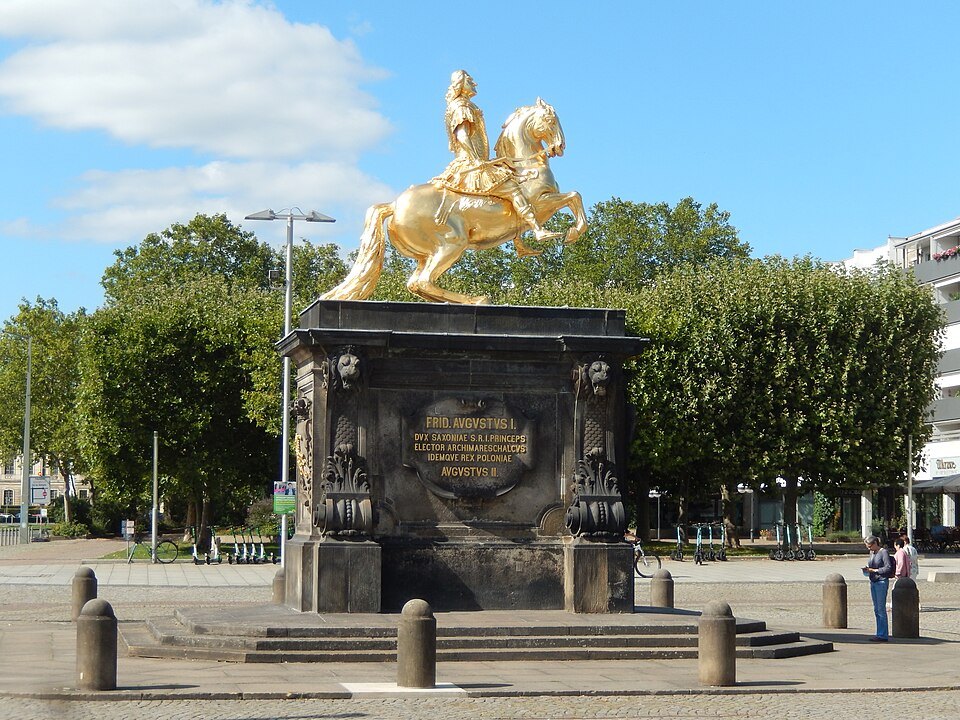
Behind the statue, the Hauptstraße runs 400 meters north to Albertplatz. Wolf Caspar von Klengel laid it out from 1687; it was 57 meters wide at the market and narrowed to 38 meters at the far end, so from the bridge it looked like an endless avenue, and from the far end like a great square. It was rebuilt as a pedestrian avenue lined with plane trees and opened in 1979.
Along its center stand eight baroque sandstone figures that once stood in the Zwinger. Halfway up is the rebuilt Dreikönigskirche, and at number 13 the Kügelgenhaus holds the Museum of Dresden Romanticism, its facade still carrying a large gilded inscription about God's blessing. At the northern end stands a white marble Schiller monument of 1913.
The square at the end of the street was renamed Jorge-Gomondai-Platz in 2007, in memory of Jorge Gomondai from Mozambique, who died after a racist attack near there in 1991. The street was planned as a sight line running from the Blockhaus to the Artesian Well on Albertplatz, where the Black Gate of the old town fortifications once stood. Beyond Albertplatz begins the Äußere Neustadt.
07Visiting
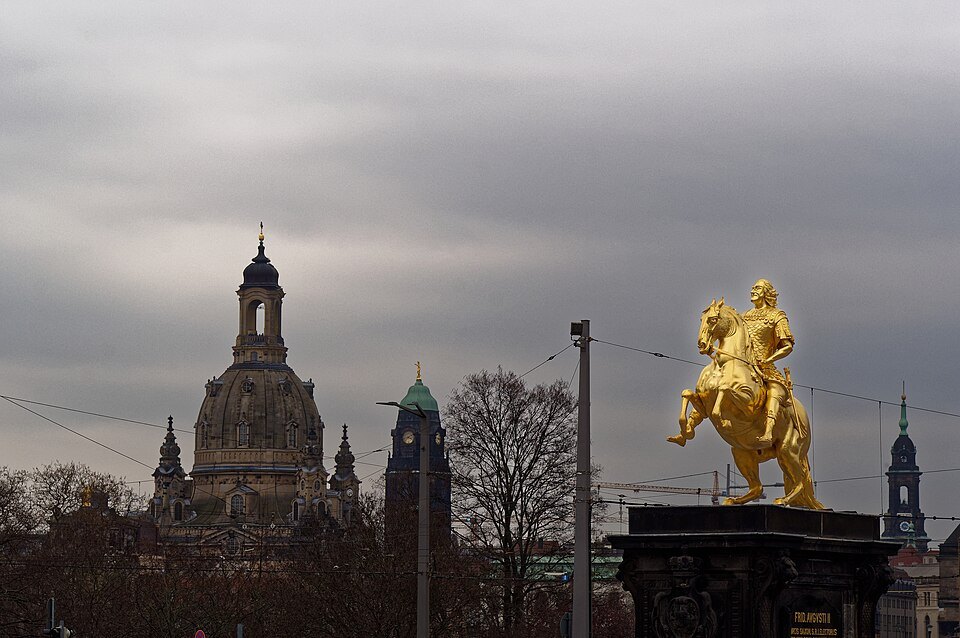
The statue itself needs ten minutes; allow an hour to walk the Hauptstraße to Albertplatz and back. The easiest approach is on foot across the Augustus Bridge from the Schlossplatz. On the way back, stop partway across the bridge and turn round: the Altstadt skyline lines up across the water, with the Hofkirche, the palace tower, the Semperoper and the Frauenkirche dome.
From the square it is a short walk west along the river to the Japanese Palace, and a longer one north through Albertplatz to the courtyards of the Kunsthofpassage. See neighborhoods for the character of each part of the Neustadt, the Elbe for the meadows either side of the bridge, and getting around for trams.