- 01Five courtyards, one passage
- 02A Neustadt idea
- 03The Courtyard of the Elements
- 04Animals and mythical creatures
- 05Light and change
- 06Visiting
01Five courtyards, one passage
The Kunsthofpassage is a chain of five small courtyards in the Äußere Neustadt, linking Görlitzer Straße with Alaunstraße through the backs of the blocks between them. Each courtyard has its own name and its own theme, carried through its facades, balconies, fountains and metalwork, so that ordinary backyards become a walk-through work of art.
It was designed by several Dresden architecture practices together with artists and stone sculptors, and completed in 2001. The courtyards are working places as well as a sight: galleries, craft studios, small shops and places to eat and drink open onto them, and people live in the apartments above.
Most visitors come for one wall, the drainpipes that play in the rain, but each of the five repays a slow look. Even the city's tourism office admits that nobody now remembers whether the aim was to rescue run-down backyards or to bring living, working and going out together; either way, that mix is what you walk through.
02A Neustadt idea
The Äußere Neustadt is a compact quarter of late nineteenth-century tenement blocks around Louisenstraße, Alaunstraße and Görlitzer Straße. It is known for the contrast of restored and unrestored houses, narrow lanes and winding rear courtyards filled with bars, restaurants and shops. The Kunsthofpassage took that backyard character and turned it into the subject of the design.
The courtyards were designed one by one, by different artists. For the Hof des Lichts a national competition was held in 1998; the entries were shown in a former East German agricultural machinery works and the winning designs were chosen by vote. The result is five spaces that share a passage but feel quite unlike one another.
03The Courtyard of the Elements
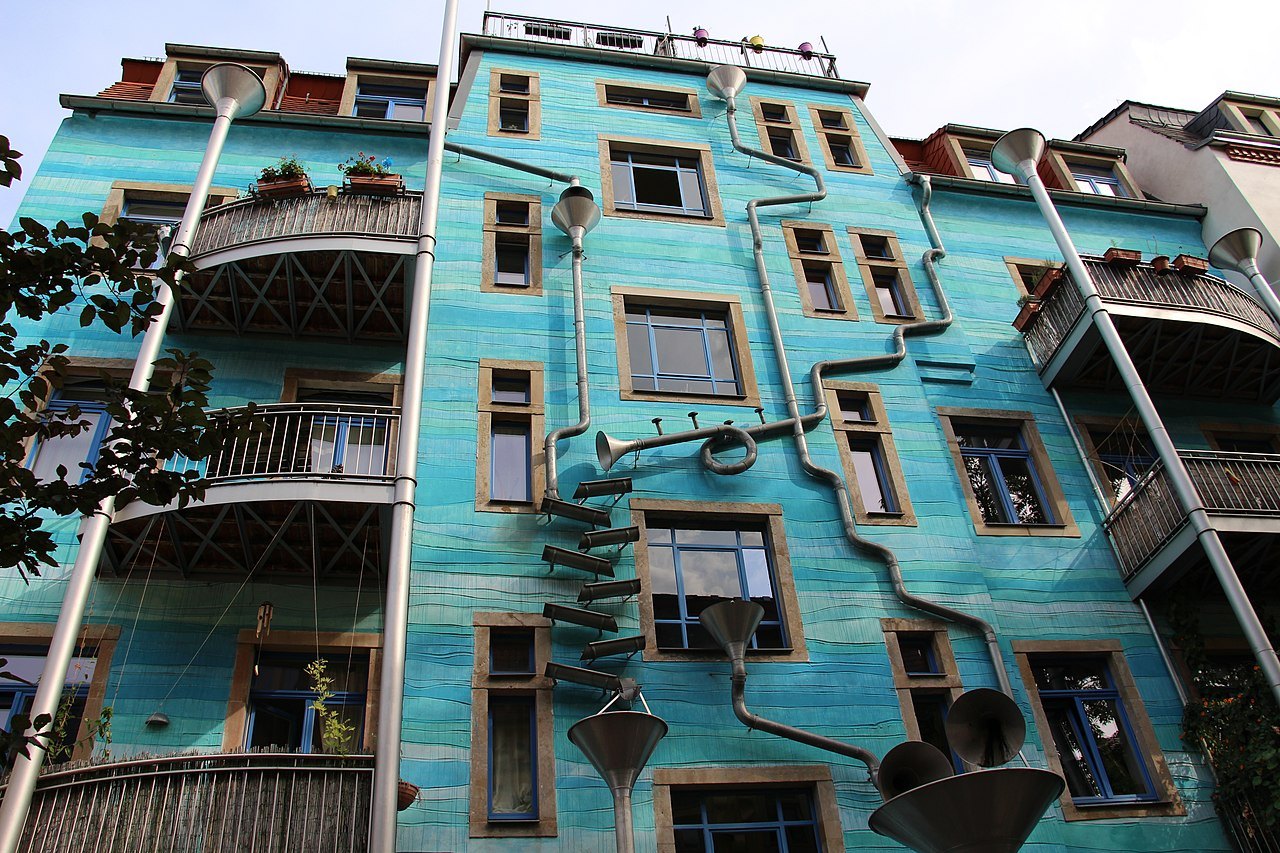
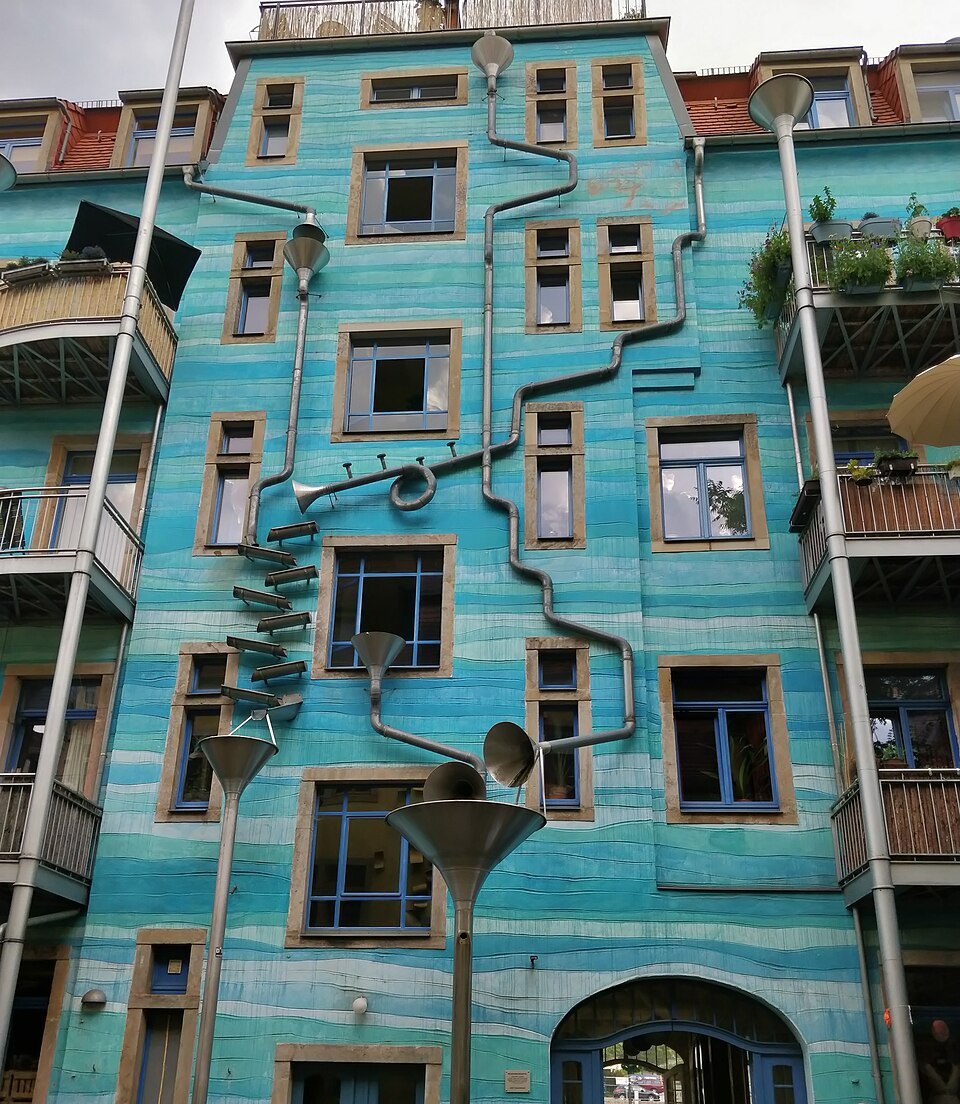
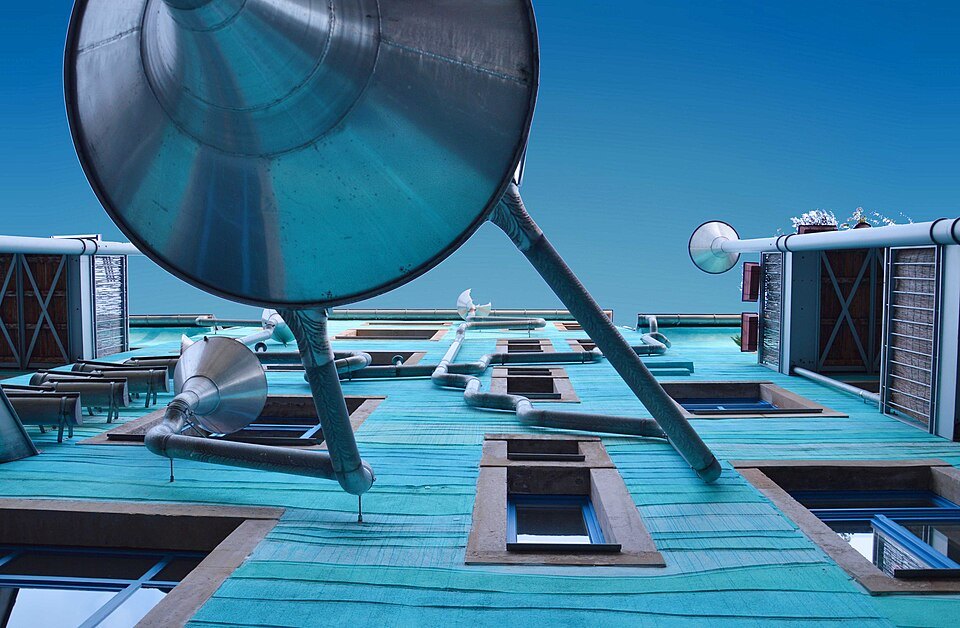
The famous wall is in the Hof der Elemente. A blue facade is hung with a tangle of gutters, funnels and downpipes that run openly across it in wild curves. When it rains, water pours through the pipes and splashes into a basin below, so the whole wall becomes a rain theater that you hear as much as see.
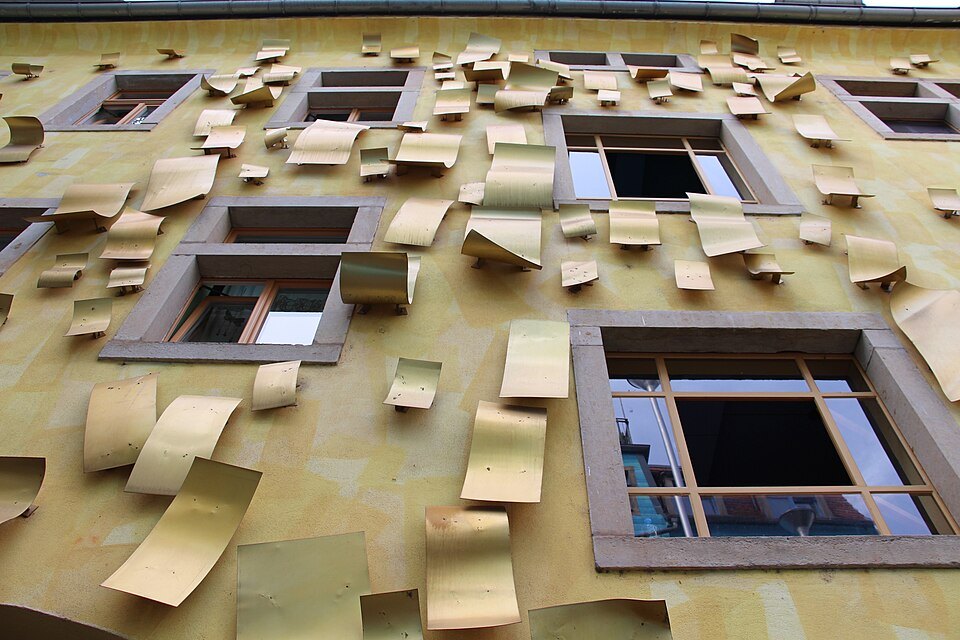
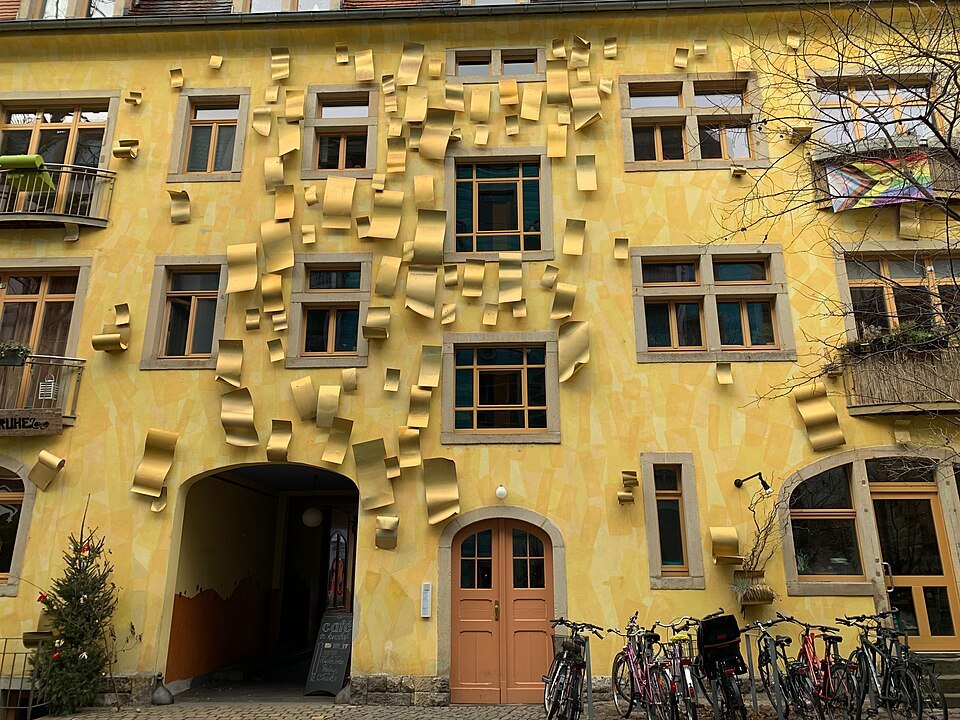
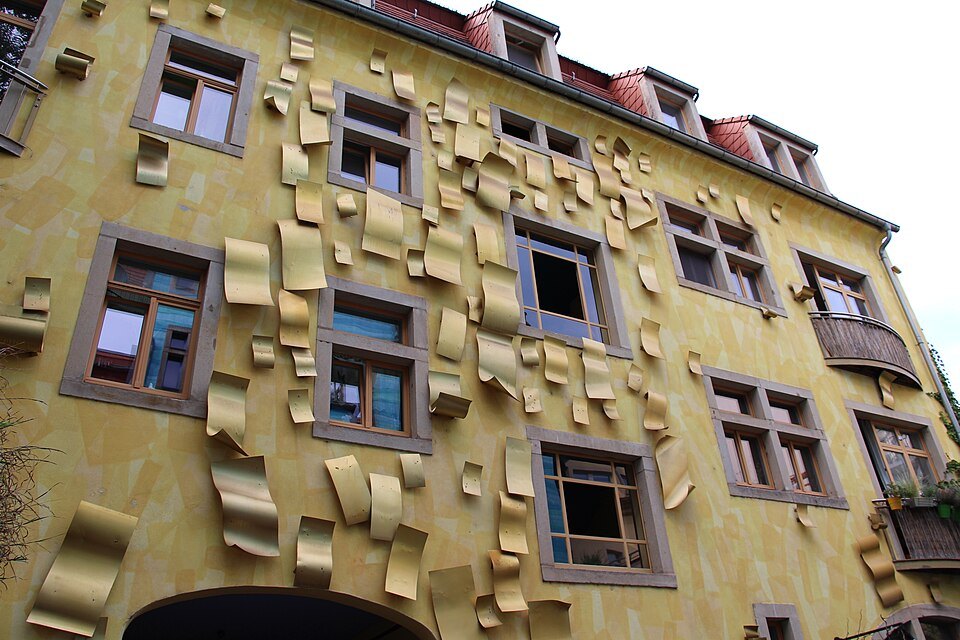
Its artists took the idea from St. Petersburg, where downpipes are far wider than in Germany and wind openly over building fronts. Opposite, a sun-yellow wall stands for the element of light: golden aluminum plates are fixed to it as if the wind had blown them there.
04Animals and mythical creatures
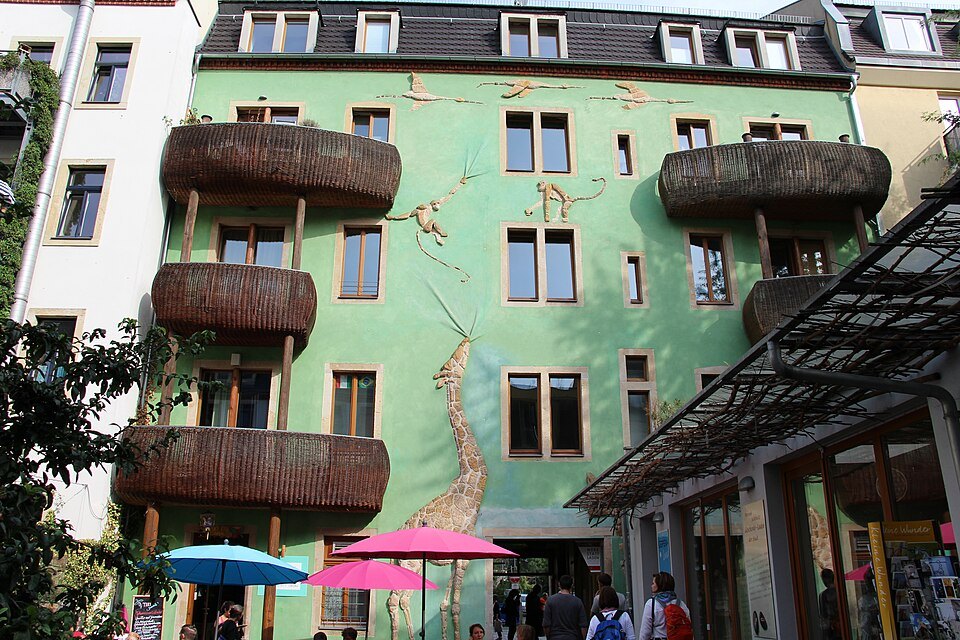
The Hof der Tiere, the Courtyard of Animals, is the liveliest of the five. On its green facade a troop of monkeys swings from window to window high above the head of a giant giraffe, and birds pass along the top of the wall. The balconies are wrapped in woven wickerwork, and the painting on the facade and stairwell suggests a jungle.
Down in the courtyard a pond with a resting water buffalo is flanked by artificial mountain rocks and more animals, and a small stream runs out of the rocks. Look around the fountain for the little creatures hidden in it. The courtyard was worked throughout in sandstone, so all its details fit together as one picture.
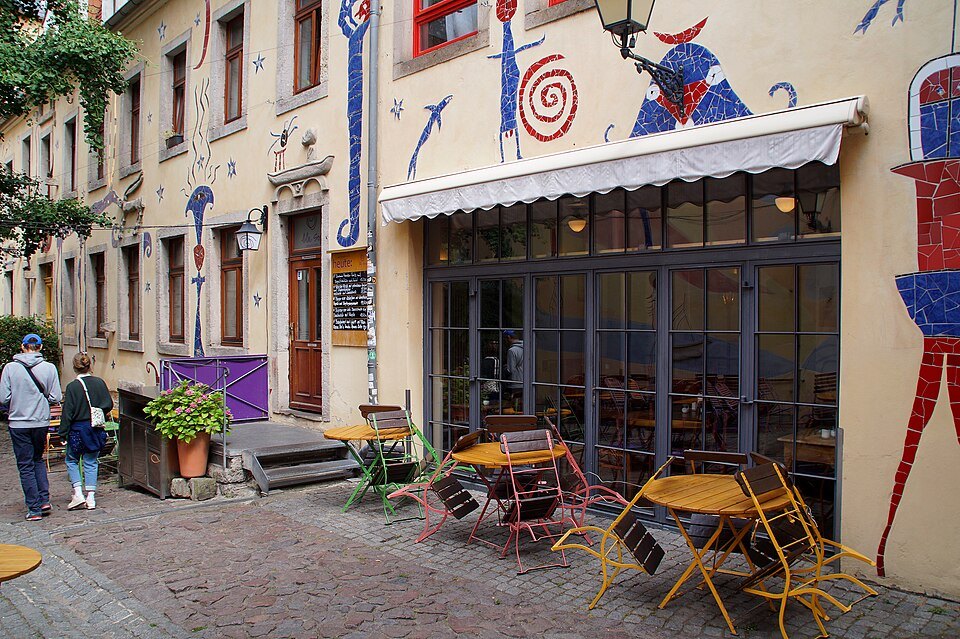
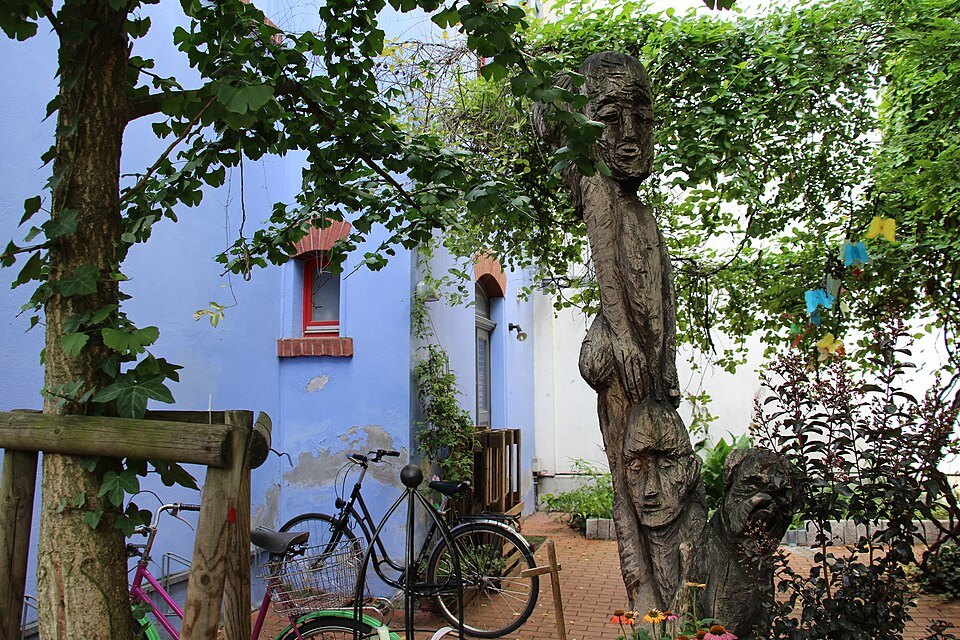
In the Hof der Fabelwesen, the Courtyard of Mythical Creatures, one artist covered about 900 square meters of wall in sgraffito and mosaic, with many of the ornamental tiles made in Portugal and the red and blue ones in Italy. The south facade shows a symbolic river of life; the north facade rises into a cosmic realm of stars and comets.
05Light and change
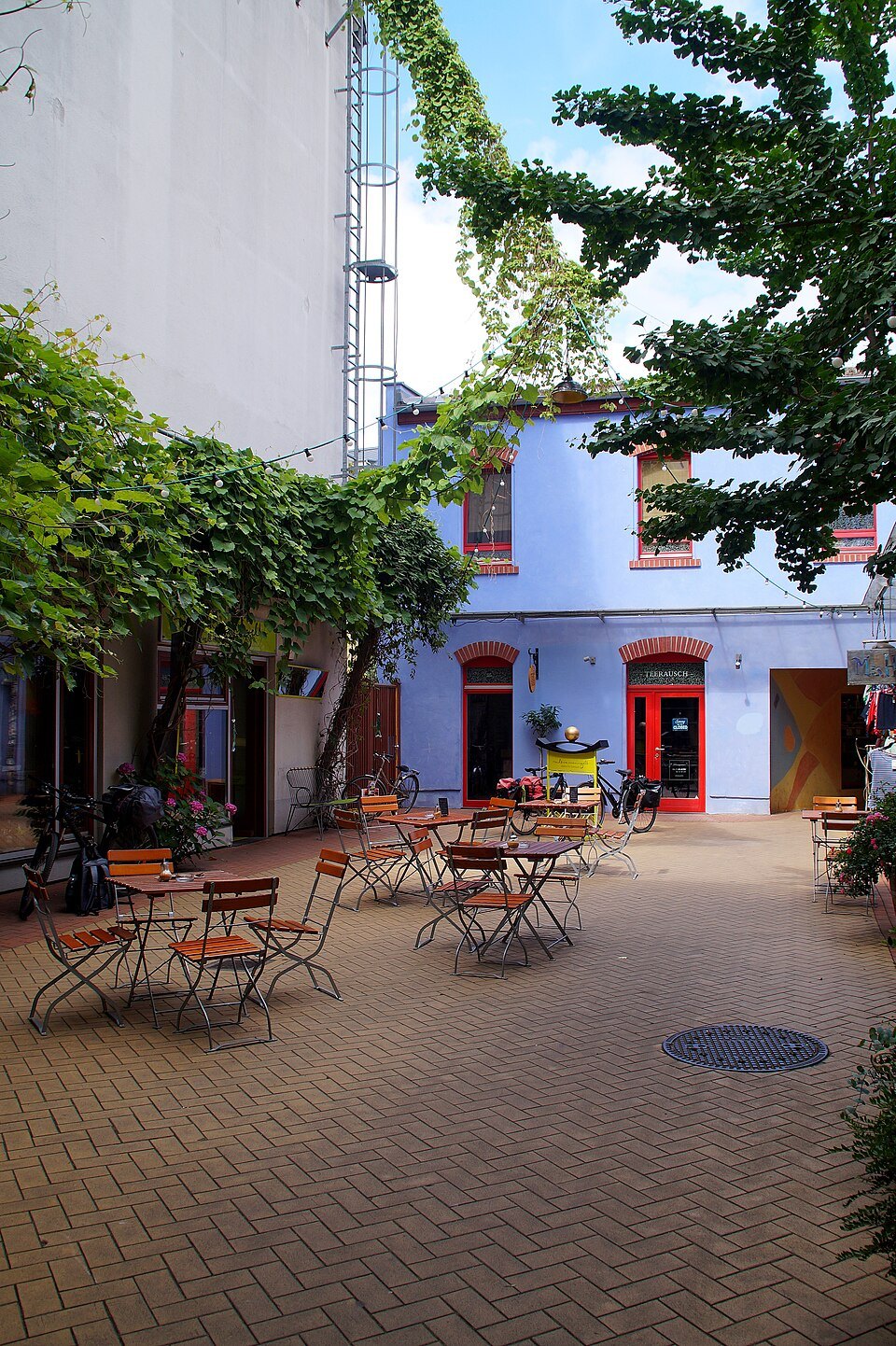
The Hof des Lichts, the Courtyard of Light, looks plain at first, but it is the center of the passage and its stage. Two catwalk stages and several projection surfaces make room for performances, installations and film screenings. Metal mirrors throw colored reflections that move with the sun across its blue walls, while the end walls of the neighboring houses are left white.
The Hof der Metamorphosen is the cool counterpart to the animals. Tall, heavy curved shields of weathering steel are fixed to the facade, touching it at a single point. They look rusted, and that rust layer protects the steel beneath. Bundles of glass fiber set into their surface are lit in the evening, turning the shields into lamps.
Look closer at the walls for 24 different papers hung in small metal frames. Each was half dipped in linseed oil and left out in the weather as a long-term experiment, so their texture keeps slowly changing. Cables strung across the facade let climbing plants grow up around the glowing shields.
06Visiting
Note The courtyards lie between apartment buildings where people live, and they are locked overnight; the passage's own website gives the times. The passage can be entered from either end, at Görlitzer Straße or at Alaunstraße. Keep voices down, and treat the stairwells and doorways as private.
Allow thirty minutes to an hour to see all five courtyards. A rainy day is the best time for the Hof der Elemente, when the pipes are working, and dusk is the time to catch the glass fibers glowing in the Hof der Metamorphosen. In dry weather the drainpipe wall is still worth seeing, but it stays silent.
From the Altstadt, walk over the Augustus Bridge past the Golden Rider, up the Hauptstraße to Albertplatz and on into the Äußere Neustadt, or take a tram (see getting around). Combine it with Pfunds Molkerei in the same part of town, read neighborhoods for the streets around it, and see eating and drinking for the Neustadt's evenings.