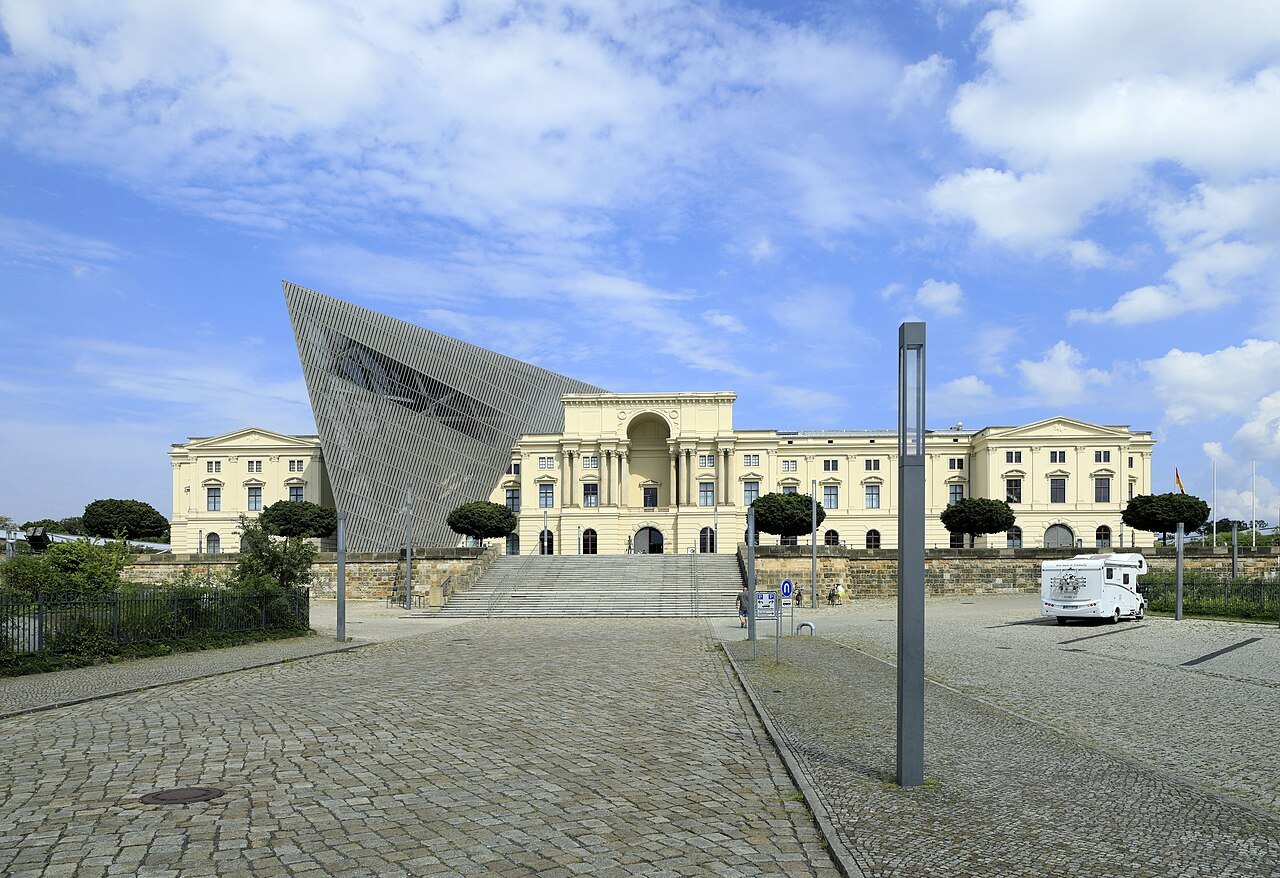
- No. 1the 1870s arsenala museum since 1897
- No. 2Libeskind's wedgeopened 2011
- No. 3the viewing platformhigh in the wedge
- No. 4the thematic tourinside the wedge
- 01A museum about people and violence
- 02An arsenal with many names
- 03The wedge
- 04Two ways through
- 05What to look for
- 06Planning a visit
01A museum about people and violence
The Militärhistorisches Museum der Bundeswehr is the leading museum of the German armed forces and one of the largest military history museums in Europe. It fills the former arsenal at the heart of the Albertstadt, the garrison quarter north of the Neustadt, and since 2011 a wedge of glass, concrete and steel by Daniel Libeskind has cut straight through its old front.
It does not set out to be a hall of tanks. The museum describes itself as a museum of cultural history rather than of technology: it puts people at the center, asks what drives war and what violence does to those who use it and those who suffer it, and aims for critical questions without pathos. Weapons, uniforms and vehicles are there too, but shown within the political, social and cultural history around them.
02An arsenal with many names
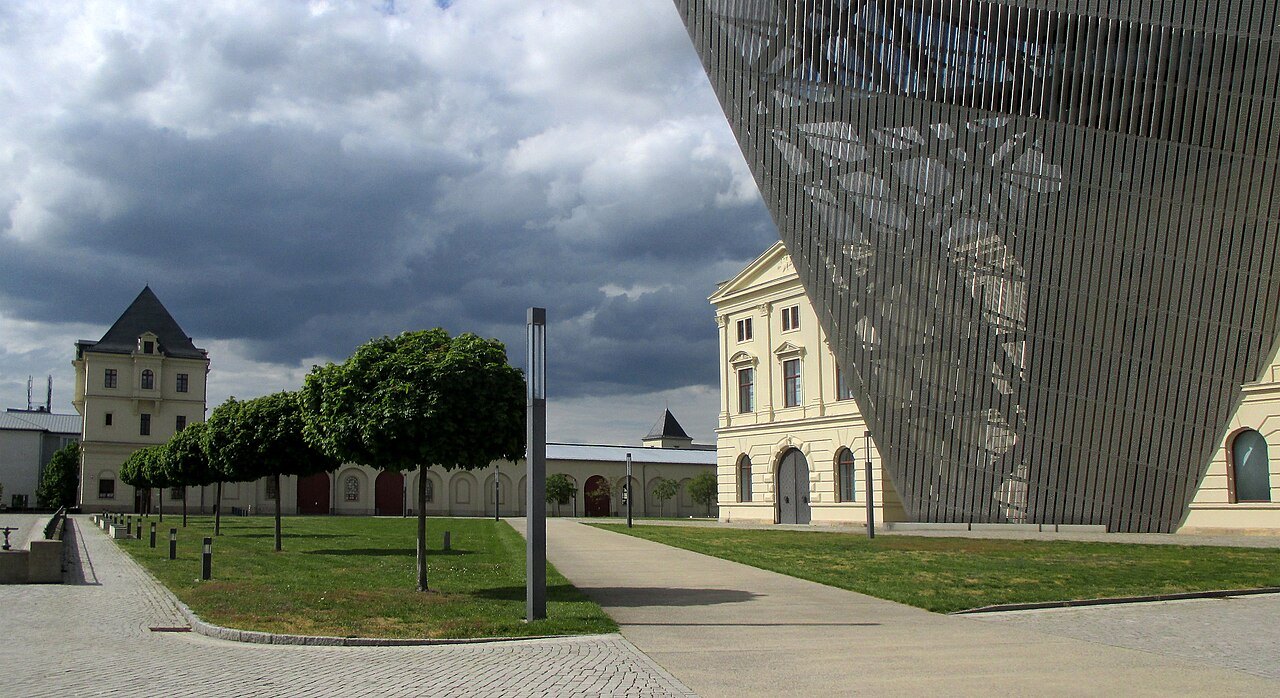
The Albertstadt was laid out under King Albert of Saxony as a complete military town, with arsenal, barracks, hospitals, workshops and a training ground. The arsenal's main building went up in the 1870s at its center. Its opening left the old arsenal on Brühl's Terrace without a use, and that building became the Albertinum.
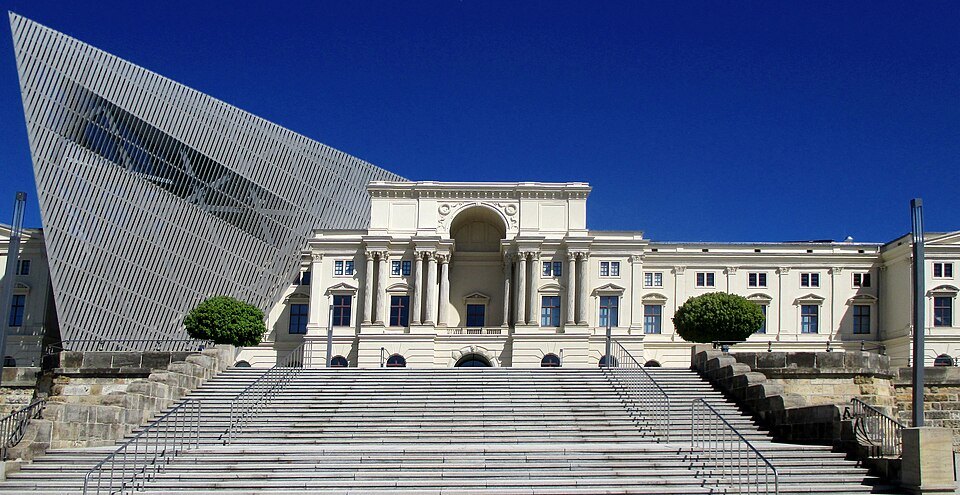
In 1897 the arsenal became a museum, the Royal Arsenal Collection and later the Royal Saxon Army Museum. It reopened in 1923–24 as the Saxon Army Museum and from 1938 served as a museum of the Wehrmacht. Standing on the edge of the city, it survived the bombing of February 1945, but the Red Army carried most of its holdings off to the Soviet Union.
For years afterwards the city used the hall for exhibitions and events. In 1972 the Army Museum of the GDR moved in, and in 1990 the German Ministry of Defence took it over as the Military History Museum. An architectural competition launched in 2001 was won by Libeskind, and after years of rebuilding the museum reopened in October 2011.
03The wedge
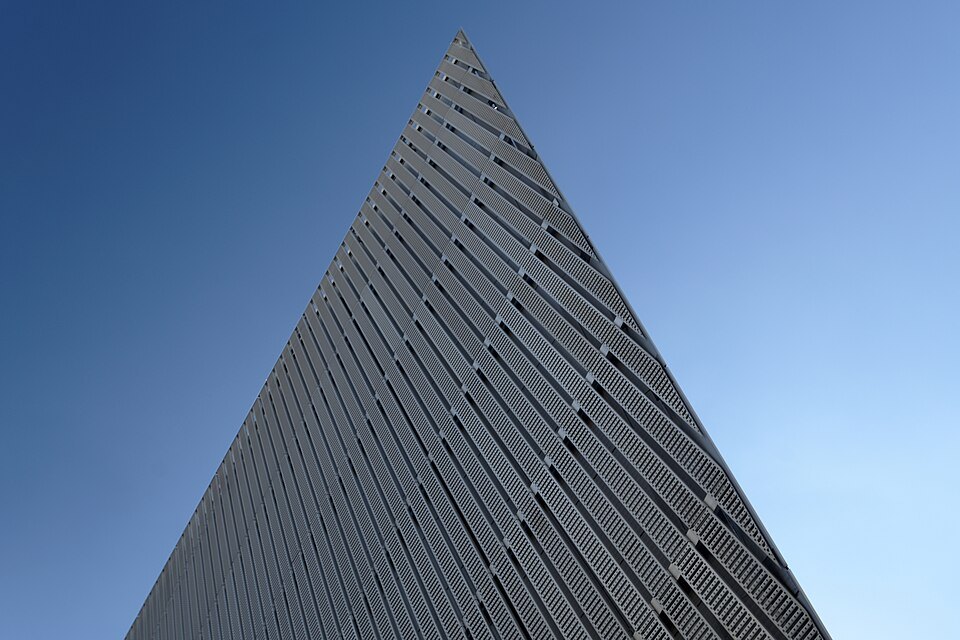
Libeskind's extension is a five-story wedge that rises to about thirty meters and splits the classical front of the central wing; about a third of the old arsenal's fabric was given up for it. The architect's studio says the openness and transparency of the new front stand for a democratic society, against the rigidity of the old building and the authoritarian past it represents.
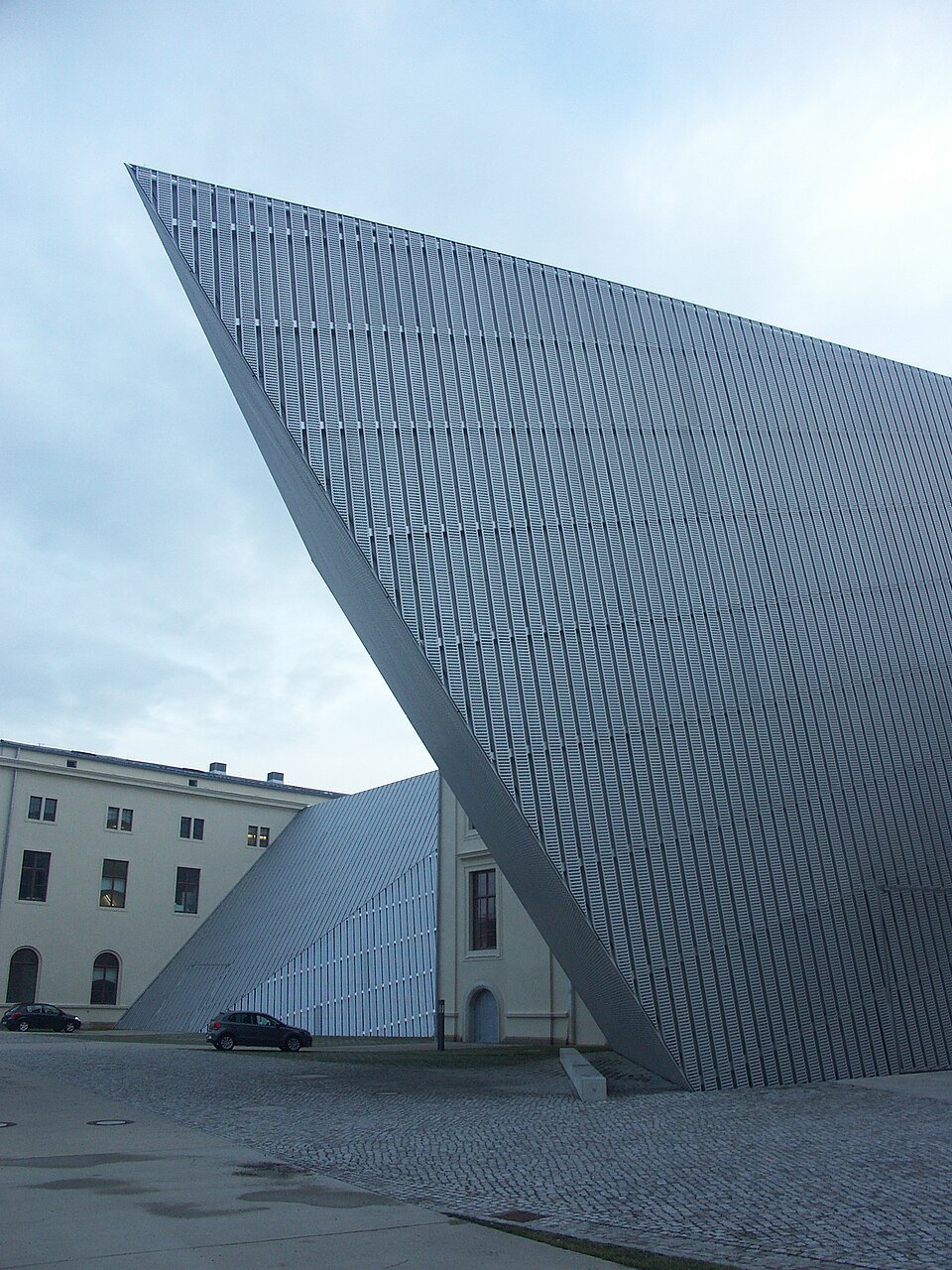
The geometry is not arbitrary. According to the museum, the wedge's angle of a little over forty degrees repeats the cone of destruction in which British bombers struck the old town in February 1945, and its sight line points to where the first marker flares were dropped — near the sports ground in the Ostragehege, northwest of the center.
High in the wedge a viewing platform looks out over the rebuilt city. A review of the exhibition describes how the view of Dresden there is set beside displays on Wieluń and Rotterdam, two cities destroyed by German bombing, each told through paired biographies of people caught up in the raids.
04Two ways through
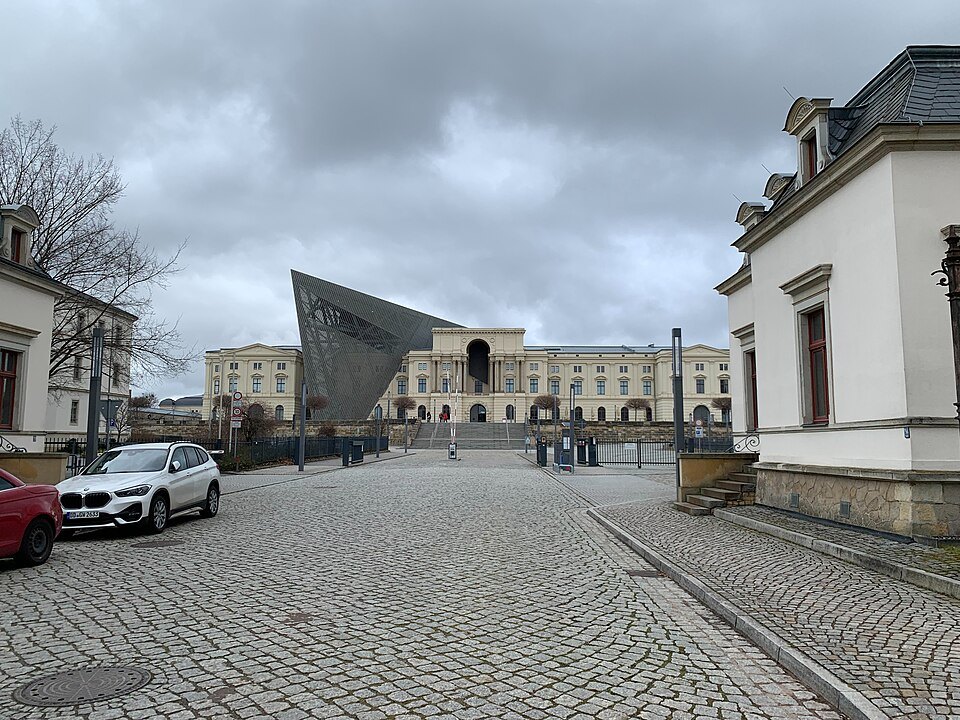
The old wings hold a chronological tour in three parts, 1300 to 1914, 1914 to 1945, and 1945 to today, which sets the relationship between the military and society in Germany against the wider history of each era. It is the traditional way of telling the story, housed in the traditional building.
The wedge holds the thematic tour, which gathers objects from many periods under headings such as war and memory, politics and violence, the formation of the body, animals in the military, suffering from war, and protection and destruction. The idea is to create a critical distance from the exhibits and to work against the fascination that military technology can exert.
05What to look for
A V-2 rocket, developed for bombing Britain, rises through several levels of the building; beside it, the forced labor of the Mittelbau-Dora concentration camp is shown, down to a food bowl with prisoner numbers scratched into it. Nearby, a wartime dollhouse has blacked-out windows, dolls carrying gas-mask bags and a bunker in its garden.
The collection also holds the ship's bell of the battleship Schleswig-Holstein, which fired what are generally regarded as the first shots of the Second World War in Europe at Westerplatte on 1 September 1939; the Brandtaucher, the first German submarine, built in Kiel in 1850 and reconstructed from its fragments; and the landing capsule of Soyuz 29, in which Sigmund Jähn, the first German in space, returned to Earth. Outside, an open-air area sets equipment of the East German army and the Bundeswehr from the Cold War side by side, together with modern weapon systems.
06Planning a visit
Note Parts of the exhibition deal directly with death, injury and forced labor, and do not soften them. The museum offers programs for children, families and school groups, so ask what suits younger visitors before setting out. Allow two to three hours to see both tours, and more for a special exhibition.
The museum lies in the Albertstadt, a tram ride north of the center through the Neustadt — see getting around. It pairs well with an afternoon in the Äußere Neustadt, with the Kunsthofpassage and Pfunds Molkerei; for the district as a whole, see neighborhoods.