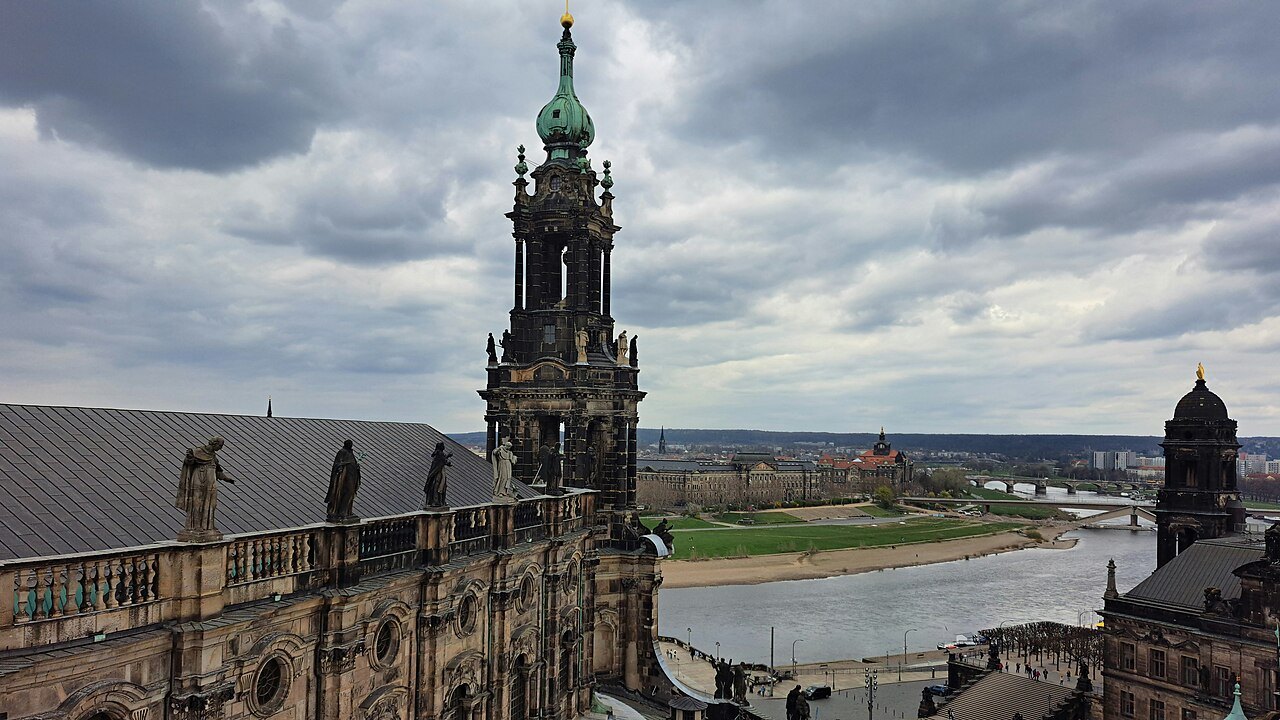
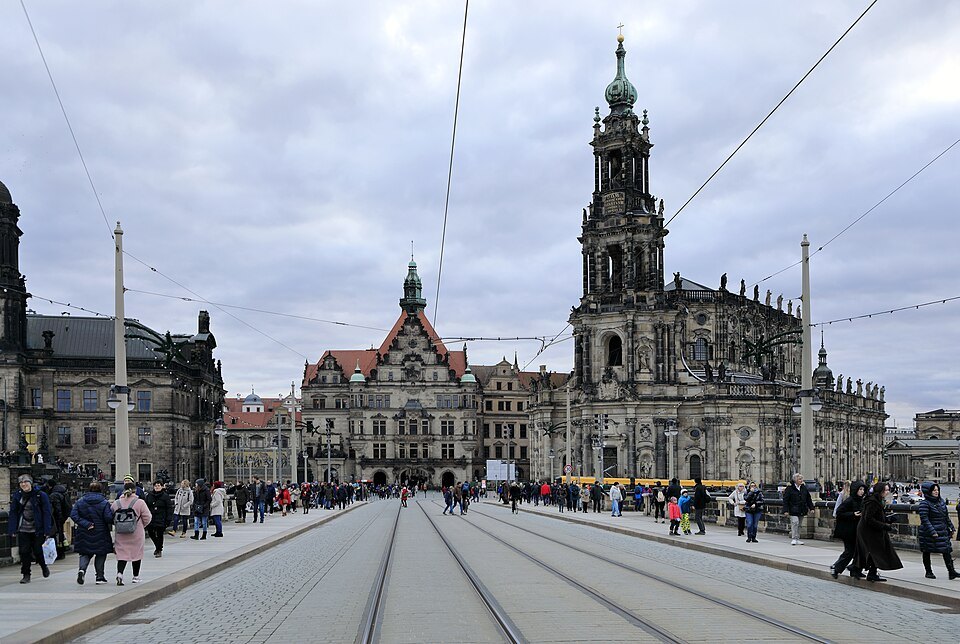
Stand in the old town and count the church towers. The Kreuzkirche is Lutheran. The Frauenkirche, rebuilt stone by stone after the war, is Lutheran too. Saxony has been one of the heartlands of the Reformation since the sixteenth century, the territory where Martin Luther found protection and his ideas took hold. And yet the largest church in Dresden, the one with the tallest tower and the grandest address next to the royal palace, is the Catholic Cathedral of the Holy Trinity — the Hofkirche. The reason has nothing to do with faith and everything to do with a crown.
A Catholic king for a Protestant land
In 1697, the Elector of Saxony, Augustus the Strong, converted to Catholicism. It was not a crisis of conscience. Augustus wanted to be King of Poland, and the Polish throne was elective, with the Catholic nobility holding real power over who got to wear the crown. Conversion was the price of entry, and he paid it, becoming August II of Poland while remaining Elector of a territory that was overwhelmingly, officially, proudly Protestant.
It was an awkward arrangement that both sides managed carefully. Saxony's Lutheran establishment kept control of its own churches and institutions; the Saxon constitution itself guaranteed the Protestant character of the state. The royal family, however, needed somewhere to practice its own religion, and by the mid-eighteenth century that need had become a building project. Augustus's son, Augustus III, who inherited both the electorate and the Polish crown, commissioned an Italian architect, Gaetano Chiaveri, to build a court church grand enough for a Catholic monarchy ruling a Protestant land. Construction ran through the 1740s and 1750s, and the result is the building that still dominates the riverside skyline next to the Residenzschloss.
Built to be seen, placed to be separate
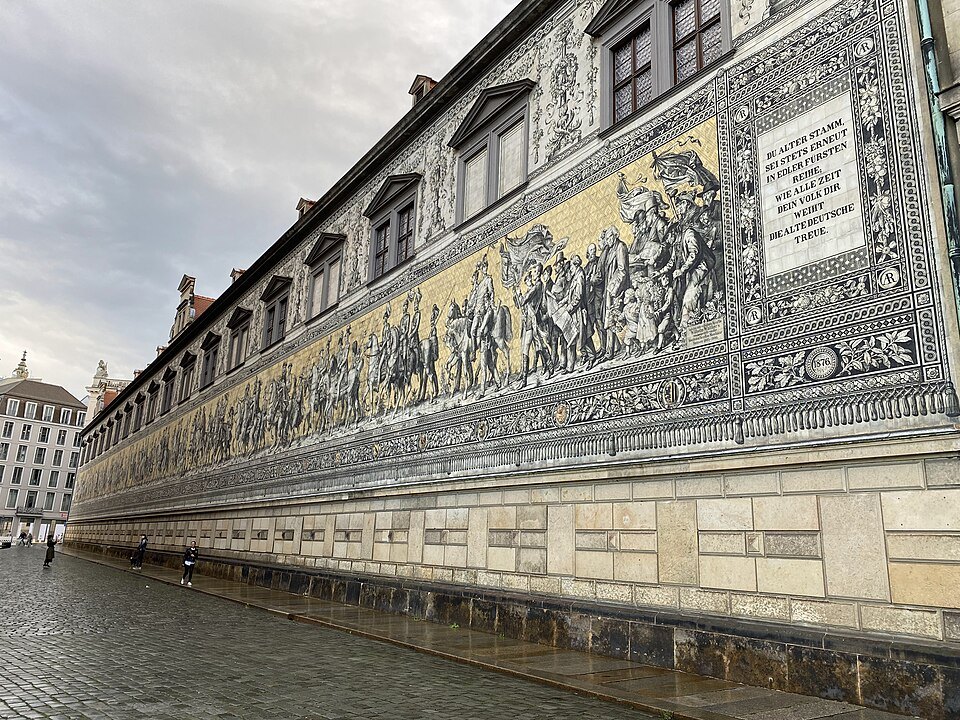
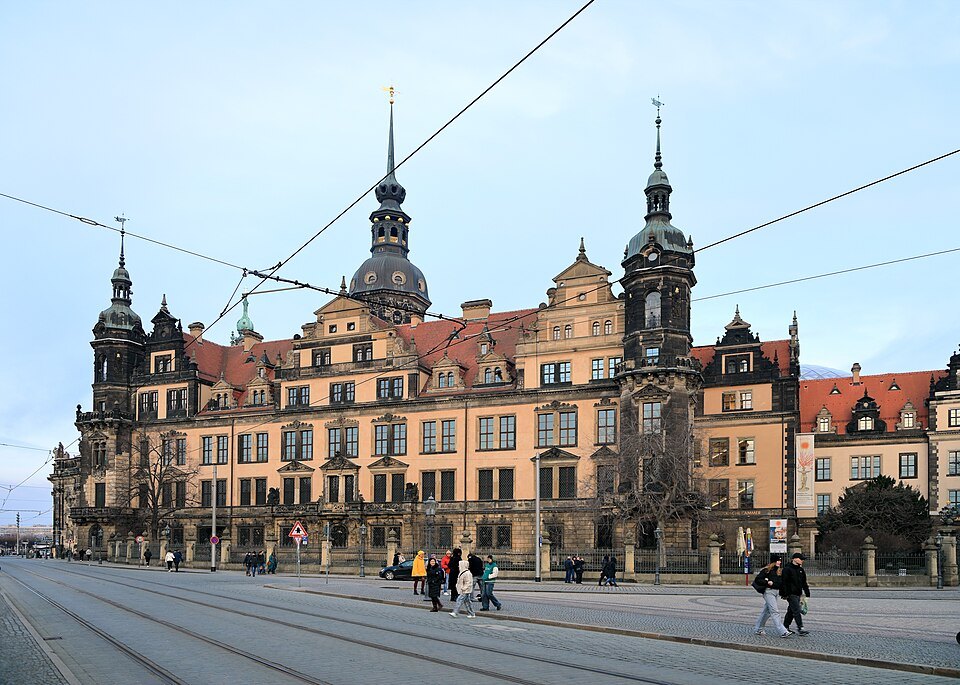
The Hofkirche was deliberately sited at a careful distance from the Protestant churches of the old town, connected directly to the palace by a covered passage known as the Fürstenzug route, so that the royal family could move between residence and worship without mixing with the city's Lutheran crowds. That covered bridge no longer exists in its original form, but the palace's exterior wall nearby carries the Fürstenzug itself, the long procession of Saxon rulers rendered in Meissen tiles — a separate piece of royal propaganda worth tracking on its own terms; our guide to walking its hundred meters explains how to read it start to finish.
Architecturally, the cathedral borrows the language of Italian Baroque rather than German church-building, which is part of why it looks so unlike its Lutheran neighbors. Its curving balustrade is lined with stone saints, more than seventy of them, visible from the street and from Brühl's Terrace above. The interior is lighter and more theatrical than the austere Protestant churches nearby, built to impress a dynasty's Catholic allies and in-laws as much as to serve the small Catholic congregation actually living in Dresden at the time.

What the cathedral holds
Inside, the building functions as both a working cathedral and a royal mausoleum. The crypt holds the remains of Saxon rulers, including Augustus the Strong's body — though not his heart, which by his own instruction was sent to Poland and rests separately in Kraków, a small detail that sums up the divided loyalties the whole building represents. The organ, an eighteenth-century instrument by Gottfried Silbermann, was his last major work and is still used for recitals; check the cathedral's own listings if you want to time a visit around music rather than sightseeing.
The cathedral is free to walk into during open hours, which makes it an easy stop to combine with the palace and the Zwinger without needing to plan around a ticketed time slot. If you're also chasing the Historic Green Vault's limited access, read up on how to get a time slot and use it well before you commit a morning to it — the cathedral itself asks no such advance booking.
Note Services take precedence over sightseeing, as you'd expect in an active cathedral. If you arrive and find part of the nave roped off or a service underway, circle back later rather than treating it purely as a museum piece.
A city still negotiating its religious history
Today's Dresden is one of the least religious cities in Germany by most surveys, so the historic tension between a Catholic court and a Protestant population reads more as an architectural curiosity than a live fault line. But the layout of the old town still tells the story: Lutheran civic churches at the center of public life, the Catholic cathedral attached to royal power, each occupying its own patch of the skyline. It's a useful lens for the rest of your walk through the rebuilt city, where so much of what you see was reconstructed after 1945 according to arguments about which version of Dresden's past deserved to be rebuilt first.
The Frauenkirche's reconstruction is the most famous of these arguments, and its stonework still carries the physical evidence of the choices made — read how to read the dark and pale stones if you want to understand that building as closely as this article asks you to understand the Hofkirche. Together, the two churches, one Protestant and rebuilt from rubble, one Catholic and one of the few major buildings in the old town to survive the 1945 bombing largely intact, make a quietly pointed pair.
For practical orientation beyond the cathedral itself, see our general notes on Dresden's sights and on getting around the old town on foot, since nearly everything mentioned here sits within a few minutes' walk of the river.
 How to find your way along the hundred meters of the Fürstenzug
 What the New Green Vault shows that the Historic one does not
 How to get a Historic Green Vault time slot and use it well